

366
T. Fukaminato et al.
(a)
(b)
300
400
500
600
700
800
0.0
0.1
0.2
0.3
0.4
0.5
0.6
0.7
Absorbance
Wavelength / nm
450
500
550
600
650
700
750
0
20
40
60
80
Fluorescence Intensity / a.u.
Wavelength / nm
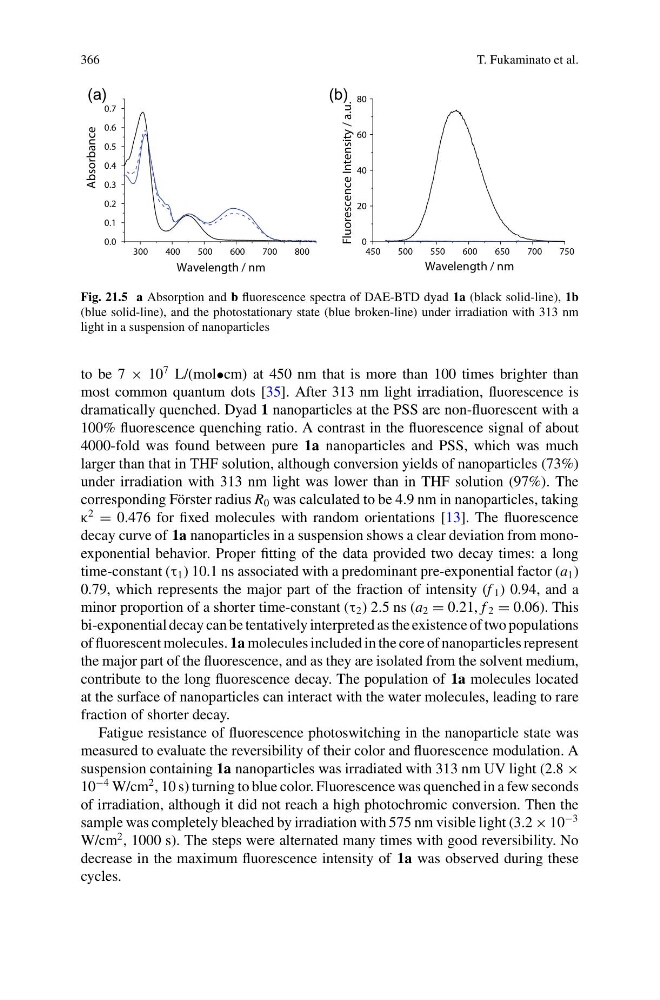
Fig. 21.5 a Absorption and b fluorescence spectra of DAE-BTD dyad 1a (black solid-line), 1b
(blue solid-line), and the photostationary state (blue broken-line) under irradiation with 313 nm
light in a suspension of nanoparticles
to be 7 × 10
7 L/(mol•cm) at 450 nm that is more than 100 times brighter than
most common quantum dots [35]. After 313 nm light irradiation, fluorescence is
dramatically quenched. Dyad 1 nanoparticles at the PSS are non-fluorescent with a
100% fluorescence quenching ratio. A contrast in the fluorescence signal of about
4000-fold was found between pure 1a nanoparticles and PSS, which was much
larger than that in THF solution, although conversion yields of nanoparticles (73%)
under irradiation with 313 nm light was lower than in THF solution (97%). The
corresponding Förster radius R 0 was calculated to be 4.9 nm in nanoparticles, taking
κ
2
= 0.476 for fixed molecules with random orientations [13]. The fluorescence
decay curve of 1a nanoparticles in a suspension shows a clear deviation from monoexponential behavior. Proper fitting of the data provided two decay times: a long
time-constant (τ 1 ) 10.1 ns associated with a predominant pre-exponential factor (a 1 )
0.79, which represents the major part of the fraction of intensity (f 1 ) 0.94, and a
minor proportion of a shorter time-constant (τ 2 ) 2.5 ns (a 2 = 0.21, f 2 = 0.06). This
bi-exponential decay can be tentatively interpreted as the existence of two populations
of fluorescent molecules. 1a molecules included in the core of nanoparticles represent
the major part of the fluorescence, and as they are isolated from the solvent medium,
contribute to the long fluorescence decay. The population of 1a molecules located
at the surface of nanoparticles can interact with the water molecules, leading to rare
fraction of shorter decay.
Fatigue resistance of fluorescence photoswitching in the nanoparticle state was
measured to evaluate the reversibility of their color and fluorescence modulation. A
suspension containing 1a nanoparticles was irradiated with 313 nm UV light (2.8 ×
10
−4 W/cm
2 , 10 s) turning to blue color. Fluorescence was quenched in a few seconds
of irradiation, although it did not reach a high photochromic conversion. Then the
sample was completely bleached by irradiation with 575 nm visible light (3.2 × 10
−3
W/cm
2 , 1000 s). The steps were alternated many times with good reversibility. No
decrease in the maximum fluorescence intensity of 1a was observed during these
cycles.
T. Fukaminato et al.
(a)
(b)
300
400
500
600
700
800
0.0
0.1
0.2
0.3
0.4
0.5
0.6
0.7
Absorbance
Wavelength / nm
450
500
550
600
650
700
750
0
20
40
60
80
Fluorescence Intensity / a.u.
Wavelength / nm
Fig. 21.5 a Absorption and b fluorescence spectra of DAE-BTD dyad 1a (black solid-line), 1b
(blue solid-line), and the photostationary state (blue broken-line) under irradiation with 313 nm
light in a suspension of nanoparticles
to be 7 × 10
7 L/(mol•cm) at 450 nm that is more than 100 times brighter than
most common quantum dots [35]. After 313 nm light irradiation, fluorescence is
dramatically quenched. Dyad 1 nanoparticles at the PSS are non-fluorescent with a
100% fluorescence quenching ratio. A contrast in the fluorescence signal of about
4000-fold was found between pure 1a nanoparticles and PSS, which was much
larger than that in THF solution, although conversion yields of nanoparticles (73%)
under irradiation with 313 nm light was lower than in THF solution (97%). The
corresponding Förster radius R 0 was calculated to be 4.9 nm in nanoparticles, taking
κ
2
= 0.476 for fixed molecules with random orientations [13]. The fluorescence
decay curve of 1a nanoparticles in a suspension shows a clear deviation from monoexponential behavior. Proper fitting of the data provided two decay times: a long
time-constant (τ 1 ) 10.1 ns associated with a predominant pre-exponential factor (a 1 )
0.79, which represents the major part of the fraction of intensity (f 1 ) 0.94, and a
minor proportion of a shorter time-constant (τ 2 ) 2.5 ns (a 2 = 0.21, f 2 = 0.06). This
bi-exponential decay can be tentatively interpreted as the existence of two populations
of fluorescent molecules. 1a molecules included in the core of nanoparticles represent
the major part of the fluorescence, and as they are isolated from the solvent medium,
contribute to the long fluorescence decay. The population of 1a molecules located
at the surface of nanoparticles can interact with the water molecules, leading to rare
fraction of shorter decay.
Fatigue resistance of fluorescence photoswitching in the nanoparticle state was
measured to evaluate the reversibility of their color and fluorescence modulation. A
suspension containing 1a nanoparticles was irradiated with 313 nm UV light (2.8 ×
10
−4 W/cm
2 , 10 s) turning to blue color. Fluorescence was quenched in a few seconds
of irradiation, although it did not reach a high photochromic conversion. Then the
sample was completely bleached by irradiation with 575 nm visible light (3.2 × 10
−3
W/cm
2 , 1000 s). The steps were alternated many times with good reversibility. No
decrease in the maximum fluorescence intensity of 1a was observed during these
cycles.