

21 Giant Amplification of Fluorescence Quenching in Photochromic …
365
21.4 Fluorescence Photoswitching in Nanoparticle
The nanoparticles of DAE-BTD dyad 1a was prepared by conventional reprecipitation method [34] and providing a suspension of nanoparticles with size tunability. In
such nanoparticles, a high chromophore density is reachable, compared to other types
of molecular assemblies or materials, providing a way to maximize the intermolecular
FRET efficiency.
Dyad 1a was well dissolved into THF to obtain a 5.0 × 10
−5 M mother solution. Then 0.6 mL of this solution was quickly added into 2.4 mL of distilled water
under vigorous stirring. After stirring for 5 min., final transparent suspension of
nanoparticles was obtained with a concentration of 1 × 10
−5 M. Characterizations of nanoparticles were performed by field-effect scanning electron microscopy
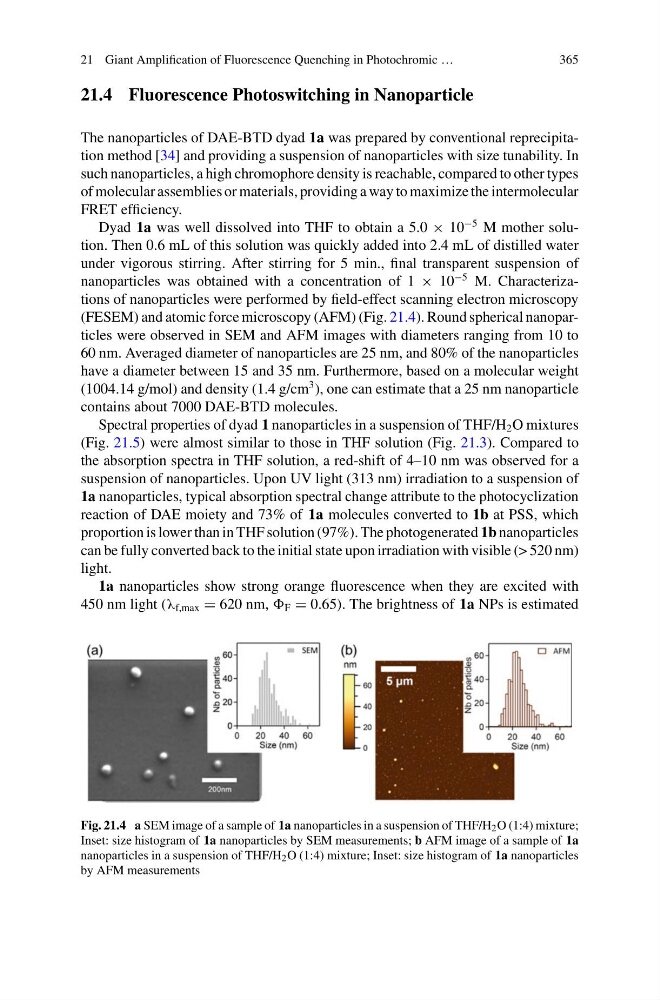
(FESEM) and atomic force microscopy (AFM) (Fig. 21.4). Round spherical nanoparticles were observed in SEM and AFM images with diameters ranging from 10 to
60 nm. Averaged diameter of nanoparticles are 25 nm, and 80% of the nanoparticles
have a diameter between 15 and 35 nm. Furthermore, based on a molecular weight
(1004.14 g/mol) and density (1.4 g/cm
3 ), one can estimate that a 25 nm nanoparticle
contains about 7000 DAE-BTD molecules.
Spectral properties of dyad 1 nanoparticles in a suspension of THF/H 2 O mixtures
(Fig. 21.5) were almost similar to those in THF solution (Fig. 21.3). Compared to
the absorption spectra in THF solution, a red-shift of 4–10 nm was observed for a
suspension of nanoparticles. Upon UV light (313 nm) irradiation to a suspension of
1a nanoparticles, typical absorption spectral change attribute to the photocyclization
reaction of DAE moiety and 73% of 1a molecules converted to 1b at PSS, which
proportion is lower than in THF solution (97%). The photogenerated 1b nanoparticles
can be fully converted back to the initial state upon irradiation with visible (> 520 nm)
light.
1a nanoparticles show strong orange fluorescence when they are excited with
450 nm light (λ f,max = 620 nm, F = 0.65). The brightness of 1a NPs is estimated
Fig. 21.4 a SEM image of a sample of 1a nanoparticles in a suspension of THF/H 2 O (1:4) mixture;
Inset: size histogram of 1a nanoparticles by SEM measurements; b AFM image of a sample of 1a
nanoparticles in a suspension of THF/H 2 O (1:4) mixture; Inset: size histogram of 1a nanoparticles
by AFM measurements
365
21.4 Fluorescence Photoswitching in Nanoparticle
The nanoparticles of DAE-BTD dyad 1a was prepared by conventional reprecipitation method [34] and providing a suspension of nanoparticles with size tunability. In
such nanoparticles, a high chromophore density is reachable, compared to other types
of molecular assemblies or materials, providing a way to maximize the intermolecular
FRET efficiency.
Dyad 1a was well dissolved into THF to obtain a 5.0 × 10
−5 M mother solution. Then 0.6 mL of this solution was quickly added into 2.4 mL of distilled water
under vigorous stirring. After stirring for 5 min., final transparent suspension of
nanoparticles was obtained with a concentration of 1 × 10
−5 M. Characterizations of nanoparticles were performed by field-effect scanning electron microscopy
(FESEM) and atomic force microscopy (AFM) (Fig. 21.4). Round spherical nanoparticles were observed in SEM and AFM images with diameters ranging from 10 to
60 nm. Averaged diameter of nanoparticles are 25 nm, and 80% of the nanoparticles
have a diameter between 15 and 35 nm. Furthermore, based on a molecular weight
(1004.14 g/mol) and density (1.4 g/cm
3 ), one can estimate that a 25 nm nanoparticle
contains about 7000 DAE-BTD molecules.
Spectral properties of dyad 1 nanoparticles in a suspension of THF/H 2 O mixtures
(Fig. 21.5) were almost similar to those in THF solution (Fig. 21.3). Compared to
the absorption spectra in THF solution, a red-shift of 4–10 nm was observed for a
suspension of nanoparticles. Upon UV light (313 nm) irradiation to a suspension of
1a nanoparticles, typical absorption spectral change attribute to the photocyclization
reaction of DAE moiety and 73% of 1a molecules converted to 1b at PSS, which
proportion is lower than in THF solution (97%). The photogenerated 1b nanoparticles
can be fully converted back to the initial state upon irradiation with visible (> 520 nm)
light.
1a nanoparticles show strong orange fluorescence when they are excited with
450 nm light (λ f,max = 620 nm, F = 0.65). The brightness of 1a NPs is estimated
Fig. 21.4 a SEM image of a sample of 1a nanoparticles in a suspension of THF/H 2 O (1:4) mixture;
Inset: size histogram of 1a nanoparticles by SEM measurements; b AFM image of a sample of 1a
nanoparticles in a suspension of THF/H 2 O (1:4) mixture; Inset: size histogram of 1a nanoparticles
by AFM measurements