

364
T. Fukaminato et al.
300
400
500
600
700
800
0.0
0.2
0.4
0.6
0.8
1.0
1.2
Absorbance
Wavelength / nm
Closed
Open
PSS at 313 nm
400
500
600
700
800
0
5
10
15
20
25
30
35
40
45
Fluorescence Intensity / a.u.
Wavelength / nm
Closed
Open
PSS at 313 nm
(a)
(b)
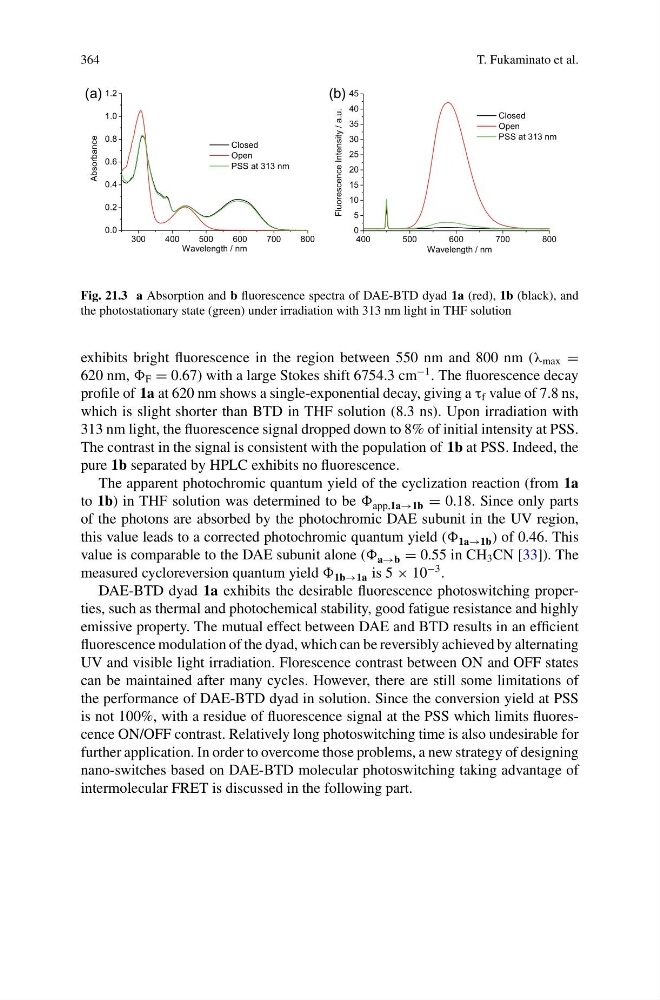
Fig. 21.3 a Absorption and b fluorescence spectra of DAE-BTD dyad 1a (red), 1b (black), and
the photostationary state (green) under irradiation with 313 nm light in THF solution
exhibits bright fluorescence in the region between 550 nm and 800 nm (λ max =
620 nm, F = 0.67) with a large Stokes shift 6754.3 cm
−1 . The fluorescence decay
profile of 1a at 620 nm shows a single-exponential decay, giving a τ f value of 7.8 ns,
which is slight shorter than BTD in THF solution (8.3 ns). Upon irradiation with
313 nm light, the fluorescence signal dropped down to 8% of initial intensity at PSS.
The contrast in the signal is consistent with the population of 1b at PSS. Indeed, the
pure 1b separated by HPLC exhibits no fluorescence.
The apparent photochromic quantum yield of the cyclization reaction (from 1a
to 1b) in THF solution was determined to be app,1a→1b = 0.18. Since only parts
of the photons are absorbed by the photochromic DAE subunit in the UV region,
this value leads to a corrected photochromic quantum yield ( 1a→1b ) of 0.46. This
value is comparable to the DAE subunit alone ( a→b = 0.55 in CH 3 CN [33]). The
measured cycloreversion quantum yield 1b→1a is 5 × 10
−3 .
DAE-BTD dyad 1a exhibits the desirable fluorescence photoswitching properties, such as thermal and photochemical stability, good fatigue resistance and highly
emissive property. The mutual effect between DAE and BTD results in an efficient
fluorescence modulation of the dyad, which can be reversibly achieved by alternating
UV and visible light irradiation. Florescence contrast between ON and OFF states
can be maintained after many cycles. However, there are still some limitations of
the performance of DAE-BTD dyad in solution. Since the conversion yield at PSS
is not 100%, with a residue of fluorescence signal at the PSS which limits fluorescence ON/OFF contrast. Relatively long photoswitching time is also undesirable for
further application. In order to overcome those problems, a new strategy of designing
nano-switches based on DAE-BTD molecular photoswitching taking advantage of
intermolecular FRET is discussed in the following part.
T. Fukaminato et al.
300
400
500
600
700
800
0.0
0.2
0.4
0.6
0.8
1.0
1.2
Absorbance
Wavelength / nm
Closed
Open
PSS at 313 nm
400
500
600
700
800
0
5
10
15
20
25
30
35
40
45
Fluorescence Intensity / a.u.
Wavelength / nm
Closed
Open
PSS at 313 nm
(a)
(b)
Fig. 21.3 a Absorption and b fluorescence spectra of DAE-BTD dyad 1a (red), 1b (black), and
the photostationary state (green) under irradiation with 313 nm light in THF solution
exhibits bright fluorescence in the region between 550 nm and 800 nm (λ max =
620 nm, F = 0.67) with a large Stokes shift 6754.3 cm
−1 . The fluorescence decay
profile of 1a at 620 nm shows a single-exponential decay, giving a τ f value of 7.8 ns,
which is slight shorter than BTD in THF solution (8.3 ns). Upon irradiation with
313 nm light, the fluorescence signal dropped down to 8% of initial intensity at PSS.
The contrast in the signal is consistent with the population of 1b at PSS. Indeed, the
pure 1b separated by HPLC exhibits no fluorescence.
The apparent photochromic quantum yield of the cyclization reaction (from 1a
to 1b) in THF solution was determined to be app,1a→1b = 0.18. Since only parts
of the photons are absorbed by the photochromic DAE subunit in the UV region,
this value leads to a corrected photochromic quantum yield ( 1a→1b ) of 0.46. This
value is comparable to the DAE subunit alone ( a→b = 0.55 in CH 3 CN [33]). The
measured cycloreversion quantum yield 1b→1a is 5 × 10
−3 .
DAE-BTD dyad 1a exhibits the desirable fluorescence photoswitching properties, such as thermal and photochemical stability, good fatigue resistance and highly
emissive property. The mutual effect between DAE and BTD results in an efficient
fluorescence modulation of the dyad, which can be reversibly achieved by alternating
UV and visible light irradiation. Florescence contrast between ON and OFF states
can be maintained after many cycles. However, there are still some limitations of
the performance of DAE-BTD dyad in solution. Since the conversion yield at PSS
is not 100%, with a residue of fluorescence signal at the PSS which limits fluorescence ON/OFF contrast. Relatively long photoswitching time is also undesirable for
further application. In order to overcome those problems, a new strategy of designing
nano-switches based on DAE-BTD molecular photoswitching taking advantage of
intermolecular FRET is discussed in the following part.