

21 Giant Amplification of Fluorescence Quenching in Photochromic …
363
H3C
N
S
N
N
S
S
OCH3
F2
F2
F2
S
S
OCH3
F2
F2
F2
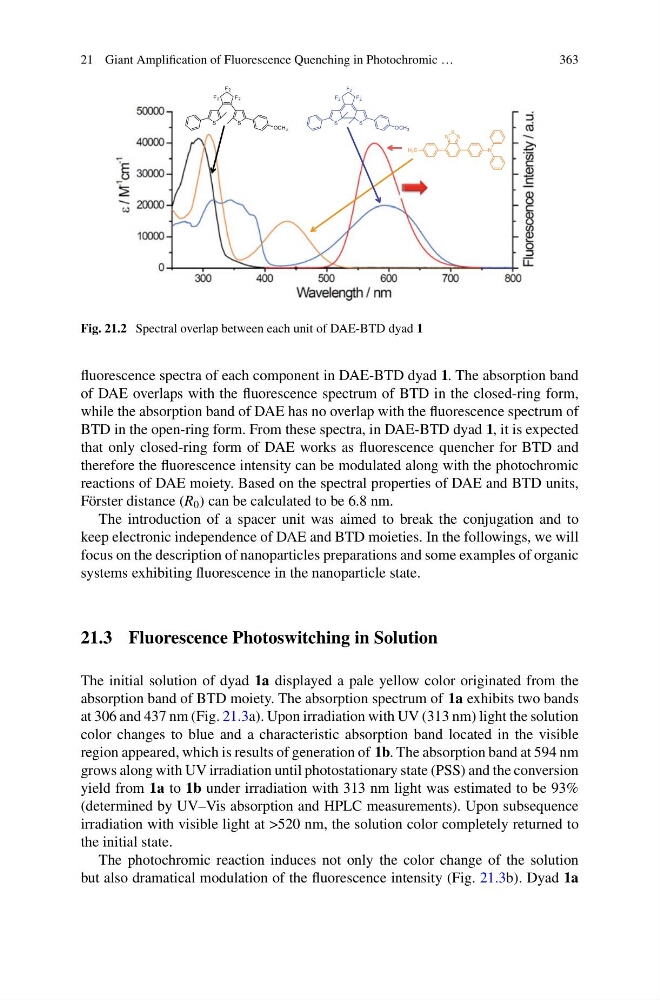
Fig. 21.2 Spectral overlap between each unit of DAE-BTD dyad 1
fluorescence spectra of each component in DAE-BTD dyad 1. The absorption band
of DAE overlaps with the fluorescence spectrum of BTD in the closed-ring form,
while the absorption band of DAE has no overlap with the fluorescence spectrum of
BTD in the open-ring form. From these spectra, in DAE-BTD dyad 1, it is expected
that only closed-ring form of DAE works as fluorescence quencher for BTD and
therefore the fluorescence intensity can be modulated along with the photochromic
reactions of DAE moiety. Based on the spectral properties of DAE and BTD units,
Förster distance (R 0 ) can be calculated to be 6.8 nm.
The introduction of a spacer unit was aimed to break the conjugation and to
keep electronic independence of DAE and BTD moieties. In the followings, we will
focus on the description of nanoparticles preparations and some examples of organic
systems exhibiting fluorescence in the nanoparticle state.
21.3 Fluorescence Photoswitching in Solution
The initial solution of dyad 1a displayed a pale yellow color originated from the
absorption band of BTD moiety. The absorption spectrum of 1a exhibits two bands
at 306 and 437 nm (Fig. 21.3a). Upon irradiation with UV (313 nm) light the solution
color changes to blue and a characteristic absorption band located in the visible
region appeared, which is results of generation of 1b. The absorption band at 594 nm
grows along with UV irradiation until photostationary state (PSS) and the conversion
yield from 1a to 1b under irradiation with 313 nm light was estimated to be 93%
(determined by UV–Vis absorption and HPLC measurements). Upon subsequence
irradiation with visible light at >520 nm, the solution color completely returned to
the initial state.
The photochromic reaction induces not only the color change of the solution
but also dramatical modulation of the fluorescence intensity (Fig. 21.3b). Dyad 1a
363
H3C
N
S
N
N
S
S
OCH3
F2
F2
F2
S
S
OCH3
F2
F2
F2
Fig. 21.2 Spectral overlap between each unit of DAE-BTD dyad 1
fluorescence spectra of each component in DAE-BTD dyad 1. The absorption band
of DAE overlaps with the fluorescence spectrum of BTD in the closed-ring form,
while the absorption band of DAE has no overlap with the fluorescence spectrum of
BTD in the open-ring form. From these spectra, in DAE-BTD dyad 1, it is expected
that only closed-ring form of DAE works as fluorescence quencher for BTD and
therefore the fluorescence intensity can be modulated along with the photochromic
reactions of DAE moiety. Based on the spectral properties of DAE and BTD units,
Förster distance (R 0 ) can be calculated to be 6.8 nm.
The introduction of a spacer unit was aimed to break the conjugation and to
keep electronic independence of DAE and BTD moieties. In the followings, we will
focus on the description of nanoparticles preparations and some examples of organic
systems exhibiting fluorescence in the nanoparticle state.
21.3 Fluorescence Photoswitching in Solution
The initial solution of dyad 1a displayed a pale yellow color originated from the
absorption band of BTD moiety. The absorption spectrum of 1a exhibits two bands
at 306 and 437 nm (Fig. 21.3a). Upon irradiation with UV (313 nm) light the solution
color changes to blue and a characteristic absorption band located in the visible
region appeared, which is results of generation of 1b. The absorption band at 594 nm
grows along with UV irradiation until photostationary state (PSS) and the conversion
yield from 1a to 1b under irradiation with 313 nm light was estimated to be 93%
(determined by UV–Vis absorption and HPLC measurements). Upon subsequence
irradiation with visible light at >520 nm, the solution color completely returned to
the initial state.
The photochromic reaction induces not only the color change of the solution
but also dramatical modulation of the fluorescence intensity (Fig. 21.3b). Dyad 1a