

362
T. Fukaminato et al.
S
S
F 2
F 2
F 2
O
N
S
N
1a (X = -NPh 2 ); 2a (X = -NMe 2 ); 3a (X = -Me)
X
S
S
F 2
F 2
F 2
O
N
S
N
X
UV
Vis.
open-ring isomer (fluorescent)
1b (X = -NPh 2 ); 2b (X = -NMe 2 ); 3b (X = -Me)
closed-ring isomer (non-fluorescent)
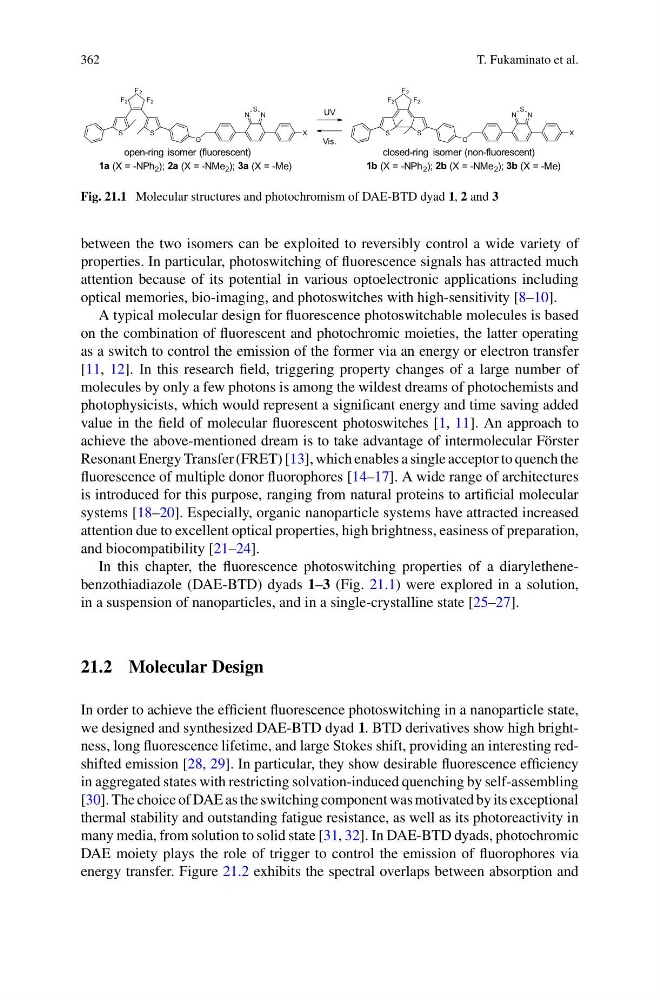
Fig. 21.1 Molecular structures and photochromism of DAE-BTD dyad 1, 2 and 3
between the two isomers can be exploited to reversibly control a wide variety of
properties. In particular, photoswitching of fluorescence signals has attracted much
attention because of its potential in various optoelectronic applications including
optical memories, bio-imaging, and photoswitches with high-sensitivity [8–10].
A typical molecular design for fluorescence photoswitchable molecules is based
on the combination of fluorescent and photochromic moieties, the latter operating
as a switch to control the emission of the former via an energy or electron transfer
[11, 12]. In this research field, triggering property changes of a large number of
molecules by only a few photons is among the wildest dreams of photochemists and
photophysicists, which would represent a significant energy and time saving added
value in the field of molecular fluorescent photoswitches [1, 11]. An approach to
achieve the above-mentioned dream is to take advantage of intermolecular Förster
Resonant Energy Transfer (FRET) [13], which enables a single acceptor to quench the
fluorescence of multiple donor fluorophores [14–17]. A wide range of architectures
is introduced for this purpose, ranging from natural proteins to artificial molecular
systems [18–20]. Especially, organic nanoparticle systems have attracted increased
attention due to excellent optical properties, high brightness, easiness of preparation,
and biocompatibility [21–24].
In this chapter, the fluorescence photoswitching properties of a diarylethenebenzothiadiazole (DAE-BTD) dyads 1–3 (Fig. 21.1) were explored in a solution,
in a suspension of nanoparticles, and in a single-crystalline state [25–27].
21.2 Molecular Design
In order to achieve the efficient fluorescence photoswitching in a nanoparticle state,
we designed and synthesized DAE-BTD dyad 1. BTD derivatives show high brightness, long fluorescence lifetime, and large Stokes shift, providing an interesting redshifted emission [28, 29]. In particular, they show desirable fluorescence efficiency
in aggregated states with restricting solvation-induced quenching by self-assembling
[30]. The choice of DAE as the switching component was motivated by its exceptional
thermal stability and outstanding fatigue resistance, as well as its photoreactivity in
many media, from solution to solid state [31, 32]. In DAE-BTD dyads, photochromic
DAE moiety plays the role of trigger to control the emission of fluorophores via
energy transfer. Figure 21.2 exhibits the spectral overlaps between absorption and
T. Fukaminato et al.
S
S
F 2
F 2
F 2
O
N
S
N
1a (X = -NPh 2 ); 2a (X = -NMe 2 ); 3a (X = -Me)
X
S
S
F 2
F 2
F 2
O
N
S
N
X
UV
Vis.
open-ring isomer (fluorescent)
1b (X = -NPh 2 ); 2b (X = -NMe 2 ); 3b (X = -Me)
closed-ring isomer (non-fluorescent)
Fig. 21.1 Molecular structures and photochromism of DAE-BTD dyad 1, 2 and 3
between the two isomers can be exploited to reversibly control a wide variety of
properties. In particular, photoswitching of fluorescence signals has attracted much
attention because of its potential in various optoelectronic applications including
optical memories, bio-imaging, and photoswitches with high-sensitivity [8–10].
A typical molecular design for fluorescence photoswitchable molecules is based
on the combination of fluorescent and photochromic moieties, the latter operating
as a switch to control the emission of the former via an energy or electron transfer
[11, 12]. In this research field, triggering property changes of a large number of
molecules by only a few photons is among the wildest dreams of photochemists and
photophysicists, which would represent a significant energy and time saving added
value in the field of molecular fluorescent photoswitches [1, 11]. An approach to
achieve the above-mentioned dream is to take advantage of intermolecular Förster
Resonant Energy Transfer (FRET) [13], which enables a single acceptor to quench the
fluorescence of multiple donor fluorophores [14–17]. A wide range of architectures
is introduced for this purpose, ranging from natural proteins to artificial molecular
systems [18–20]. Especially, organic nanoparticle systems have attracted increased
attention due to excellent optical properties, high brightness, easiness of preparation,
and biocompatibility [21–24].
In this chapter, the fluorescence photoswitching properties of a diarylethenebenzothiadiazole (DAE-BTD) dyads 1–3 (Fig. 21.1) were explored in a solution,
in a suspension of nanoparticles, and in a single-crystalline state [25–27].
21.2 Molecular Design
In order to achieve the efficient fluorescence photoswitching in a nanoparticle state,
we designed and synthesized DAE-BTD dyad 1. BTD derivatives show high brightness, long fluorescence lifetime, and large Stokes shift, providing an interesting redshifted emission [28, 29]. In particular, they show desirable fluorescence efficiency
in aggregated states with restricting solvation-induced quenching by self-assembling
[30]. The choice of DAE as the switching component was motivated by its exceptional
thermal stability and outstanding fatigue resistance, as well as its photoreactivity in
many media, from solution to solid state [31, 32]. In DAE-BTD dyads, photochromic
DAE moiety plays the role of trigger to control the emission of fluorophores via
energy transfer. Figure 21.2 exhibits the spectral overlaps between absorption and