

21 Giant Amplification of Fluorescence Quenching in Photochromic …
367
Comparing to THF solution, the nanoparticle exhibits many advantages. Most
interestingly, the fluorescence quenching ratio was 100% with excellent reversibility.
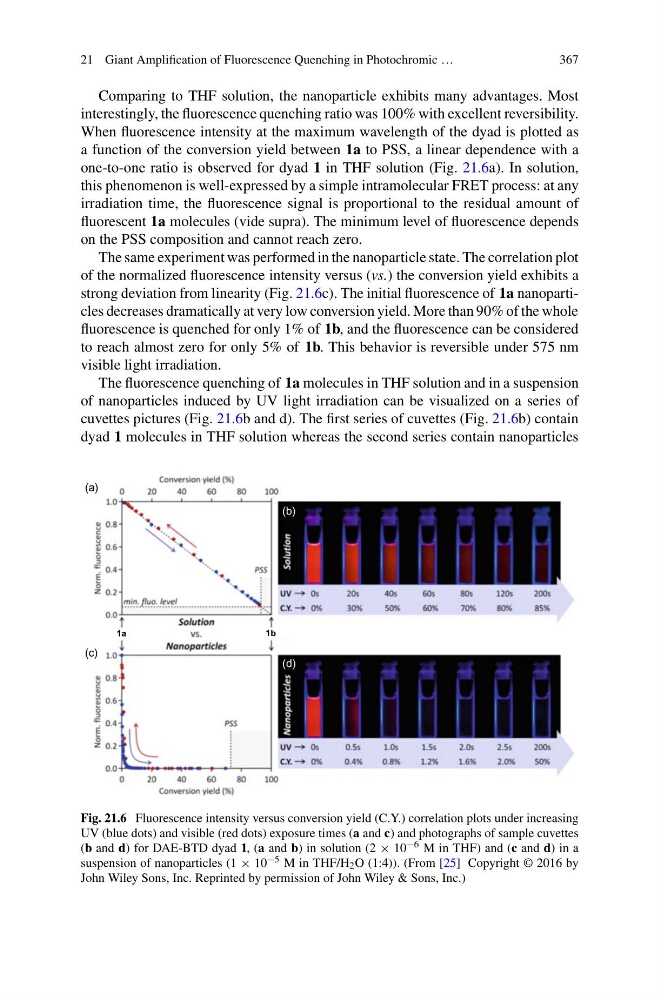
When fluorescence intensity at the maximum wavelength of the dyad is plotted as
a function of the conversion yield between 1a to PSS, a linear dependence with a
one-to-one ratio is observed for dyad 1 in THF solution (Fig. 21.6a). In solution,
this phenomenon is well-expressed by a simple intramolecular FRET process: at any
irradiation time, the fluorescence signal is proportional to the residual amount of
fluorescent 1a molecules (vide supra). The minimum level of fluorescence depends
on the PSS composition and cannot reach zero.
The same experiment was performed in the nanoparticle state. The correlation plot
of the normalized fluorescence intensity versus (vs.) the conversion yield exhibits a
strong deviation from linearity (Fig. 21.6c). The initial fluorescence of 1a nanoparticles decreases dramatically at very low conversion yield. More than 90% of the whole
fluorescence is quenched for only 1% of 1b, and the fluorescence can be considered
to reach almost zero for only 5% of 1b. This behavior is reversible under 575 nm
visible light irradiation.
The fluorescence quenching of 1a molecules in THF solution and in a suspension
of nanoparticles induced by UV light irradiation can be visualized on a series of
cuvettes pictures (Fig. 21.6b and d). The first series of cuvettes (Fig. 21.6b) contain
dyad 1 molecules in THF solution whereas the second series contain nanoparticles
(a)
(c)
(b)
(d)
1a
1b
Fig. 21.6 Fluorescence intensity versus conversion yield (C.Y.) correlation plots under increasing
UV (blue dots) and visible (red dots) exposure times (a and c) and photographs of sample cuvettes
(b and d) for DAE-BTD dyad 1, (a and b) in solution (2 × 10 −6 M in THF) and (c and d) in a
suspension of nanoparticles (1 × 10 −5 M in THF/H 2 O (1:4)). (From [25] Copyright © 2016 by
John Wiley Sons, Inc. Reprinted by permission of John Wiley & Sons, Inc.)
367
Comparing to THF solution, the nanoparticle exhibits many advantages. Most
interestingly, the fluorescence quenching ratio was 100% with excellent reversibility.
When fluorescence intensity at the maximum wavelength of the dyad is plotted as
a function of the conversion yield between 1a to PSS, a linear dependence with a
one-to-one ratio is observed for dyad 1 in THF solution (Fig. 21.6a). In solution,
this phenomenon is well-expressed by a simple intramolecular FRET process: at any
irradiation time, the fluorescence signal is proportional to the residual amount of
fluorescent 1a molecules (vide supra). The minimum level of fluorescence depends
on the PSS composition and cannot reach zero.
The same experiment was performed in the nanoparticle state. The correlation plot
of the normalized fluorescence intensity versus (vs.) the conversion yield exhibits a
strong deviation from linearity (Fig. 21.6c). The initial fluorescence of 1a nanoparticles decreases dramatically at very low conversion yield. More than 90% of the whole
fluorescence is quenched for only 1% of 1b, and the fluorescence can be considered
to reach almost zero for only 5% of 1b. This behavior is reversible under 575 nm
visible light irradiation.
The fluorescence quenching of 1a molecules in THF solution and in a suspension
of nanoparticles induced by UV light irradiation can be visualized on a series of
cuvettes pictures (Fig. 21.6b and d). The first series of cuvettes (Fig. 21.6b) contain
dyad 1 molecules in THF solution whereas the second series contain nanoparticles
(a)
(c)
(b)
(d)
1a
1b
Fig. 21.6 Fluorescence intensity versus conversion yield (C.Y.) correlation plots under increasing
UV (blue dots) and visible (red dots) exposure times (a and c) and photographs of sample cuvettes
(b and d) for DAE-BTD dyad 1, (a and b) in solution (2 × 10 −6 M in THF) and (c and d) in a
suspension of nanoparticles (1 × 10 −5 M in THF/H 2 O (1:4)). (From [25] Copyright © 2016 by
John Wiley Sons, Inc. Reprinted by permission of John Wiley & Sons, Inc.)