

20 Functional Photoactive Materials Based on Flexible π Molecules
353
Epoxy
Thiol
Catalytic
Amine
+ FLAP1
Epoxy
Epoxy + Thiol
Not completely cured
/ nm
/ nm
Cured after 1 h
After addition of amine
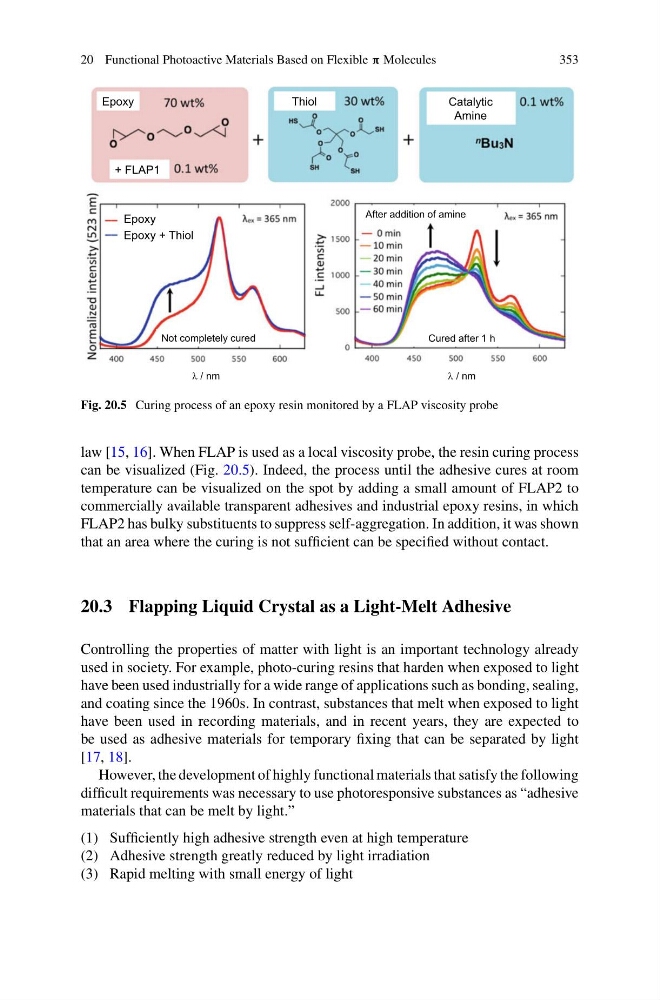
Fig. 20.5 Curing process of an epoxy resin monitored by a FLAP viscosity probe
law [15, 16]. When FLAP is used as a local viscosity probe, the resin curing process
can be visualized (Fig. 20.5). Indeed, the process until the adhesive cures at room
temperature can be visualized on the spot by adding a small amount of FLAP2 to
commercially available transparent adhesives and industrial epoxy resins, in which
FLAP2 has bulky substituents to suppress self-aggregation. In addition, it was shown
that an area where the curing is not sufficient can be specified without contact.
20.3 Flapping Liquid Crystal as a Light-Melt Adhesive
Controlling the properties of matter with light is an important technology already
used in society. For example, photo-curing resins that harden when exposed to light
have been used industrially for a wide range of applications such as bonding, sealing,
and coating since the 1960s. In contrast, substances that melt when exposed to light
have been used in recording materials, and in recent years, they are expected to
be used as adhesive materials for temporary fixing that can be separated by light
[17, 18].
However, the development of highly functional materials that satisfy the following
difficult requirements was necessary to use photoresponsive substances as “adhesive
materials that can be melt by light.”
(1) Sufficiently high adhesive strength even at high temperature
(2) Adhesive strength greatly reduced by light irradiation
(3) Rapid melting with small energy of light
353
Epoxy
Thiol
Catalytic
Amine
+ FLAP1
Epoxy
Epoxy + Thiol
Not completely cured
/ nm
/ nm
Cured after 1 h
After addition of amine
Fig. 20.5 Curing process of an epoxy resin monitored by a FLAP viscosity probe
law [15, 16]. When FLAP is used as a local viscosity probe, the resin curing process
can be visualized (Fig. 20.5). Indeed, the process until the adhesive cures at room
temperature can be visualized on the spot by adding a small amount of FLAP2 to
commercially available transparent adhesives and industrial epoxy resins, in which
FLAP2 has bulky substituents to suppress self-aggregation. In addition, it was shown
that an area where the curing is not sufficient can be specified without contact.
20.3 Flapping Liquid Crystal as a Light-Melt Adhesive
Controlling the properties of matter with light is an important technology already
used in society. For example, photo-curing resins that harden when exposed to light
have been used industrially for a wide range of applications such as bonding, sealing,
and coating since the 1960s. In contrast, substances that melt when exposed to light
have been used in recording materials, and in recent years, they are expected to
be used as adhesive materials for temporary fixing that can be separated by light
[17, 18].
However, the development of highly functional materials that satisfy the following
difficult requirements was necessary to use photoresponsive substances as “adhesive
materials that can be melt by light.”
(1) Sufficiently high adhesive strength even at high temperature
(2) Adhesive strength greatly reduced by light irradiation
(3) Rapid melting with small energy of light