

20 Functional Photoactive Materials Based on Flexible π Molecules
351
FLAP1 which is composed of a rigid anthracene skeleton and a flexible conjugated
8-membered ring (cyclooctatetraene, COT) [6, 7].
FLAP1 shows RGB luminescence with a single component depending on the
environment without changing the excitation wavelength. FLAP1 emits green light
in solution, blue light in a polymer thin film, and red light in a crystal when excited
with ultraviolet light. FLAP1 has a V-shaped structure in the S 0 ground state. When
photoexcited, FLAP1 undergoes a quick internal conversion from a higher excited
state to the lowest singlet excited state (S 1 ). In S 1 , the molecules trapped by the
polymer in the thin film cannot be relaxed freely, and emit blue fluorescence while
maintaining almost V-shaped form. On the other hand, after photoexcitation in solution, the molecule undergoes a conformational change flexibly from a V-shaped to
a planar forms, and it emits lower-energy green fluorescence. Furthermore, the red
fluorescence in the crystal is derived from excimer emission due to intermolecular
interaction of rigid anthracene sites.
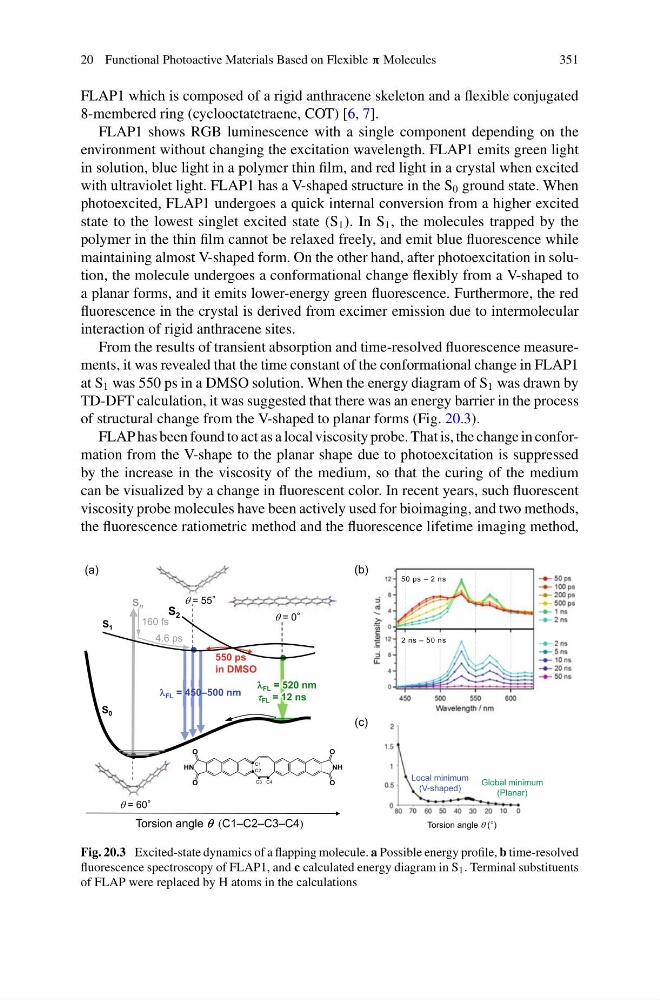
From the results of transient absorption and time-resolved fluorescence measurements, it was revealed that the time constant of the conformational change in FLAP1
at S 1 was 550 ps in a DMSO solution. When the energy diagram of S 1 was drawn by
TD-DFT calculation, it was suggested that there was an energy barrier in the process
of structural change from the V-shaped to planar forms (Fig. 20.3).
FLAP has been found to act as a local viscosity probe. That is, the change in conformation from the V-shape to the planar shape due to photoexcitation is suppressed
by the increase in the viscosity of the medium, so that the curing of the medium
can be visualized by a change in fluorescent color. In recent years, such fluorescent
viscosity probe molecules have been actively used for bioimaging, and two methods,
the fluorescence ratiometric method and the fluorescence lifetime imaging method,
Fig. 20.3 Excited-state dynamics of a flapping molecule. a Possible energy profile, b time-resolved
fluorescence spectroscopy of FLAP1, and c calculated energy diagram in S 1 . Terminal substituents
of FLAP were replaced by H atoms in the calculations
351
FLAP1 which is composed of a rigid anthracene skeleton and a flexible conjugated
8-membered ring (cyclooctatetraene, COT) [6, 7].
FLAP1 shows RGB luminescence with a single component depending on the
environment without changing the excitation wavelength. FLAP1 emits green light
in solution, blue light in a polymer thin film, and red light in a crystal when excited
with ultraviolet light. FLAP1 has a V-shaped structure in the S 0 ground state. When
photoexcited, FLAP1 undergoes a quick internal conversion from a higher excited
state to the lowest singlet excited state (S 1 ). In S 1 , the molecules trapped by the
polymer in the thin film cannot be relaxed freely, and emit blue fluorescence while
maintaining almost V-shaped form. On the other hand, after photoexcitation in solution, the molecule undergoes a conformational change flexibly from a V-shaped to
a planar forms, and it emits lower-energy green fluorescence. Furthermore, the red
fluorescence in the crystal is derived from excimer emission due to intermolecular
interaction of rigid anthracene sites.
From the results of transient absorption and time-resolved fluorescence measurements, it was revealed that the time constant of the conformational change in FLAP1
at S 1 was 550 ps in a DMSO solution. When the energy diagram of S 1 was drawn by
TD-DFT calculation, it was suggested that there was an energy barrier in the process
of structural change from the V-shaped to planar forms (Fig. 20.3).
FLAP has been found to act as a local viscosity probe. That is, the change in conformation from the V-shape to the planar shape due to photoexcitation is suppressed
by the increase in the viscosity of the medium, so that the curing of the medium
can be visualized by a change in fluorescent color. In recent years, such fluorescent
viscosity probe molecules have been actively used for bioimaging, and two methods,
the fluorescence ratiometric method and the fluorescence lifetime imaging method,
Fig. 20.3 Excited-state dynamics of a flapping molecule. a Possible energy profile, b time-resolved
fluorescence spectroscopy of FLAP1, and c calculated energy diagram in S 1 . Terminal substituents
of FLAP were replaced by H atoms in the calculations