

334
K. Higashiguchi and K. Matsuda
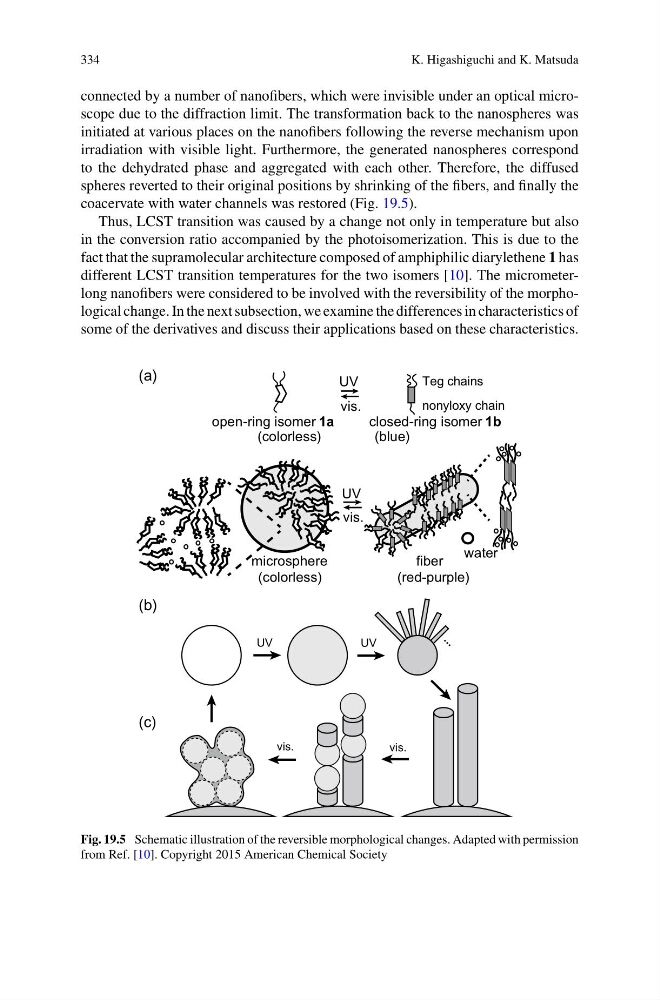
connected by a number of nanofibers, which were invisible under an optical microscope due to the diffraction limit. The transformation back to the nanospheres was
initiated at various places on the nanofibers following the reverse mechanism upon
irradiation with visible light. Furthermore, the generated nanospheres correspond
to the dehydrated phase and aggregated with each other. Therefore, the diffused
spheres reverted to their original positions by shrinking of the fibers, and finally the
coacervate with water channels was restored (Fig. 19.5).
Thus, LCST transition was caused by a change not only in temperature but also
in the conversion ratio accompanied by the photoisomerization. This is due to the
fact that the supramolecular architecture composed of amphiphilic diarylethene 1 has
different LCST transition temperatures for the two isomers [10]. The micrometerlong nanofibers were considered to be involved with the reversibility of the morphological change. In the next subsection, we examine the differences in characteristics of
some of the derivatives and discuss their applications based on these characteristics.
vis.
UV
vis.
(b)
UV
(c)
UV
vis.
microsphere
fiber
open-ring isomer 1a
closed-ring isomer 1b
(colorless)
(blue)
Teg chains
nonyloxy chain
UV
vis.
(colorless)
(red-purple)
(a)
water
Fig. 19.5 Schematic illustration of the reversible morphological changes. Adapted with permission
from Ref. [10]. Copyright 2015 American Chemical Society
K. Higashiguchi and K. Matsuda
connected by a number of nanofibers, which were invisible under an optical microscope due to the diffraction limit. The transformation back to the nanospheres was
initiated at various places on the nanofibers following the reverse mechanism upon
irradiation with visible light. Furthermore, the generated nanospheres correspond
to the dehydrated phase and aggregated with each other. Therefore, the diffused
spheres reverted to their original positions by shrinking of the fibers, and finally the
coacervate with water channels was restored (Fig. 19.5).
Thus, LCST transition was caused by a change not only in temperature but also
in the conversion ratio accompanied by the photoisomerization. This is due to the
fact that the supramolecular architecture composed of amphiphilic diarylethene 1 has
different LCST transition temperatures for the two isomers [10]. The micrometerlong nanofibers were considered to be involved with the reversibility of the morphological change. In the next subsection, we examine the differences in characteristics of
some of the derivatives and discuss their applications based on these characteristics.
vis.
UV
vis.
(b)
UV
(c)
UV
vis.
microsphere
fiber
open-ring isomer 1a
closed-ring isomer 1b
(colorless)
(blue)
Teg chains
nonyloxy chain
UV
vis.
(colorless)
(red-purple)
(a)
water
Fig. 19.5 Schematic illustration of the reversible morphological changes. Adapted with permission
from Ref. [10]. Copyright 2015 American Chemical Society