

332
K. Higashiguchi and K. Matsuda
UV
vis.
0
10
20
30
40
0
2 0
4 0
6 0
8 0
1 0 0
Tempe rature / °C
Ratio of closed-ring isomer / %
fiber
(coacervate)
sphere
(rod-like micelle)
0
0.2
0.4
0.6
0.8
1.0
1.2
1.4
1.6
300
400
500
600
700
800
O.D.
Wavelength / nm
cooling
(a)
(b)
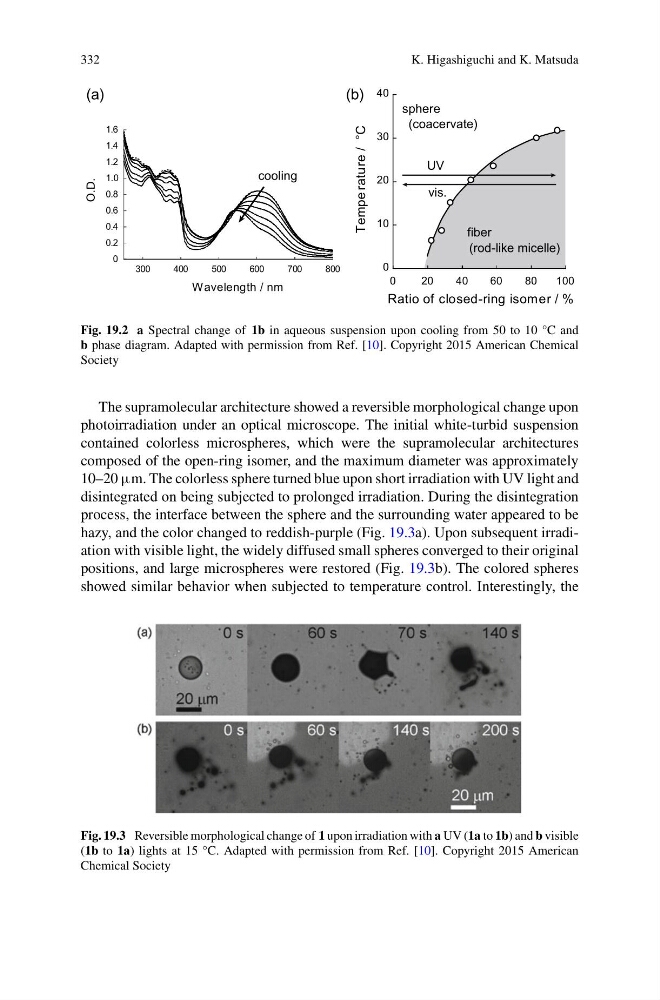
Fig. 19.2 a Spectral change of 1b in aqueous suspension upon cooling from 50 to 10 °C and
b phase diagram. Adapted with permission from Ref. [10]. Copyright 2015 American Chemical
Society
The supramolecular architecture showed a reversible morphological change upon
photoirradiation under an optical microscope. The initial white-turbid suspension
contained colorless microspheres, which were the supramolecular architectures
composed of the open-ring isomer, and the maximum diameter was approximately
10–20 µm. The colorless sphere turned blue upon short irradiation with UV light and
disintegrated on being subjected to prolonged irradiation. During the disintegration
process, the interface between the sphere and the surrounding water appeared to be
hazy, and the color changed to reddish-purple (Fig. 19.3a). Upon subsequent irradiation with visible light, the widely diffused small spheres converged to their original
positions, and large microspheres were restored (Fig. 19.3b). The colored spheres
showed similar behavior when subjected to temperature control. Interestingly, the
Fig. 19.3 Reversible morphological change of 1 upon irradiation with a UV (1a to 1b) and b visible
(1b to 1a) lights at 15 °C. Adapted with permission from Ref. [10]. Copyright 2015 American
Chemical Society
K. Higashiguchi and K. Matsuda
UV
vis.
0
10
20
30
40
0
2 0
4 0
6 0
8 0
1 0 0
Tempe rature / °C
Ratio of closed-ring isomer / %
fiber
(coacervate)
sphere
(rod-like micelle)
0
0.2
0.4
0.6
0.8
1.0
1.2
1.4
1.6
300
400
500
600
700
800
O.D.
Wavelength / nm
cooling
(a)
(b)
Fig. 19.2 a Spectral change of 1b in aqueous suspension upon cooling from 50 to 10 °C and
b phase diagram. Adapted with permission from Ref. [10]. Copyright 2015 American Chemical
Society
The supramolecular architecture showed a reversible morphological change upon
photoirradiation under an optical microscope. The initial white-turbid suspension
contained colorless microspheres, which were the supramolecular architectures
composed of the open-ring isomer, and the maximum diameter was approximately
10–20 µm. The colorless sphere turned blue upon short irradiation with UV light and
disintegrated on being subjected to prolonged irradiation. During the disintegration
process, the interface between the sphere and the surrounding water appeared to be
hazy, and the color changed to reddish-purple (Fig. 19.3a). Upon subsequent irradiation with visible light, the widely diffused small spheres converged to their original
positions, and large microspheres were restored (Fig. 19.3b). The colored spheres
showed similar behavior when subjected to temperature control. Interestingly, the
Fig. 19.3 Reversible morphological change of 1 upon irradiation with a UV (1a to 1b) and b visible
(1b to 1a) lights at 15 °C. Adapted with permission from Ref. [10]. Copyright 2015 American
Chemical Society