

19 Photoinduced Morphological Transformation and Photodriven …
331
purple upon continuous irradiation with UV light (Fig. 19.1b). The reddish purple
suspension returned to the original white-turbid suspension upon irradiation with
visible light. Therefore, it can be said that the spectral shift did not originate from the
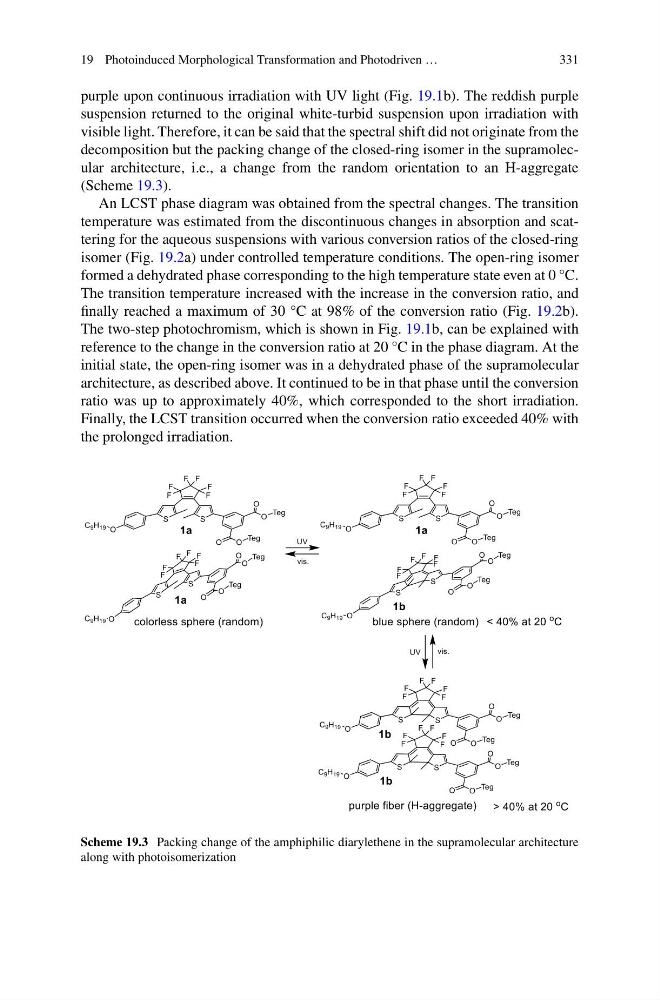
decomposition but the packing change of the closed-ring isomer in the supramolecular architecture, i.e., a change from the random orientation to an H-aggregate
(Scheme 19.3).
An LCST phase diagram was obtained from the spectral changes. The transition
temperature was estimated from the discontinuous changes in absorption and scattering for the aqueous suspensions with various conversion ratios of the closed-ring
isomer (Fig. 19.2a) under controlled temperature conditions. The open-ring isomer
formed a dehydrated phase corresponding to the high temperature state even at 0 °C.
The transition temperature increased with the increase in the conversion ratio, and
finally reached a maximum of 30 °C at 98% of the conversion ratio (Fig. 19.2b).
The two-step photochromism, which is shown in Fig. 19.1b, can be explained with
reference to the change in the conversion ratio at 20 °C in the phase diagram. At the
initial state, the open-ring isomer was in a dehydrated phase of the supramolecular
architecture, as described above. It continued to be in that phase until the conversion
ratio was up to approximately 40%, which corresponded to the short irradiation.
Finally, the LCST transition occurred when the conversion ratio exceeded 40% with
the prolonged irradiation.
Scheme 19.3 Packing change of the amphiphilic diarylethene in the supramolecular architecture
along with photoisomerization
331
purple upon continuous irradiation with UV light (Fig. 19.1b). The reddish purple
suspension returned to the original white-turbid suspension upon irradiation with
visible light. Therefore, it can be said that the spectral shift did not originate from the
decomposition but the packing change of the closed-ring isomer in the supramolecular architecture, i.e., a change from the random orientation to an H-aggregate
(Scheme 19.3).
An LCST phase diagram was obtained from the spectral changes. The transition
temperature was estimated from the discontinuous changes in absorption and scattering for the aqueous suspensions with various conversion ratios of the closed-ring
isomer (Fig. 19.2a) under controlled temperature conditions. The open-ring isomer
formed a dehydrated phase corresponding to the high temperature state even at 0 °C.
The transition temperature increased with the increase in the conversion ratio, and
finally reached a maximum of 30 °C at 98% of the conversion ratio (Fig. 19.2b).
The two-step photochromism, which is shown in Fig. 19.1b, can be explained with
reference to the change in the conversion ratio at 20 °C in the phase diagram. At the
initial state, the open-ring isomer was in a dehydrated phase of the supramolecular
architecture, as described above. It continued to be in that phase until the conversion
ratio was up to approximately 40%, which corresponded to the short irradiation.
Finally, the LCST transition occurred when the conversion ratio exceeded 40% with
the prolonged irradiation.
Scheme 19.3 Packing change of the amphiphilic diarylethene in the supramolecular architecture
along with photoisomerization