

322
Y. Haketa et al.
T 1 states occurs with time constants of 260 and 820 fs, respectively, and vibrational
cooling from the high vibrational level of the T 1 states with lifetimes of 85 and
80 ps, respectively, was observed. With >10 ns time constants, the longest lifetime
components can be assigned to the T 1 states, although the exact lifetimes could not
be determined using transient absorption measurements on the sub-picosecond to
nanosecond timescale.
The nanosecond to microsecond timescale transient absorption measurements
with the randomly interleaved pulse train (RIPT) method elucidated the long-lived
components, which were 1.2 and 0.82 ms for 20a,b, respectively (Fig. 18.19c) [46].
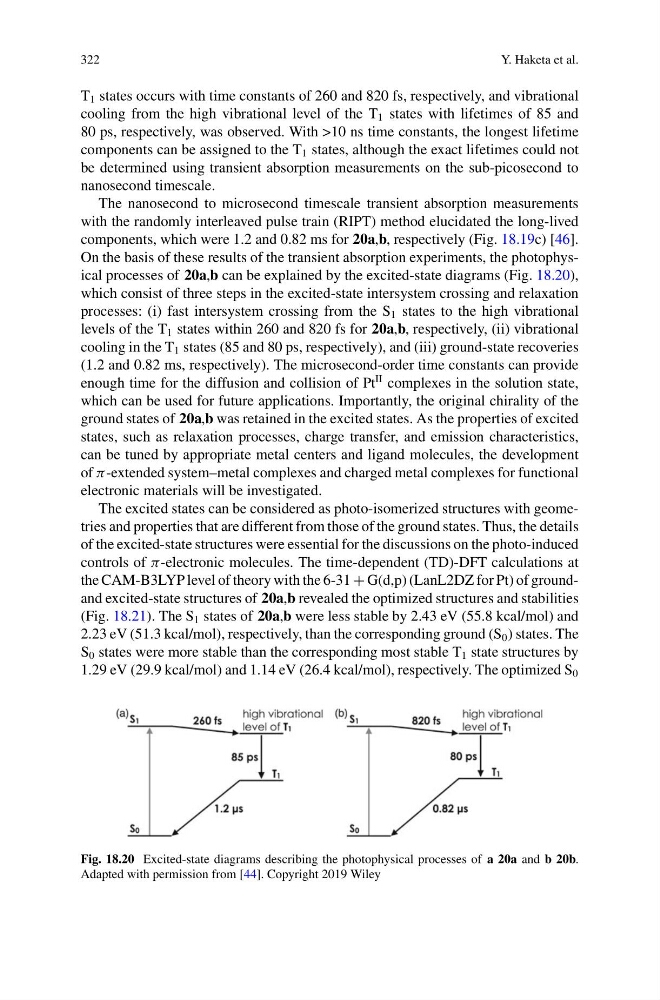
On the basis of these results of the transient absorption experiments, the photophysical processes of 20a,b can be explained by the excited-state diagrams (Fig. 18.20),
which consist of three steps in the excited-state intersystem crossing and relaxation
processes: (i) fast intersystem crossing from the S 1 states to the high vibrational
levels of the T 1 states within 260 and 820 fs for 20a,b, respectively, (ii) vibrational
cooling in the T 1 states (85 and 80 ps, respectively), and (iii) ground-state recoveries
(1.2 and 0.82 ms, respectively). The microsecond-order time constants can provide
enough time for the diffusion and collision of Pt
II complexes in the solution state,
which can be used for future applications. Importantly, the original chirality of the
ground states of 20a,b was retained in the excited states. As the properties of excited
states, such as relaxation processes, charge transfer, and emission characteristics,
can be tuned by appropriate metal centers and ligand molecules, the development
of π-extended system–metal complexes and charged metal complexes for functional
electronic materials will be investigated.
The excited states can be considered as photo-isomerized structures with geometries and properties that are different from those of the ground states. Thus, the details
of the excited-state structures were essential for the discussions on the photo-induced
controls of π-electronic molecules. The time-dependent (TD)-DFT calculations at
the CAM-B3LYP level of theory with the 6-31 + G(d,p) (LanL2DZ for Pt) of groundand excited-state structures of 20a,b revealed the optimized structures and stabilities
(Fig. 18.21). The S 1 states of 20a,b were less stable by 2.43 eV (55.8 kcal/mol) and
2.23 eV (51.3 kcal/mol), respectively, than the corresponding ground (S 0 ) states. The
S 0 states were more stable than the corresponding most stable T 1 state structures by
1.29 eV (29.9 kcal/mol) and 1.14 eV (26.4 kcal/mol), respectively. The optimized S 0
Fig. 18.20 Excited-state diagrams describing the photophysical processes of a 20a and b 20b.
Adapted with permission from [44]. Copyright 2019 Wiley
Y. Haketa et al.
T 1 states occurs with time constants of 260 and 820 fs, respectively, and vibrational
cooling from the high vibrational level of the T 1 states with lifetimes of 85 and
80 ps, respectively, was observed. With >10 ns time constants, the longest lifetime
components can be assigned to the T 1 states, although the exact lifetimes could not
be determined using transient absorption measurements on the sub-picosecond to
nanosecond timescale.
The nanosecond to microsecond timescale transient absorption measurements
with the randomly interleaved pulse train (RIPT) method elucidated the long-lived
components, which were 1.2 and 0.82 ms for 20a,b, respectively (Fig. 18.19c) [46].
On the basis of these results of the transient absorption experiments, the photophysical processes of 20a,b can be explained by the excited-state diagrams (Fig. 18.20),
which consist of three steps in the excited-state intersystem crossing and relaxation
processes: (i) fast intersystem crossing from the S 1 states to the high vibrational
levels of the T 1 states within 260 and 820 fs for 20a,b, respectively, (ii) vibrational
cooling in the T 1 states (85 and 80 ps, respectively), and (iii) ground-state recoveries
(1.2 and 0.82 ms, respectively). The microsecond-order time constants can provide
enough time for the diffusion and collision of Pt
II complexes in the solution state,
which can be used for future applications. Importantly, the original chirality of the
ground states of 20a,b was retained in the excited states. As the properties of excited
states, such as relaxation processes, charge transfer, and emission characteristics,
can be tuned by appropriate metal centers and ligand molecules, the development
of π-extended system–metal complexes and charged metal complexes for functional
electronic materials will be investigated.
The excited states can be considered as photo-isomerized structures with geometries and properties that are different from those of the ground states. Thus, the details
of the excited-state structures were essential for the discussions on the photo-induced
controls of π-electronic molecules. The time-dependent (TD)-DFT calculations at
the CAM-B3LYP level of theory with the 6-31 + G(d,p) (LanL2DZ for Pt) of groundand excited-state structures of 20a,b revealed the optimized structures and stabilities
(Fig. 18.21). The S 1 states of 20a,b were less stable by 2.43 eV (55.8 kcal/mol) and
2.23 eV (51.3 kcal/mol), respectively, than the corresponding ground (S 0 ) states. The
S 0 states were more stable than the corresponding most stable T 1 state structures by
1.29 eV (29.9 kcal/mol) and 1.14 eV (26.4 kcal/mol), respectively. The optimized S 0
Fig. 18.20 Excited-state diagrams describing the photophysical processes of a 20a and b 20b.
Adapted with permission from [44]. Copyright 2019 Wiley