

18 π-Electronic Ion-Pairing Assemblies …
323
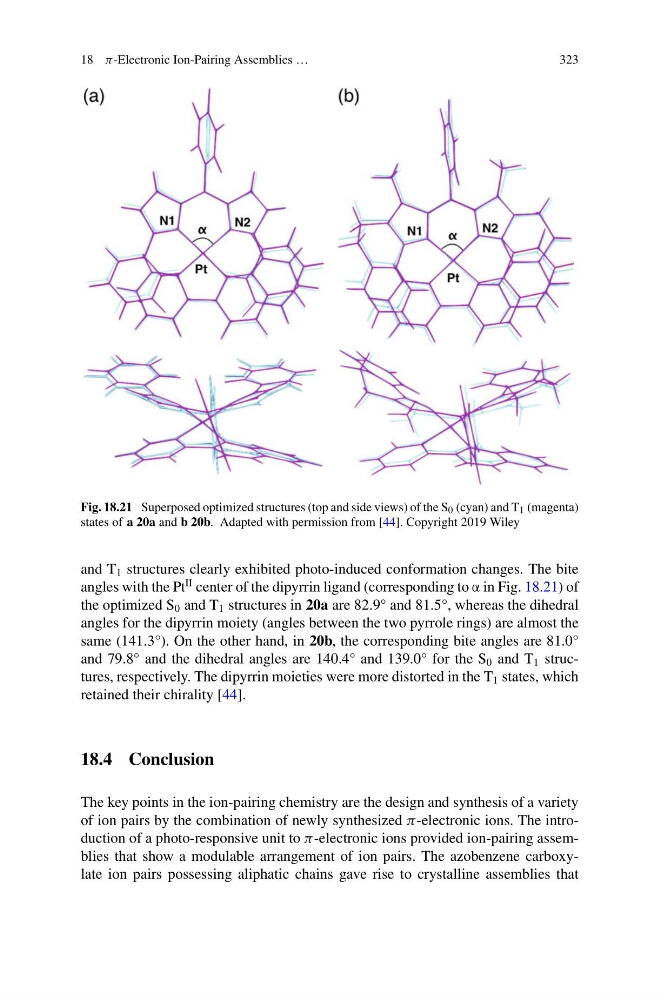
Fig. 18.21 Superposed optimized structures (top and side views) of the S 0 (cyan) and T 1 (magenta)
states of a 20a and b 20b. Adapted with permission from [44]. Copyright 2019 Wiley
and T 1 structures clearly exhibited photo-induced conformation changes. The bite
angles with the Pt
II center of the dipyrrin ligand (corresponding to α in Fig. 18.21) of
the optimized S 0 and T 1 structures in 20a are 82.9° and 81.5°, whereas the dihedral
angles for the dipyrrin moiety (angles between the two pyrrole rings) are almost the
same (141.3°). On the other hand, in 20b, the corresponding bite angles are 81.0°
and 79.8° and the dihedral angles are 140.4° and 139.0° for the S 0 and T 1 structures, respectively. The dipyrrin moieties were more distorted in the T 1 states, which
retained their chirality [44].
18.4 Conclusion
The key points in the ion-pairing chemistry are the design and synthesis of a variety
of ion pairs by the combination of newly synthesized π-electronic ions. The introduction of a photo-responsive unit to π-electronic ions provided ion-pairing assemblies that show a modulable arrangement of ion pairs. The azobenzene carboxylate ion pairs possessing aliphatic chains gave rise to crystalline assemblies that
323
Fig. 18.21 Superposed optimized structures (top and side views) of the S 0 (cyan) and T 1 (magenta)
states of a 20a and b 20b. Adapted with permission from [44]. Copyright 2019 Wiley
and T 1 structures clearly exhibited photo-induced conformation changes. The bite
angles with the Pt
II center of the dipyrrin ligand (corresponding to α in Fig. 18.21) of
the optimized S 0 and T 1 structures in 20a are 82.9° and 81.5°, whereas the dihedral
angles for the dipyrrin moiety (angles between the two pyrrole rings) are almost the
same (141.3°). On the other hand, in 20b, the corresponding bite angles are 81.0°
and 79.8° and the dihedral angles are 140.4° and 139.0° for the S 0 and T 1 structures, respectively. The dipyrrin moieties were more distorted in the T 1 states, which
retained their chirality [44].
18.4 Conclusion
The key points in the ion-pairing chemistry are the design and synthesis of a variety
of ion pairs by the combination of newly synthesized π-electronic ions. The introduction of a photo-responsive unit to π-electronic ions provided ion-pairing assemblies that show a modulable arrangement of ion pairs. The azobenzene carboxylate ion pairs possessing aliphatic chains gave rise to crystalline assemblies that