

320
Y. Haketa et al.
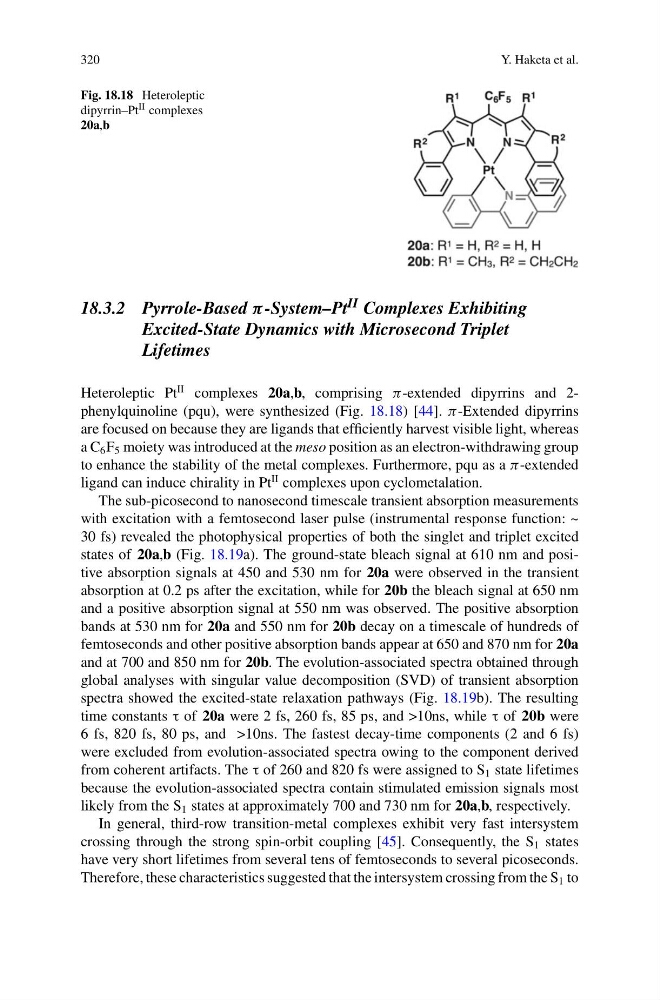
Fig. 18.18 Heteroleptic
dipyrrin–Pt II complexes
20a,b
18.3.2 Pyrrole-Based π-System–Pt II Complexes Exhibiting
Excited-State Dynamics with Microsecond Triplet
Lifetimes
Heteroleptic Pt
II complexes 20a,b, comprising π-extended dipyrrins and 2phenylquinoline (pqu), were synthesized (Fig. 18.18) [44]. π-Extended dipyrrins
are focused on because they are ligands that efficiently harvest visible light, whereas
a C 6 F 5 moiety was introduced at the meso position as an electron-withdrawing group
to enhance the stability of the metal complexes. Furthermore, pqu as a π-extended
ligand can induce chirality in Pt
II complexes upon cyclometalation.
The sub-picosecond to nanosecond timescale transient absorption measurements
with excitation with a femtosecond laser pulse (instrumental response function: ~
30 fs) revealed the photophysical properties of both the singlet and triplet excited
states of 20a,b (Fig. 18.19a). The ground-state bleach signal at 610 nm and positive absorption signals at 450 and 530 nm for 20a were observed in the transient
absorption at 0.2 ps after the excitation, while for 20b the bleach signal at 650 nm
and a positive absorption signal at 550 nm was observed. The positive absorption
bands at 530 nm for 20a and 550 nm for 20b decay on a timescale of hundreds of
femtoseconds and other positive absorption bands appear at 650 and 870 nm for 20a
and at 700 and 850 nm for 20b. The evolution-associated spectra obtained through
global analyses with singular value decomposition (SVD) of transient absorption
spectra showed the excited-state relaxation pathways (Fig. 18.19b). The resulting
time constants τ of 20a were 2 fs, 260 fs, 85 ps, and >10ns, while τ of 20b were
6 fs, 820 fs, 80 ps, and >10ns. The fastest decay-time components (2 and 6 fs)
were excluded from evolution-associated spectra owing to the component derived
from coherent artifacts. The τ of 260 and 820 fs were assigned to S 1 state lifetimes
because the evolution-associated spectra contain stimulated emission signals most
likely from the S 1 states at approximately 700 and 730 nm for 20a,b, respectively.
In general, third-row transition-metal complexes exhibit very fast intersystem
crossing through the strong spin-orbit coupling [45]. Consequently, the S 1 states
have very short lifetimes from several tens of femtoseconds to several picoseconds.
Therefore, these characteristics suggested that the intersystem crossing from the S 1 to
Y. Haketa et al.
Fig. 18.18 Heteroleptic
dipyrrin–Pt II complexes
20a,b
18.3.2 Pyrrole-Based π-System–Pt II Complexes Exhibiting
Excited-State Dynamics with Microsecond Triplet
Lifetimes
Heteroleptic Pt
II complexes 20a,b, comprising π-extended dipyrrins and 2phenylquinoline (pqu), were synthesized (Fig. 18.18) [44]. π-Extended dipyrrins
are focused on because they are ligands that efficiently harvest visible light, whereas
a C 6 F 5 moiety was introduced at the meso position as an electron-withdrawing group
to enhance the stability of the metal complexes. Furthermore, pqu as a π-extended
ligand can induce chirality in Pt
II complexes upon cyclometalation.
The sub-picosecond to nanosecond timescale transient absorption measurements
with excitation with a femtosecond laser pulse (instrumental response function: ~
30 fs) revealed the photophysical properties of both the singlet and triplet excited
states of 20a,b (Fig. 18.19a). The ground-state bleach signal at 610 nm and positive absorption signals at 450 and 530 nm for 20a were observed in the transient
absorption at 0.2 ps after the excitation, while for 20b the bleach signal at 650 nm
and a positive absorption signal at 550 nm was observed. The positive absorption
bands at 530 nm for 20a and 550 nm for 20b decay on a timescale of hundreds of
femtoseconds and other positive absorption bands appear at 650 and 870 nm for 20a
and at 700 and 850 nm for 20b. The evolution-associated spectra obtained through
global analyses with singular value decomposition (SVD) of transient absorption
spectra showed the excited-state relaxation pathways (Fig. 18.19b). The resulting
time constants τ of 20a were 2 fs, 260 fs, 85 ps, and >10ns, while τ of 20b were
6 fs, 820 fs, 80 ps, and >10ns. The fastest decay-time components (2 and 6 fs)
were excluded from evolution-associated spectra owing to the component derived
from coherent artifacts. The τ of 260 and 820 fs were assigned to S 1 state lifetimes
because the evolution-associated spectra contain stimulated emission signals most
likely from the S 1 states at approximately 700 and 730 nm for 20a,b, respectively.
In general, third-row transition-metal complexes exhibit very fast intersystem
crossing through the strong spin-orbit coupling [45]. Consequently, the S 1 states
have very short lifetimes from several tens of femtoseconds to several picoseconds.
Therefore, these characteristics suggested that the intersystem crossing from the S 1 to