

18 π-Electronic Ion-Pairing Assemblies …
319
only on the surface [37], where free volume is available, and may be suppressed by
packing of the π-electronic systems and alkyl chains in the solid-state [42].
18.3 Excited-State Dynamics of π-System–Pt II Complexes
18.3.1 Excited-State Dynamics
In general, the structures and reactivity of triplet states are different from those
of the corresponding ground states. Thus, it is crucial to investigate the excitedstate dynamics, which include radiative and non-radiative processes, as well as the
reactivity of excited states because highly efficient photofunctional materials can be
fabricated. Applications that depend on the strong absorption of visible light often
require transition-metal complexes of π-electronic molecules and their assemblies,
which exhibit diverse properties and functions based on their coordination bonds.
Among metal complexes, cyclometalated Pt
II complexes have gained much attention
due to their photophysical properties and show high triplet quantum yields, long-lived
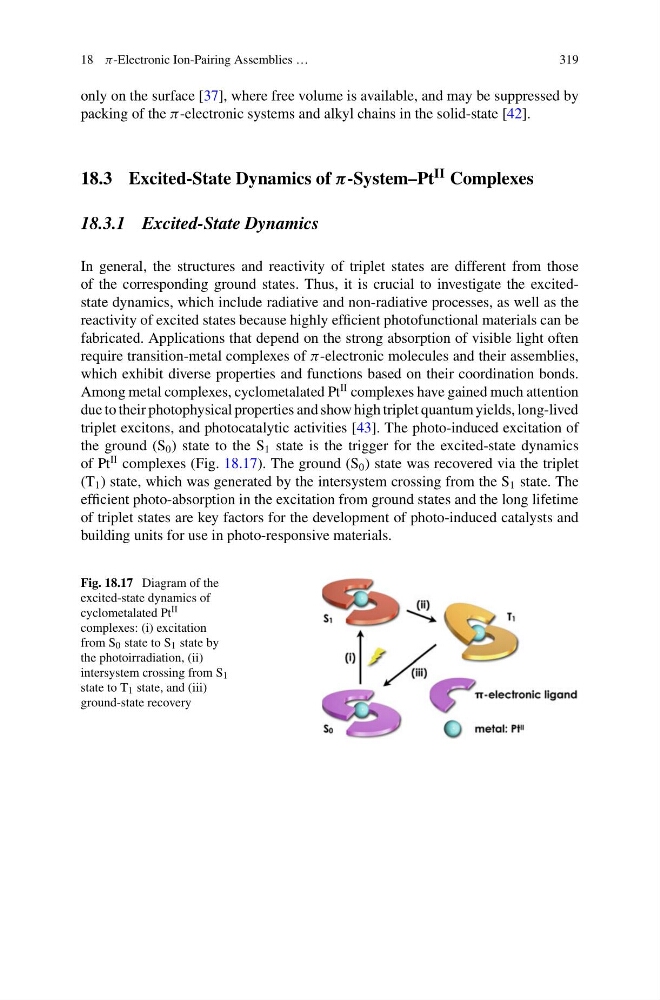
triplet excitons, and photocatalytic activities [43]. The photo-induced excitation of
the ground (S 0 ) state to the S 1 state is the trigger for the excited-state dynamics
of Pt
II complexes (Fig. 18.17). The ground (S 0 ) state was recovered via the triplet
(T 1 ) state, which was generated by the intersystem crossing from the S 1 state. The
efficient photo-absorption in the excitation from ground states and the long lifetime
of triplet states are key factors for the development of photo-induced catalysts and
building units for use in photo-responsive materials.
Fig. 18.17 Diagram of the
excited-state dynamics of
cyclometalated Pt II
complexes: (i) excitation
from S 0 state to S 1 state by
the photoirradiation, (ii)
intersystem crossing from S 1
state to T 1 state, and (iii)
ground-state recovery
319
only on the surface [37], where free volume is available, and may be suppressed by
packing of the π-electronic systems and alkyl chains in the solid-state [42].
18.3 Excited-State Dynamics of π-System–Pt II Complexes
18.3.1 Excited-State Dynamics
In general, the structures and reactivity of triplet states are different from those
of the corresponding ground states. Thus, it is crucial to investigate the excitedstate dynamics, which include radiative and non-radiative processes, as well as the
reactivity of excited states because highly efficient photofunctional materials can be
fabricated. Applications that depend on the strong absorption of visible light often
require transition-metal complexes of π-electronic molecules and their assemblies,
which exhibit diverse properties and functions based on their coordination bonds.
Among metal complexes, cyclometalated Pt
II complexes have gained much attention
due to their photophysical properties and show high triplet quantum yields, long-lived
triplet excitons, and photocatalytic activities [43]. The photo-induced excitation of
the ground (S 0 ) state to the S 1 state is the trigger for the excited-state dynamics
of Pt
II complexes (Fig. 18.17). The ground (S 0 ) state was recovered via the triplet
(T 1 ) state, which was generated by the intersystem crossing from the S 1 state. The
efficient photo-absorption in the excitation from ground states and the long lifetime
of triplet states are key factors for the development of photo-induced catalysts and
building units for use in photo-responsive materials.
Fig. 18.17 Diagram of the
excited-state dynamics of
cyclometalated Pt II
complexes: (i) excitation
from S 0 state to S 1 state by
the photoirradiation, (ii)
intersystem crossing from S 1
state to T 1 state, and (iii)
ground-state recovery