

318
Y. Haketa et al.
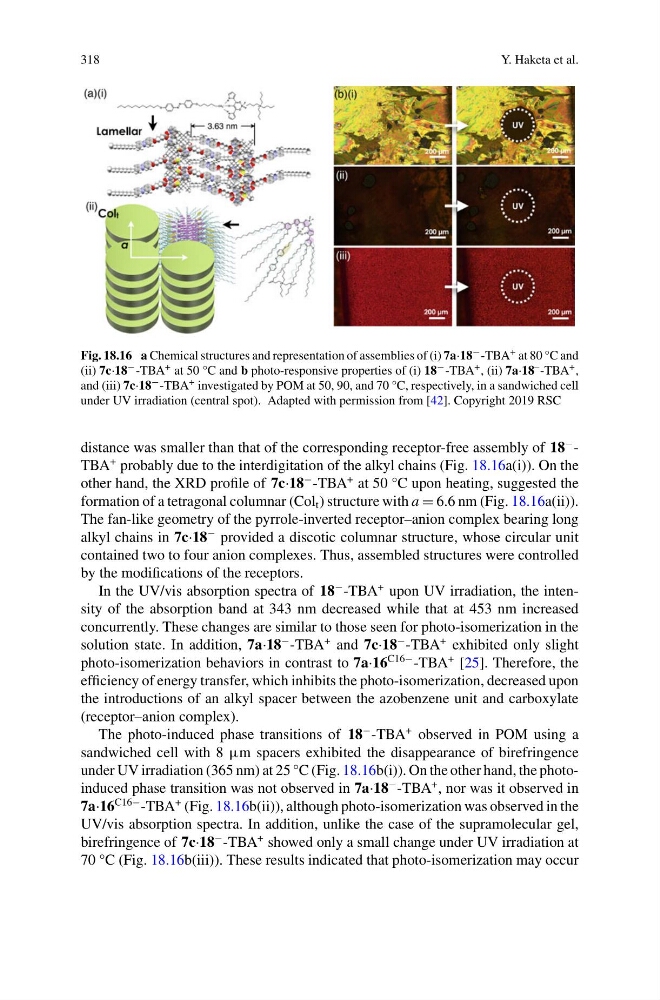
Fig. 18.16 a Chemical structures and representation of assemblies of (i) 7a·18 − -TBA + at 80 °C and
(ii) 7c·18 − -TBA + at 50 °C and b photo-responsive properties of (i) 18 − -TBA + , (ii) 7a·18 – -TBA + ,
and (iii) 7c·18 − -TBA + investigated by POM at 50, 90, and 70 °C, respectively, in a sandwiched cell
under UV irradiation (central spot). Adapted with permission from [42]. Copyright 2019 RSC
distance was smaller than that of the corresponding receptor-free assembly of 18
− -
TBA
+ probably due to the interdigitation of the alkyl chains (Fig. 18.16a(i)). On the
other hand, the XRD profile of 7c·18
− -TBA
+ at 50 °C upon heating, suggested the
formation of a tetragonal columnar (Col t ) structure with a = 6.6 nm (Fig. 18.16a(ii)).
The fan-like geometry of the pyrrole-inverted receptor–anion complex bearing long
alkyl chains in 7c·18
− provided a discotic columnar structure, whose circular unit
contained two to four anion complexes. Thus, assembled structures were controlled
by the modifications of the receptors.
In the UV/vis absorption spectra of 18
− -TBA
+ upon UV irradiation, the intensity of the absorption band at 343 nm decreased while that at 453 nm increased
concurrently. These changes are similar to those seen for photo-isomerization in the
solution state. In addition, 7a·18
− -TBA
+ and 7c·18
− -TBA
+ exhibited only slight
photo-isomerization behaviors in contrast to 7a·16
C16− -TBA
+ [25]. Therefore, the
efficiency of energy transfer, which inhibits the photo-isomerization, decreased upon
the introductions of an alkyl spacer between the azobenzene unit and carboxylate
(receptor–anion complex).
The photo-induced phase transitions of 18
− -TBA
+ observed in POM using a
sandwiched cell with 8 μm spacers exhibited the disappearance of birefringence
under UV irradiation (365 nm) at 25 °C (Fig. 18.16b(i)). On the other hand, the photoinduced phase transition was not observed in 7a·18
− -TBA
+ , nor was it observed in
7a·16
C16− -TBA
+ (Fig. 18.16b(ii)), although photo-isomerization was observed in the
UV/vis absorption spectra. In addition, unlike the case of the supramolecular gel,
birefringence of 7c·18
− -TBA
+ showed only a small change under UV irradiation at
70 °C (Fig. 18.16b(iii)). These results indicated that photo-isomerization may occur
Y. Haketa et al.
Fig. 18.16 a Chemical structures and representation of assemblies of (i) 7a·18 − -TBA + at 80 °C and
(ii) 7c·18 − -TBA + at 50 °C and b photo-responsive properties of (i) 18 − -TBA + , (ii) 7a·18 – -TBA + ,
and (iii) 7c·18 − -TBA + investigated by POM at 50, 90, and 70 °C, respectively, in a sandwiched cell
under UV irradiation (central spot). Adapted with permission from [42]. Copyright 2019 RSC
distance was smaller than that of the corresponding receptor-free assembly of 18
− -
TBA
+ probably due to the interdigitation of the alkyl chains (Fig. 18.16a(i)). On the
other hand, the XRD profile of 7c·18
− -TBA
+ at 50 °C upon heating, suggested the
formation of a tetragonal columnar (Col t ) structure with a = 6.6 nm (Fig. 18.16a(ii)).
The fan-like geometry of the pyrrole-inverted receptor–anion complex bearing long
alkyl chains in 7c·18
− provided a discotic columnar structure, whose circular unit
contained two to four anion complexes. Thus, assembled structures were controlled
by the modifications of the receptors.
In the UV/vis absorption spectra of 18
− -TBA
+ upon UV irradiation, the intensity of the absorption band at 343 nm decreased while that at 453 nm increased
concurrently. These changes are similar to those seen for photo-isomerization in the
solution state. In addition, 7a·18
− -TBA
+ and 7c·18
− -TBA
+ exhibited only slight
photo-isomerization behaviors in contrast to 7a·16
C16− -TBA
+ [25]. Therefore, the
efficiency of energy transfer, which inhibits the photo-isomerization, decreased upon
the introductions of an alkyl spacer between the azobenzene unit and carboxylate
(receptor–anion complex).
The photo-induced phase transitions of 18
− -TBA
+ observed in POM using a
sandwiched cell with 8 μm spacers exhibited the disappearance of birefringence
under UV irradiation (365 nm) at 25 °C (Fig. 18.16b(i)). On the other hand, the photoinduced phase transition was not observed in 7a·18
− -TBA
+ , nor was it observed in
7a·16
C16− -TBA
+ (Fig. 18.16b(ii)), although photo-isomerization was observed in the
UV/vis absorption spectra. In addition, unlike the case of the supramolecular gel,
birefringence of 7c·18
− -TBA
+ showed only a small change under UV irradiation at
70 °C (Fig. 18.16b(iii)). These results indicated that photo-isomerization may occur