

316
Y. Haketa et al.
isomerization of the azobenzene moiety and provides a photostable assembly even
in the presence of photo-responsive azobenzene carboxylates. In other words, the
modification of receptors and azobenzene, which affects the packing structures, could
control the photo-responsive properties of the dimension-controlled assemblies [40].
In order to improve the photo-responsive behaviors, azobenzene bearing alkyl
chains that can enhance the dynamic nature of the molecules [41] on both sides were
designed [42]. Introduction of spacers between the azobenzene and carboxylate units
can also interfere with the energy transfer to the receptor–anion complex parts.
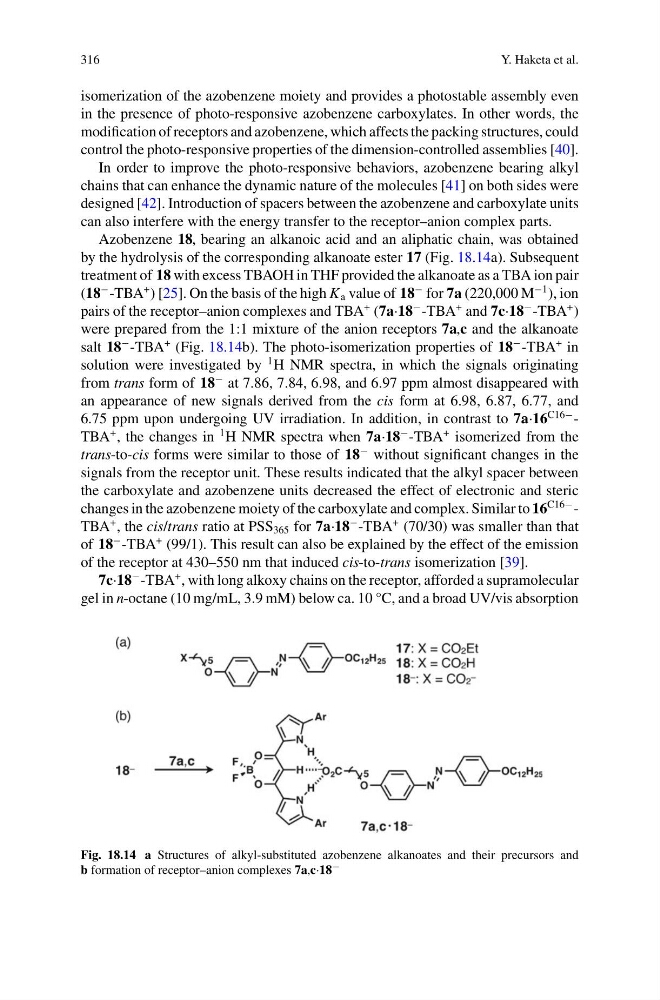
Azobenzene 18, bearing an alkanoic acid and an aliphatic chain, was obtained
by the hydrolysis of the corresponding alkanoate ester 17 (Fig. 18.14a). Subsequent
treatment of 18 with excess TBAOH in THF provided the alkanoate as a TBA ion pair
(18
− -TBA
+ ) [25]. On the basis of the high K a value of 18
− for 7a (220,000 M
−1 ), ion
pairs of the receptor–anion complexes and TBA
+ (7a·18
− -TBA
+ and 7c·18
− -TBA
+ )
were prepared from the 1:1 mixture of the anion receptors 7a,c and the alkanoate
salt 18
− -TBA
+ (Fig. 18.14b). The photo-isomerization properties of 18
− -TBA
+ in
solution were investigated by
1 H NMR spectra, in which the signals originating
from trans form of 18
− at 7.86, 7.84, 6.98, and 6.97 ppm almost disappeared with
an appearance of new signals derived from the cis form at 6.98, 6.87, 6.77, and
6.75 ppm upon undergoing UV irradiation. In addition, in contrast to 7a·16
C16− -
TBA
+ , the changes in
1 H NMR spectra when 7a·18
− -TBA
+ isomerized from the
trans-to-cis forms were similar to those of 18
− without significant changes in the
signals from the receptor unit. These results indicated that the alkyl spacer between
the carboxylate and azobenzene units decreased the effect of electronic and steric
changes in the azobenzene moiety of the carboxylate and complex. Similar to 16
C16− -
TBA
+ , the cis/trans ratio at PSS 365 for 7a·18
− -TBA
+ (70/30) was smaller than that
of 18
− -TBA
+ (99/1). This result can also be explained by the effect of the emission
of the receptor at 430–550 nm that induced cis-to-trans isomerization [39].
7c·18
− -TBA
+ , with long alkoxy chains on the receptor, afforded a supramolecular
gel in n-octane (10 mg/mL, 3.9 mM) below ca. 10 °C, and a broad UV/vis absorption
Fig. 18.14 a Structures of alkyl-substituted azobenzene alkanoates and their precursors and
b formation of receptor–anion complexes 7a,c·18 −
Y. Haketa et al.
isomerization of the azobenzene moiety and provides a photostable assembly even
in the presence of photo-responsive azobenzene carboxylates. In other words, the
modification of receptors and azobenzene, which affects the packing structures, could
control the photo-responsive properties of the dimension-controlled assemblies [40].
In order to improve the photo-responsive behaviors, azobenzene bearing alkyl
chains that can enhance the dynamic nature of the molecules [41] on both sides were
designed [42]. Introduction of spacers between the azobenzene and carboxylate units
can also interfere with the energy transfer to the receptor–anion complex parts.
Azobenzene 18, bearing an alkanoic acid and an aliphatic chain, was obtained
by the hydrolysis of the corresponding alkanoate ester 17 (Fig. 18.14a). Subsequent
treatment of 18 with excess TBAOH in THF provided the alkanoate as a TBA ion pair
(18
− -TBA
+ ) [25]. On the basis of the high K a value of 18
− for 7a (220,000 M
−1 ), ion
pairs of the receptor–anion complexes and TBA
+ (7a·18
− -TBA
+ and 7c·18
− -TBA
+ )
were prepared from the 1:1 mixture of the anion receptors 7a,c and the alkanoate
salt 18
− -TBA
+ (Fig. 18.14b). The photo-isomerization properties of 18
− -TBA
+ in
solution were investigated by
1 H NMR spectra, in which the signals originating
from trans form of 18
− at 7.86, 7.84, 6.98, and 6.97 ppm almost disappeared with
an appearance of new signals derived from the cis form at 6.98, 6.87, 6.77, and
6.75 ppm upon undergoing UV irradiation. In addition, in contrast to 7a·16
C16− -
TBA
+ , the changes in
1 H NMR spectra when 7a·18
− -TBA
+ isomerized from the
trans-to-cis forms were similar to those of 18
− without significant changes in the
signals from the receptor unit. These results indicated that the alkyl spacer between
the carboxylate and azobenzene units decreased the effect of electronic and steric
changes in the azobenzene moiety of the carboxylate and complex. Similar to 16
C16− -
TBA
+ , the cis/trans ratio at PSS 365 for 7a·18
− -TBA
+ (70/30) was smaller than that
of 18
− -TBA
+ (99/1). This result can also be explained by the effect of the emission
of the receptor at 430–550 nm that induced cis-to-trans isomerization [39].
7c·18
− -TBA
+ , with long alkoxy chains on the receptor, afforded a supramolecular
gel in n-octane (10 mg/mL, 3.9 mM) below ca. 10 °C, and a broad UV/vis absorption
Fig. 18.14 a Structures of alkyl-substituted azobenzene alkanoates and their precursors and
b formation of receptor–anion complexes 7a,c·18 −