

310
Y. Haketa et al.
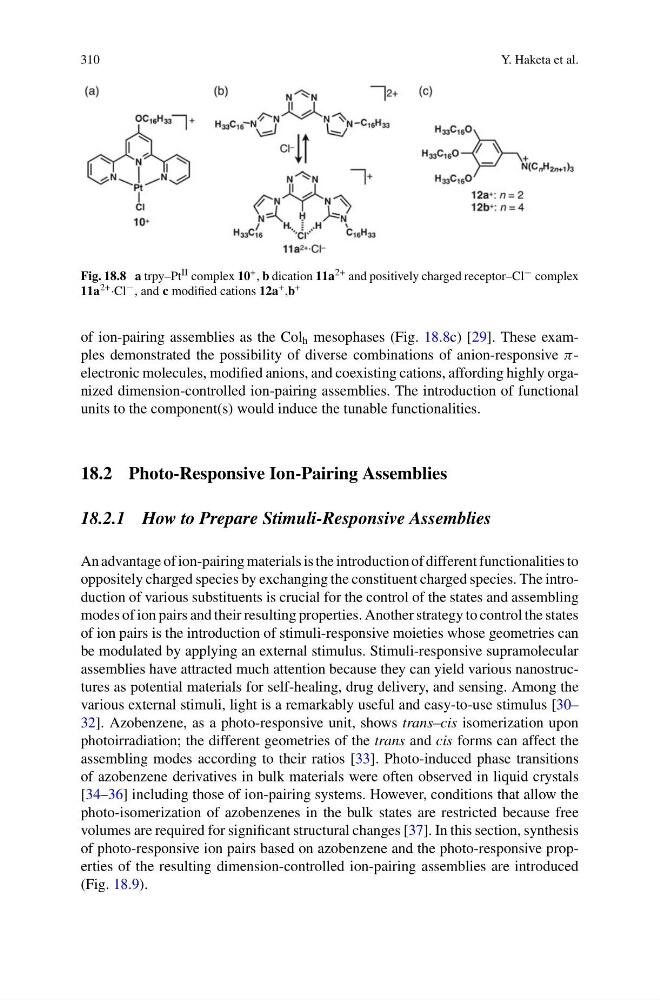
Fig. 18.8 a trpy–Pt II complex 10 + , b dication 11a 2+ and positively charged receptor–Cl − complex
11a 2+ ·Cl − , and c modified cations 12a + ,b +
of ion-pairing assemblies as the Col h mesophases (Fig. 18.8c) [29]. These examples demonstrated the possibility of diverse combinations of anion-responsive πelectronic molecules, modified anions, and coexisting cations, affording highly organized dimension-controlled ion-pairing assemblies. The introduction of functional
units to the component(s) would induce the tunable functionalities.
18.2 Photo-Responsive Ion-Pairing Assemblies
18.2.1 How to Prepare Stimuli-Responsive Assemblies
An advantage of ion-pairing materials is the introduction of different functionalities to
oppositely charged species by exchanging the constituent charged species. The introduction of various substituents is crucial for the control of the states and assembling
modes of ion pairs and their resulting properties. Another strategy to control the states
of ion pairs is the introduction of stimuli-responsive moieties whose geometries can
be modulated by applying an external stimulus. Stimuli-responsive supramolecular
assemblies have attracted much attention because they can yield various nanostructures as potential materials for self-healing, drug delivery, and sensing. Among the
various external stimuli, light is a remarkably useful and easy-to-use stimulus [30–
32]. Azobenzene, as a photo-responsive unit, shows trans–cis isomerization upon
photoirradiation; the different geometries of the trans and cis forms can affect the
assembling modes according to their ratios [33]. Photo-induced phase transitions
of azobenzene derivatives in bulk materials were often observed in liquid crystals
[34–36] including those of ion-pairing systems. However, conditions that allow the
photo-isomerization of azobenzenes in the bulk states are restricted because free
volumes are required for significant structural changes [37]. In this section, synthesis
of photo-responsive ion pairs based on azobenzene and the photo-responsive properties of the resulting dimension-controlled ion-pairing assemblies are introduced
(Fig. 18.9).
Y. Haketa et al.
Fig. 18.8 a trpy–Pt II complex 10 + , b dication 11a 2+ and positively charged receptor–Cl − complex
11a 2+ ·Cl − , and c modified cations 12a + ,b +
of ion-pairing assemblies as the Col h mesophases (Fig. 18.8c) [29]. These examples demonstrated the possibility of diverse combinations of anion-responsive πelectronic molecules, modified anions, and coexisting cations, affording highly organized dimension-controlled ion-pairing assemblies. The introduction of functional
units to the component(s) would induce the tunable functionalities.
18.2 Photo-Responsive Ion-Pairing Assemblies
18.2.1 How to Prepare Stimuli-Responsive Assemblies
An advantage of ion-pairing materials is the introduction of different functionalities to
oppositely charged species by exchanging the constituent charged species. The introduction of various substituents is crucial for the control of the states and assembling
modes of ion pairs and their resulting properties. Another strategy to control the states
of ion pairs is the introduction of stimuli-responsive moieties whose geometries can
be modulated by applying an external stimulus. Stimuli-responsive supramolecular
assemblies have attracted much attention because they can yield various nanostructures as potential materials for self-healing, drug delivery, and sensing. Among the
various external stimuli, light is a remarkably useful and easy-to-use stimulus [30–
32]. Azobenzene, as a photo-responsive unit, shows trans–cis isomerization upon
photoirradiation; the different geometries of the trans and cis forms can affect the
assembling modes according to their ratios [33]. Photo-induced phase transitions
of azobenzene derivatives in bulk materials were often observed in liquid crystals
[34–36] including those of ion-pairing systems. However, conditions that allow the
photo-isomerization of azobenzenes in the bulk states are restricted because free
volumes are required for significant structural changes [37]. In this section, synthesis
of photo-responsive ion pairs based on azobenzene and the photo-responsive properties of the resulting dimension-controlled ion-pairing assemblies are introduced
(Fig. 18.9).