

18 π-Electronic Ion-Pairing Assemblies …
309
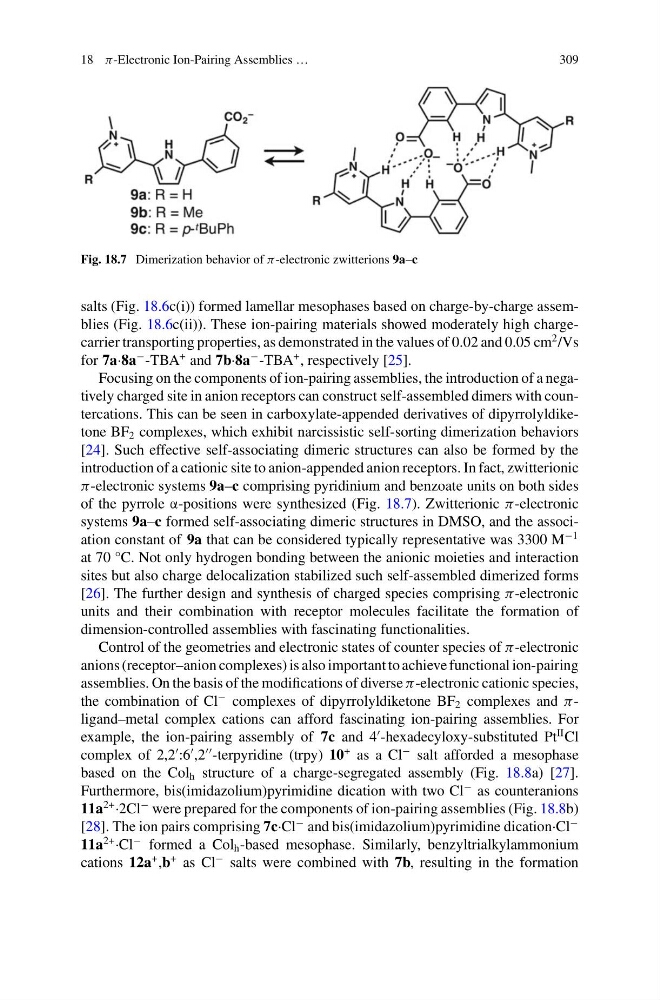
Fig. 18.7 Dimerization behavior of π-electronic zwitterions 9a–c
salts (Fig. 18.6c(i)) formed lamellar mesophases based on charge-by-charge assemblies (Fig. 18.6c(ii)). These ion-pairing materials showed moderately high chargecarrier transporting properties, as demonstrated in the values of 0.02 and 0.05 cm
2 /Vs
for 7a·8a
− -TBA
+ and 7b·8a
− -TBA
+ , respectively [25].
Focusing on the components of ion-pairing assemblies, the introduction of a negatively charged site in anion receptors can construct self-assembled dimers with countercations. This can be seen in carboxylate-appended derivatives of dipyrrolyldiketone BF 2 complexes, which exhibit narcissistic self-sorting dimerization behaviors
[24]. Such effective self-associating dimeric structures can also be formed by the
introduction of a cationic site to anion-appended anion receptors. In fact, zwitterionic
π-electronic systems 9a–c comprising pyridinium and benzoate units on both sides
of the pyrrole α-positions were synthesized (Fig. 18.7). Zwitterionic π-electronic
systems 9a–c formed self-associating dimeric structures in DMSO, and the association constant of 9a that can be considered typically representative was 3300 M
−1
at 70 °C. Not only hydrogen bonding between the anionic moieties and interaction
sites but also charge delocalization stabilized such self-assembled dimerized forms
[26]. The further design and synthesis of charged species comprising π-electronic
units and their combination with receptor molecules facilitate the formation of
dimension-controlled assemblies with fascinating functionalities.
Control of the geometries and electronic states of counter species of π-electronic
anions (receptor–anion complexes) is also important to achieve functional ion-pairing
assemblies. On the basis of the modifications of diverse π-electronic cationic species,
the combination of Cl
− complexes of dipyrrolyldiketone BF 2 complexes and πligand–metal complex cations can afford fascinating ion-pairing assemblies. For
example, the ion-pairing assembly of 7c and 4
-hexadecyloxy-substituted Pt
II Cl
complex of 2,2
:6
,2
-terpyridine (trpy) 10
+ as a Cl
− salt afforded a mesophase
based on the Col h structure of a charge-segregated assembly (Fig. 18.8a) [27].
Furthermore, bis(imidazolium)pyrimidine dication with two Cl
− as counteranions
11a
2+ ·2Cl
− were prepared for the components of ion-pairing assemblies (Fig. 18.8b)
[28]. The ion pairs comprising 7c·Cl
− and bis(imidazolium)pyrimidine dication·Cl
−
11a
2+ ·Cl
− formed a Col h -based mesophase. Similarly, benzyltrialkylammonium
cations 12a
+ ,b
+ as Cl
− salts were combined with 7b, resulting in the formation
309
Fig. 18.7 Dimerization behavior of π-electronic zwitterions 9a–c
salts (Fig. 18.6c(i)) formed lamellar mesophases based on charge-by-charge assemblies (Fig. 18.6c(ii)). These ion-pairing materials showed moderately high chargecarrier transporting properties, as demonstrated in the values of 0.02 and 0.05 cm
2 /Vs
for 7a·8a
− -TBA
+ and 7b·8a
− -TBA
+ , respectively [25].
Focusing on the components of ion-pairing assemblies, the introduction of a negatively charged site in anion receptors can construct self-assembled dimers with countercations. This can be seen in carboxylate-appended derivatives of dipyrrolyldiketone BF 2 complexes, which exhibit narcissistic self-sorting dimerization behaviors
[24]. Such effective self-associating dimeric structures can also be formed by the
introduction of a cationic site to anion-appended anion receptors. In fact, zwitterionic
π-electronic systems 9a–c comprising pyridinium and benzoate units on both sides
of the pyrrole α-positions were synthesized (Fig. 18.7). Zwitterionic π-electronic
systems 9a–c formed self-associating dimeric structures in DMSO, and the association constant of 9a that can be considered typically representative was 3300 M
−1
at 70 °C. Not only hydrogen bonding between the anionic moieties and interaction
sites but also charge delocalization stabilized such self-assembled dimerized forms
[26]. The further design and synthesis of charged species comprising π-electronic
units and their combination with receptor molecules facilitate the formation of
dimension-controlled assemblies with fascinating functionalities.
Control of the geometries and electronic states of counter species of π-electronic
anions (receptor–anion complexes) is also important to achieve functional ion-pairing
assemblies. On the basis of the modifications of diverse π-electronic cationic species,
the combination of Cl
− complexes of dipyrrolyldiketone BF 2 complexes and πligand–metal complex cations can afford fascinating ion-pairing assemblies. For
example, the ion-pairing assembly of 7c and 4
-hexadecyloxy-substituted Pt
II Cl
complex of 2,2
:6
,2
-terpyridine (trpy) 10
+ as a Cl
− salt afforded a mesophase
based on the Col h structure of a charge-segregated assembly (Fig. 18.8a) [27].
Furthermore, bis(imidazolium)pyrimidine dication with two Cl
− as counteranions
11a
2+ ·2Cl
− were prepared for the components of ion-pairing assemblies (Fig. 18.8b)
[28]. The ion pairs comprising 7c·Cl
− and bis(imidazolium)pyrimidine dication·Cl
−
11a
2+ ·Cl
− formed a Col h -based mesophase. Similarly, benzyltrialkylammonium
cations 12a
+ ,b
+ as Cl
− salts were combined with 7b, resulting in the formation