

18 π-Electronic Ion-Pairing Assemblies …
311
Fig. 18.9 Conceptual
diagram of ion-pairing
assemblies based on
photo-responsive ions and
their photo-responsive
properties. The combination
of various photo-responsive
anions and countercations
can control the assembled
structures and resulting
properties
18.2.2 Design and Synthesis of Photo-Responsive Ion Pairs
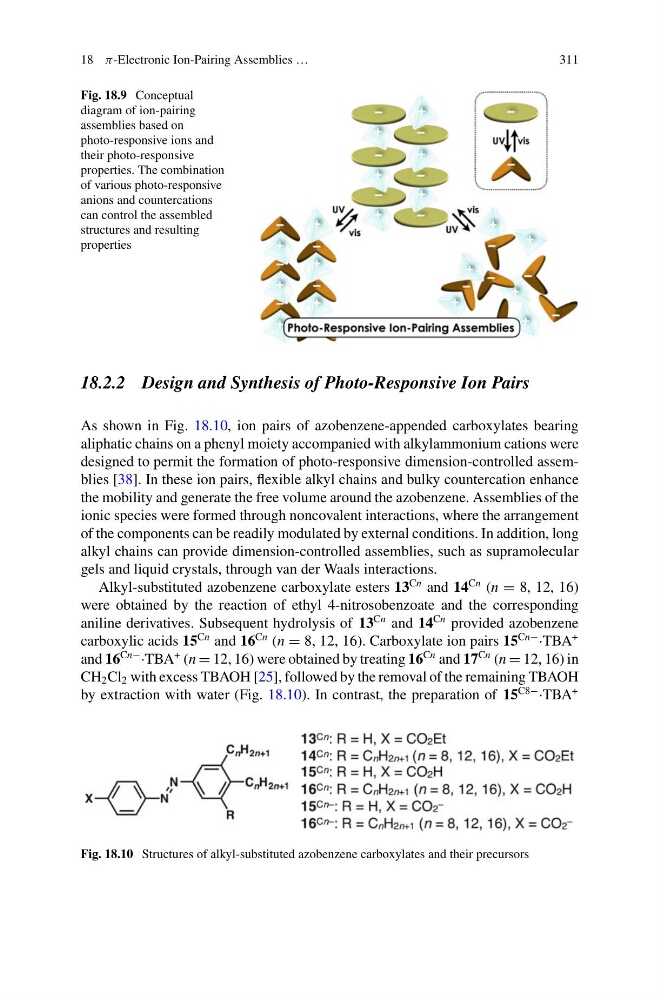
As shown in Fig. 18.10, ion pairs of azobenzene-appended carboxylates bearing
aliphatic chains on a phenyl moiety accompanied with alkylammonium cations were
designed to permit the formation of photo-responsive dimension-controlled assemblies [38]. In these ion pairs, flexible alkyl chains and bulky countercation enhance
the mobility and generate the free volume around the azobenzene. Assemblies of the
ionic species were formed through noncovalent interactions, where the arrangement
of the components can be readily modulated by external conditions. In addition, long
alkyl chains can provide dimension-controlled assemblies, such as supramolecular
gels and liquid crystals, through van der Waals interactions.
Alkyl-substituted azobenzene carboxylate esters 13
Cn and 14
Cn (n = 8, 12, 16)
were obtained by the reaction of ethyl 4-nitrosobenzoate and the corresponding
aniline derivatives. Subsequent hydrolysis of 13
Cn and 14
Cn provided azobenzene
carboxylic acids 15
Cn and 16
Cn (n = 8, 12, 16). Carboxylate ion pairs 15
Cn− ·TBA
+
and 16
Cn− ·TBA
+ (n = 12, 16) were obtained by treating 16
Cn and 17
Cn (n = 12, 16) in
CH 2 Cl 2 with excess TBAOH [25], followed by the removal of the remaining TBAOH
by extraction with water (Fig. 18.10). In contrast, the preparation of 15
C8− ·TBA
+
Fig. 18.10 Structures of alkyl-substituted azobenzene carboxylates and their precursors
311
Fig. 18.9 Conceptual
diagram of ion-pairing
assemblies based on
photo-responsive ions and
their photo-responsive
properties. The combination
of various photo-responsive
anions and countercations
can control the assembled
structures and resulting
properties
18.2.2 Design and Synthesis of Photo-Responsive Ion Pairs
As shown in Fig. 18.10, ion pairs of azobenzene-appended carboxylates bearing
aliphatic chains on a phenyl moiety accompanied with alkylammonium cations were
designed to permit the formation of photo-responsive dimension-controlled assemblies [38]. In these ion pairs, flexible alkyl chains and bulky countercation enhance
the mobility and generate the free volume around the azobenzene. Assemblies of the
ionic species were formed through noncovalent interactions, where the arrangement
of the components can be readily modulated by external conditions. In addition, long
alkyl chains can provide dimension-controlled assemblies, such as supramolecular
gels and liquid crystals, through van der Waals interactions.
Alkyl-substituted azobenzene carboxylate esters 13
Cn and 14
Cn (n = 8, 12, 16)
were obtained by the reaction of ethyl 4-nitrosobenzoate and the corresponding
aniline derivatives. Subsequent hydrolysis of 13
Cn and 14
Cn provided azobenzene
carboxylic acids 15
Cn and 16
Cn (n = 8, 12, 16). Carboxylate ion pairs 15
Cn− ·TBA
+
and 16
Cn− ·TBA
+ (n = 12, 16) were obtained by treating 16
Cn and 17
Cn (n = 12, 16) in
CH 2 Cl 2 with excess TBAOH [25], followed by the removal of the remaining TBAOH
by extraction with water (Fig. 18.10). In contrast, the preparation of 15
C8− ·TBA
+
Fig. 18.10 Structures of alkyl-substituted azobenzene carboxylates and their precursors