

18 π-Electronic Ion-Pairing Assemblies …
305
chains 3c
− -TBA
+ formed a liquid crystal mesophase of the Col h structure, as
observed by POM (Fig. 18.3b(ii)) [13]. The deprotonation of pyrrole NH unit of
appropriately designed pyrrole-based π-electronic systems can also provide corresponding anionic species accompanied by countercations. For example, deprotonation of single NH of dipyrrolylquinoxalines (DPQ) by TBAOH resulted in the
formation of ion pairs of anionic DPQ
− and TBA
+ . DPQ
− -TBA
+ showed a chargeby-charge columnar assembly, as revealed by single-crystal X-ray analysis, whereas
the ion pair of aliphatic DPQ
− and TBA
+ formed n-octane gel (10 mg/mL) based on
the organized fibril morphologies [14].
Larger π-electronic molecules with an acid unit can provide stable anionic species
owing to the more effective delocalization of the negative charge in the π-electronic
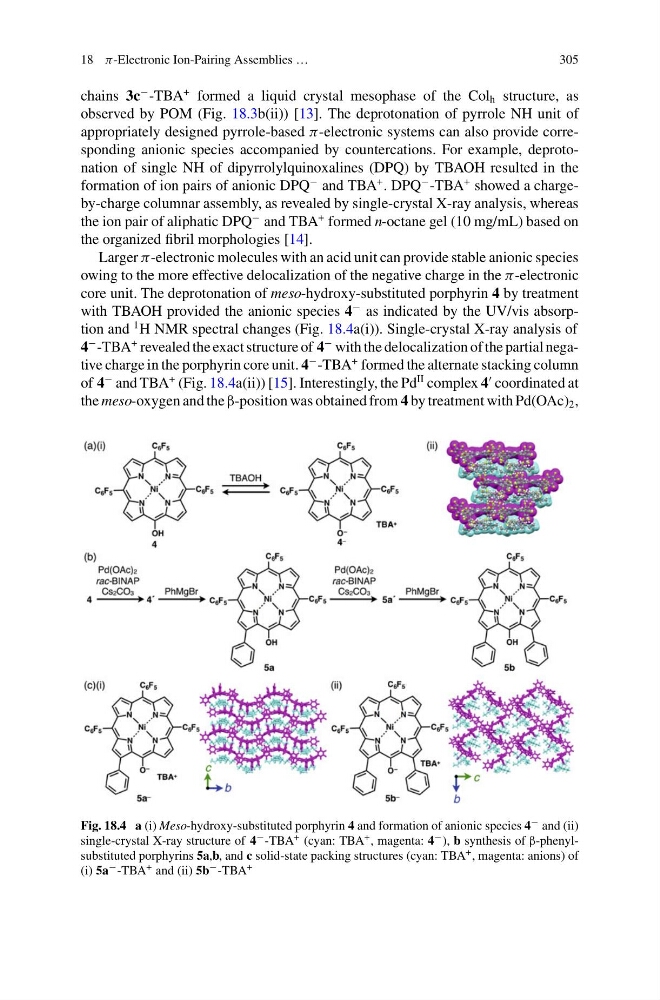
core unit. The deprotonation of meso-hydroxy-substituted porphyrin 4 by treatment
with TBAOH provided the anionic species 4
− as indicated by the UV/vis absorption and
1 H NMR spectral changes (Fig. 18.4a(i)). Single-crystal X-ray analysis of
4
− -TBA
+ revealed the exact structure of 4
− with the delocalization of the partial negative charge in the porphyrin core unit. 4
− -TBA
+ formed the alternate stacking column
of 4
− and TBA
+ (Fig. 18.4a(ii)) [15]. Interestingly, the Pd
II complex 4
coordinated at
the meso-oxygen and the β-position was obtained from 4 by treatment with Pd(OAc) 2 ,
Fig. 18.4 a (i) Meso-hydroxy-substituted porphyrin 4 and formation of anionic species 4 − and (ii)
single-crystal X-ray structure of 4 − -TBA + (cyan: TBA + , magenta: 4 − ), b synthesis of β-phenylsubstituted porphyrins 5a,b, and c solid-state packing structures (cyan: TBA + , magenta: anions) of
(i) 5a − -TBA + and (ii) 5b − -TBA +
305
chains 3c
− -TBA
+ formed a liquid crystal mesophase of the Col h structure, as
observed by POM (Fig. 18.3b(ii)) [13]. The deprotonation of pyrrole NH unit of
appropriately designed pyrrole-based π-electronic systems can also provide corresponding anionic species accompanied by countercations. For example, deprotonation of single NH of dipyrrolylquinoxalines (DPQ) by TBAOH resulted in the
formation of ion pairs of anionic DPQ
− and TBA
+ . DPQ
− -TBA
+ showed a chargeby-charge columnar assembly, as revealed by single-crystal X-ray analysis, whereas
the ion pair of aliphatic DPQ
− and TBA
+ formed n-octane gel (10 mg/mL) based on
the organized fibril morphologies [14].
Larger π-electronic molecules with an acid unit can provide stable anionic species
owing to the more effective delocalization of the negative charge in the π-electronic
core unit. The deprotonation of meso-hydroxy-substituted porphyrin 4 by treatment
with TBAOH provided the anionic species 4
− as indicated by the UV/vis absorption and
1 H NMR spectral changes (Fig. 18.4a(i)). Single-crystal X-ray analysis of
4
− -TBA
+ revealed the exact structure of 4
− with the delocalization of the partial negative charge in the porphyrin core unit. 4
− -TBA
+ formed the alternate stacking column
of 4
− and TBA
+ (Fig. 18.4a(ii)) [15]. Interestingly, the Pd
II complex 4
coordinated at
the meso-oxygen and the β-position was obtained from 4 by treatment with Pd(OAc) 2 ,
Fig. 18.4 a (i) Meso-hydroxy-substituted porphyrin 4 and formation of anionic species 4 − and (ii)
single-crystal X-ray structure of 4 − -TBA + (cyan: TBA + , magenta: 4 − ), b synthesis of β-phenylsubstituted porphyrins 5a,b, and c solid-state packing structures (cyan: TBA + , magenta: anions) of
(i) 5a − -TBA + and (ii) 5b − -TBA +