

306
Y. Haketa et al.
rac-BINAP, and Cs 2 CO 3 (Fig. 18.4b) [16]. The coupling reaction of 5b
with PhMgBr
afforded the β-phenyl-substituted porphyrin 5a. Subsequently, by similar procedures, 5a was converted to β-diphenyl-substituted 5b via the Pd
II complex 5b
.
Deprotonation of the OH unit of 5a,b by TBAOH provided the π-electronic anions
5a
− ,b
− . The ion pairs 5a
− ,b
− -TBA
+ formed charge-by-charge assemblies in the
solid-state as elucidated by single-crystal X-ray analysis (Fig. 18.4c) [16]. The introduction of more effectively hydrogen-bonding aryl moieties would stabilize anionic
O-appended π-electronic species.
Metal complexes using π-electronic ligands that partially compensate for the positive charges of metal ions can also be used as planar π-electronic charged species.
As Au
III is a d
8 state, which forms square-planar complexes with suitable ligand
species, Au
III complexes of porphyrins are π-electronic cationic species that require
no axial ligand coordination. In fact, a variety of porphyrin–Au
III complexes (e.g.,
6a
+ ,b
+ ) were prepared as ion pairs in combination with counteranions such as BF 4
− ,
PF 6
− , 1
− , and 4
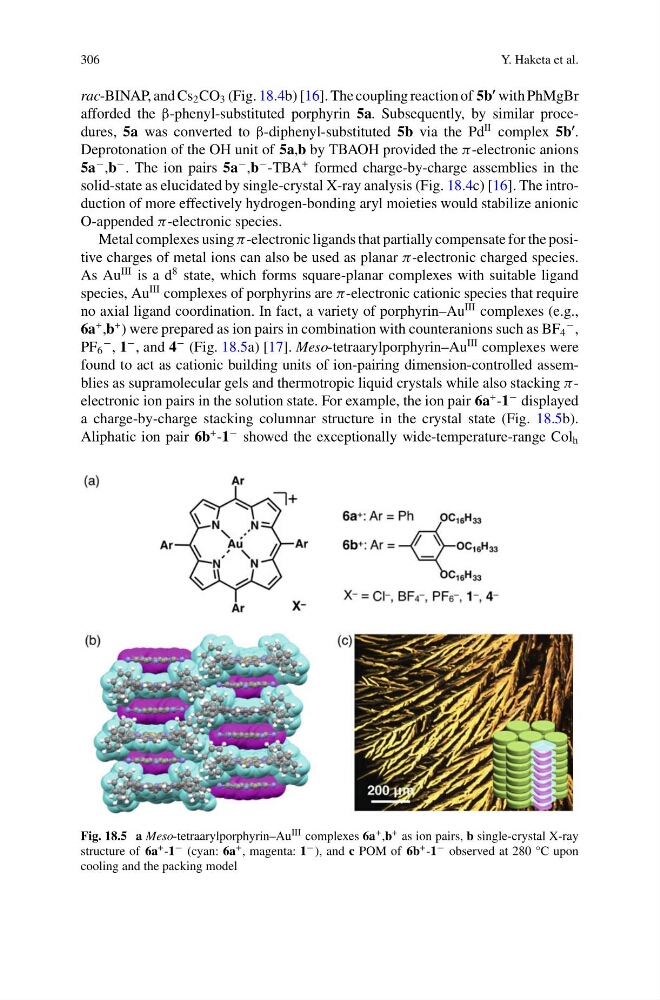
− (Fig. 18.5a) [17]. Meso-tetraarylporphyrin–Au
III complexes were
found to act as cationic building units of ion-pairing dimension-controlled assemblies as supramolecular gels and thermotropic liquid crystals while also stacking πelectronic ion pairs in the solution state. For example, the ion pair 6a
+ -1
− displayed
a charge-by-charge stacking columnar structure in the crystal state (Fig. 18.5b).
Aliphatic ion pair 6b
+ -1
− showed the exceptionally wide-temperature-range Col h
Fig. 18.5 a Meso-tetraarylporphyrin–Au III complexes 6a + ,b + as ion pairs, b single-crystal X-ray
structure of 6a + -1 − (cyan: 6a + , magenta: 1 − ), and c POM of 6b + -1 − observed at 280 °C upon
cooling and the packing model
Y. Haketa et al.
rac-BINAP, and Cs 2 CO 3 (Fig. 18.4b) [16]. The coupling reaction of 5b
with PhMgBr
afforded the β-phenyl-substituted porphyrin 5a. Subsequently, by similar procedures, 5a was converted to β-diphenyl-substituted 5b via the Pd
II complex 5b
.
Deprotonation of the OH unit of 5a,b by TBAOH provided the π-electronic anions
5a
− ,b
− . The ion pairs 5a
− ,b
− -TBA
+ formed charge-by-charge assemblies in the
solid-state as elucidated by single-crystal X-ray analysis (Fig. 18.4c) [16]. The introduction of more effectively hydrogen-bonding aryl moieties would stabilize anionic
O-appended π-electronic species.
Metal complexes using π-electronic ligands that partially compensate for the positive charges of metal ions can also be used as planar π-electronic charged species.
As Au
III is a d
8 state, which forms square-planar complexes with suitable ligand
species, Au
III complexes of porphyrins are π-electronic cationic species that require
no axial ligand coordination. In fact, a variety of porphyrin–Au
III complexes (e.g.,
6a
+ ,b
+ ) were prepared as ion pairs in combination with counteranions such as BF 4
− ,
PF 6
− , 1
− , and 4
− (Fig. 18.5a) [17]. Meso-tetraarylporphyrin–Au
III complexes were
found to act as cationic building units of ion-pairing dimension-controlled assemblies as supramolecular gels and thermotropic liquid crystals while also stacking πelectronic ion pairs in the solution state. For example, the ion pair 6a
+ -1
− displayed
a charge-by-charge stacking columnar structure in the crystal state (Fig. 18.5b).
Aliphatic ion pair 6b
+ -1
− showed the exceptionally wide-temperature-range Col h
Fig. 18.5 a Meso-tetraarylporphyrin–Au III complexes 6a + ,b + as ion pairs, b single-crystal X-ray
structure of 6a + -1 − (cyan: 6a + , magenta: 1 − ), and c POM of 6b + -1 − observed at 280 °C upon
cooling and the packing model