

304
Y. Haketa et al.
1
− -(C 12 H 25 ) 3 CH 3 N
+ showed a hole-transporting property (0.4 cm
2 /Vs) in the film
prepared by the drop-casting of a CHCl 3 solution [11].
π-Electronic anions are less stable than π-electronic cations because the excess
electrons in the anions induce oxidation and result in decomposition. On the other
hand, the deprotonation of the acid unit introduced in the appropriate π-electronic
molecules affords anion-appended π-electronic species. For example, the deprotonation of carboxy and hydroxy units provides corresponding anions with accompanying
countercations. The partial negative charges can be delocalized in the π-electronic
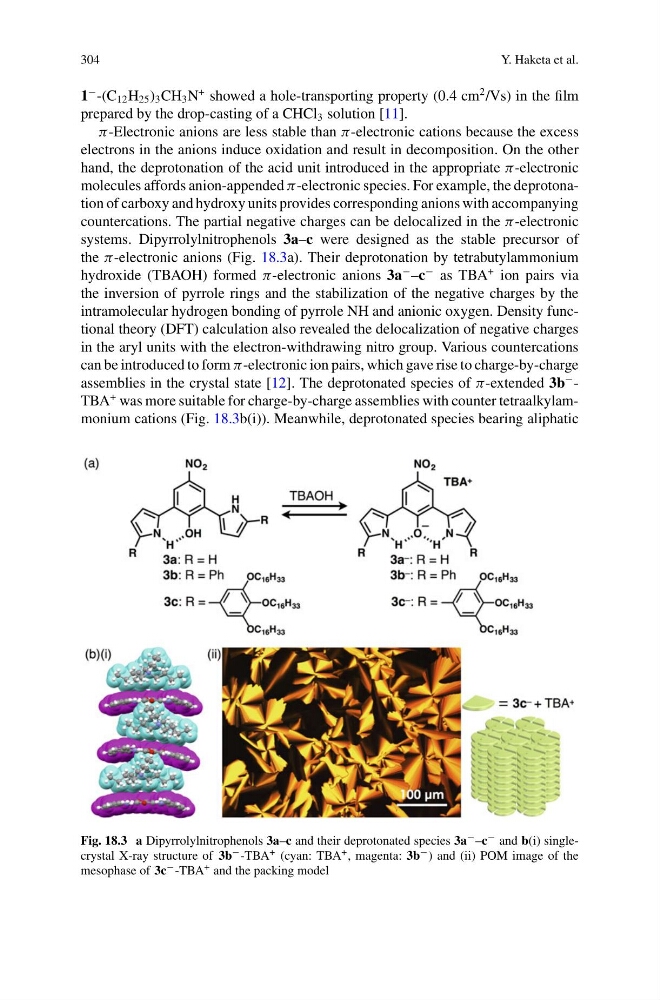
systems. Dipyrrolylnitrophenols 3a–c were designed as the stable precursor of
the π-electronic anions (Fig. 18.3a). Their deprotonation by tetrabutylammonium
hydroxide (TBAOH) formed π-electronic anions 3a
− –c
− as TBA
+ ion pairs via
the inversion of pyrrole rings and the stabilization of the negative charges by the
intramolecular hydrogen bonding of pyrrole NH and anionic oxygen. Density functional theory (DFT) calculation also revealed the delocalization of negative charges
in the aryl units with the electron-withdrawing nitro group. Various countercations
can be introduced to form π-electronic ion pairs, which gave rise to charge-by-charge
assemblies in the crystal state [12]. The deprotonated species of π-extended 3b
− -
TBA
+ was more suitable for charge-by-charge assemblies with counter tetraalkylammonium cations (Fig. 18.3b(i)). Meanwhile, deprotonated species bearing aliphatic
Fig. 18.3 a Dipyrrolylnitrophenols 3a–c and their deprotonated species 3a − –c − and b(i) singlecrystal X-ray structure of 3b − -TBA + (cyan: TBA + , magenta: 3b − ) and (ii) POM image of the
mesophase of 3c − -TBA + and the packing model
Y. Haketa et al.
1
− -(C 12 H 25 ) 3 CH 3 N
+ showed a hole-transporting property (0.4 cm
2 /Vs) in the film
prepared by the drop-casting of a CHCl 3 solution [11].
π-Electronic anions are less stable than π-electronic cations because the excess
electrons in the anions induce oxidation and result in decomposition. On the other
hand, the deprotonation of the acid unit introduced in the appropriate π-electronic
molecules affords anion-appended π-electronic species. For example, the deprotonation of carboxy and hydroxy units provides corresponding anions with accompanying
countercations. The partial negative charges can be delocalized in the π-electronic
systems. Dipyrrolylnitrophenols 3a–c were designed as the stable precursor of
the π-electronic anions (Fig. 18.3a). Their deprotonation by tetrabutylammonium
hydroxide (TBAOH) formed π-electronic anions 3a
− –c
− as TBA
+ ion pairs via
the inversion of pyrrole rings and the stabilization of the negative charges by the
intramolecular hydrogen bonding of pyrrole NH and anionic oxygen. Density functional theory (DFT) calculation also revealed the delocalization of negative charges
in the aryl units with the electron-withdrawing nitro group. Various countercations
can be introduced to form π-electronic ion pairs, which gave rise to charge-by-charge
assemblies in the crystal state [12]. The deprotonated species of π-extended 3b
− -
TBA
+ was more suitable for charge-by-charge assemblies with counter tetraalkylammonium cations (Fig. 18.3b(i)). Meanwhile, deprotonated species bearing aliphatic
Fig. 18.3 a Dipyrrolylnitrophenols 3a–c and their deprotonated species 3a − –c − and b(i) singlecrystal X-ray structure of 3b − -TBA + (cyan: TBA + , magenta: 3b − ) and (ii) POM image of the
mesophase of 3c − -TBA + and the packing model