

18 π-Electronic Ion-Pairing Assemblies …
303
the assembling behaviors of photo-responsive π-electronic ion pairs are discussed.
Finally, the excited-state dynamics of chiral pyrrole-based π-system–Pt
II complexes
are explained.
18.1.2 Ion-Pairing Assemblies Based on π-Electronic Ions
π-Electronic ions that have planar geometries (genuine π-electronic ions) and exhibit
various characteristic electronic properties are suitable for ordered stacking structures owing to the effective electrostatic interaction of charged aromatic cores. Thus,
π-electronic ion pairs and their ion-pairing assemblies have been well investigated.
In this section, a brief summary of several recent advances is provided followed
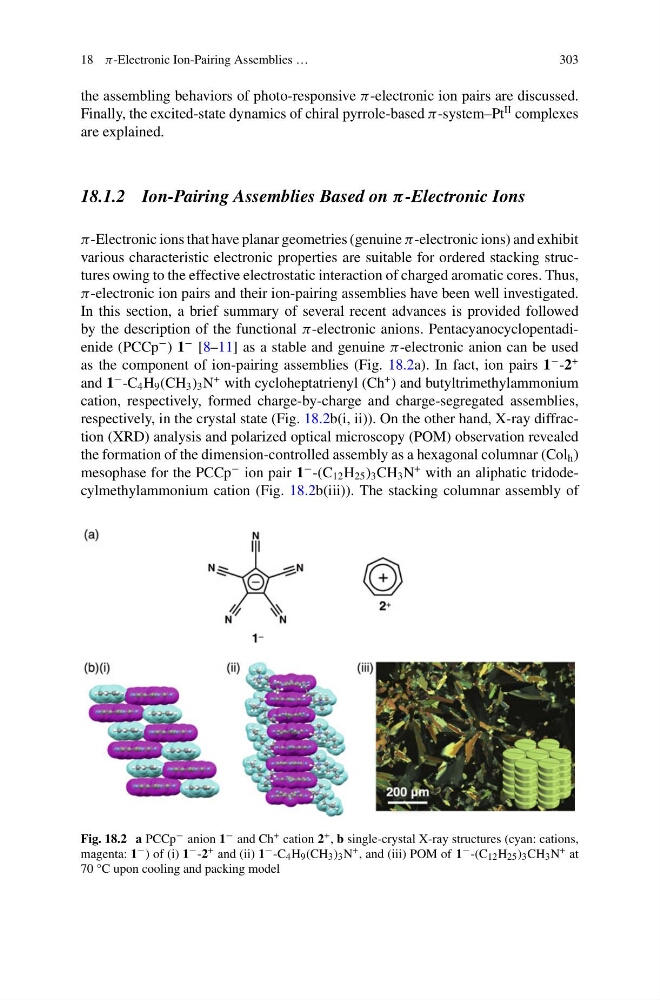
by the description of the functional π-electronic anions. Pentacyanocyclopentadienide (PCCp
− ) 1
− [8–11] as a stable and genuine π-electronic anion can be used
as the component of ion-pairing assemblies (Fig. 18.2a). In fact, ion pairs 1
− -2
+
and 1
− -C 4 H 9 (CH 3 ) 3 N
+ with cycloheptatrienyl (Ch
+ ) and butyltrimethylammonium
cation, respectively, formed charge-by-charge and charge-segregated assemblies,
respectively, in the crystal state (Fig. 18.2b(i, ii)). On the other hand, X-ray diffraction (XRD) analysis and polarized optical microscopy (POM) observation revealed
the formation of the dimension-controlled assembly as a hexagonal columnar (Col h )
mesophase for the PCCp
− ion pair 1
− -(C 12 H 25 ) 3 CH 3 N
+ with an aliphatic tridodecylmethylammonium cation (Fig. 18.2b(iii)). The stacking columnar assembly of
Fig. 18.2 a PCCp − anion 1 − and Ch + cation 2 + , b single-crystal X-ray structures (cyan: cations,
magenta: 1 − ) of (i) 1 − -2 + and (ii) 1 − -C 4 H 9 (CH 3 ) 3 N + , and (iii) POM of 1 − -(C 12 H 25 ) 3 CH 3 N + at
70 °C upon cooling and packing model
303
the assembling behaviors of photo-responsive π-electronic ion pairs are discussed.
Finally, the excited-state dynamics of chiral pyrrole-based π-system–Pt
II complexes
are explained.
18.1.2 Ion-Pairing Assemblies Based on π-Electronic Ions
π-Electronic ions that have planar geometries (genuine π-electronic ions) and exhibit
various characteristic electronic properties are suitable for ordered stacking structures owing to the effective electrostatic interaction of charged aromatic cores. Thus,
π-electronic ion pairs and their ion-pairing assemblies have been well investigated.
In this section, a brief summary of several recent advances is provided followed
by the description of the functional π-electronic anions. Pentacyanocyclopentadienide (PCCp
− ) 1
− [8–11] as a stable and genuine π-electronic anion can be used
as the component of ion-pairing assemblies (Fig. 18.2a). In fact, ion pairs 1
− -2
+
and 1
− -C 4 H 9 (CH 3 ) 3 N
+ with cycloheptatrienyl (Ch
+ ) and butyltrimethylammonium
cation, respectively, formed charge-by-charge and charge-segregated assemblies,
respectively, in the crystal state (Fig. 18.2b(i, ii)). On the other hand, X-ray diffraction (XRD) analysis and polarized optical microscopy (POM) observation revealed
the formation of the dimension-controlled assembly as a hexagonal columnar (Col h )
mesophase for the PCCp
− ion pair 1
− -(C 12 H 25 ) 3 CH 3 N
+ with an aliphatic tridodecylmethylammonium cation (Fig. 18.2b(iii)). The stacking columnar assembly of
Fig. 18.2 a PCCp − anion 1 − and Ch + cation 2 + , b single-crystal X-ray structures (cyan: cations,
magenta: 1 − ) of (i) 1 − -2 + and (ii) 1 − -C 4 H 9 (CH 3 ) 3 N + , and (iii) POM of 1 − -(C 12 H 25 ) 3 CH 3 N + at
70 °C upon cooling and packing model