

302
Y. Haketa et al.
assemble through electrostatic interaction with other noncovalent interactions, fabricating electronically and optically functional dimension-controlled assemblies (e.g.,
soft crystalline materials, gels, liquid crystals, etc.) [3–7]. Appropriately designed
π-electronic ion pairs with suitable geometries and electronic states result in their
ordered arrangement and diverse packing modes. As the key concept of ion-pairing
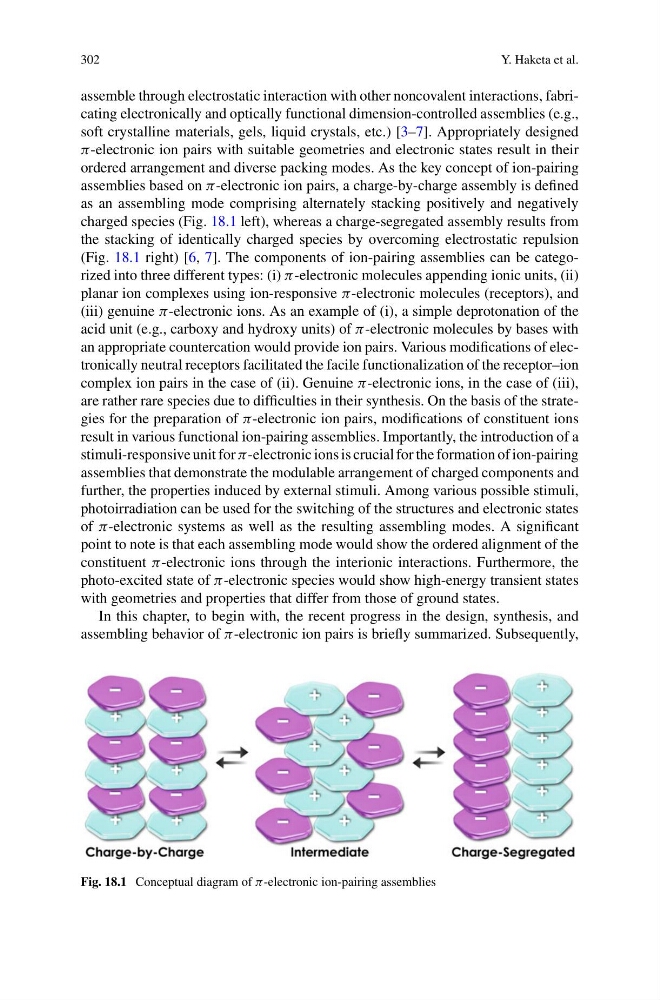
assemblies based on π-electronic ion pairs, a charge-by-charge assembly is defined
as an assembling mode comprising alternately stacking positively and negatively
charged species (Fig. 18.1 left), whereas a charge-segregated assembly results from
the stacking of identically charged species by overcoming electrostatic repulsion
(Fig. 18.1 right) [6, 7]. The components of ion-pairing assemblies can be categorized into three different types: (i) π-electronic molecules appending ionic units, (ii)
planar ion complexes using ion-responsive π-electronic molecules (receptors), and
(iii) genuine π-electronic ions. As an example of (i), a simple deprotonation of the
acid unit (e.g., carboxy and hydroxy units) of π-electronic molecules by bases with
an appropriate countercation would provide ion pairs. Various modifications of electronically neutral receptors facilitated the facile functionalization of the receptor–ion
complex ion pairs in the case of (ii). Genuine π-electronic ions, in the case of (iii),
are rather rare species due to difficulties in their synthesis. On the basis of the strategies for the preparation of π-electronic ion pairs, modifications of constituent ions
result in various functional ion-pairing assemblies. Importantly, the introduction of a
stimuli-responsive unit for π-electronic ions is crucial for the formation of ion-pairing
assemblies that demonstrate the modulable arrangement of charged components and
further, the properties induced by external stimuli. Among various possible stimuli,
photoirradiation can be used for the switching of the structures and electronic states
of π-electronic systems as well as the resulting assembling modes. A significant
point to note is that each assembling mode would show the ordered alignment of the
constituent π-electronic ions through the interionic interactions. Furthermore, the
photo-excited state of π-electronic species would show high-energy transient states
with geometries and properties that differ from those of ground states.
In this chapter, to begin with, the recent progress in the design, synthesis, and
assembling behavior of π-electronic ion pairs is briefly summarized. Subsequently,
Fig. 18.1 Conceptual diagram of π-electronic ion-pairing assemblies
Y. Haketa et al.
assemble through electrostatic interaction with other noncovalent interactions, fabricating electronically and optically functional dimension-controlled assemblies (e.g.,
soft crystalline materials, gels, liquid crystals, etc.) [3–7]. Appropriately designed
π-electronic ion pairs with suitable geometries and electronic states result in their
ordered arrangement and diverse packing modes. As the key concept of ion-pairing
assemblies based on π-electronic ion pairs, a charge-by-charge assembly is defined
as an assembling mode comprising alternately stacking positively and negatively
charged species (Fig. 18.1 left), whereas a charge-segregated assembly results from
the stacking of identically charged species by overcoming electrostatic repulsion
(Fig. 18.1 right) [6, 7]. The components of ion-pairing assemblies can be categorized into three different types: (i) π-electronic molecules appending ionic units, (ii)
planar ion complexes using ion-responsive π-electronic molecules (receptors), and
(iii) genuine π-electronic ions. As an example of (i), a simple deprotonation of the
acid unit (e.g., carboxy and hydroxy units) of π-electronic molecules by bases with
an appropriate countercation would provide ion pairs. Various modifications of electronically neutral receptors facilitated the facile functionalization of the receptor–ion
complex ion pairs in the case of (ii). Genuine π-electronic ions, in the case of (iii),
are rather rare species due to difficulties in their synthesis. On the basis of the strategies for the preparation of π-electronic ion pairs, modifications of constituent ions
result in various functional ion-pairing assemblies. Importantly, the introduction of a
stimuli-responsive unit for π-electronic ions is crucial for the formation of ion-pairing
assemblies that demonstrate the modulable arrangement of charged components and
further, the properties induced by external stimuli. Among various possible stimuli,
photoirradiation can be used for the switching of the structures and electronic states
of π-electronic systems as well as the resulting assembling modes. A significant
point to note is that each assembling mode would show the ordered alignment of the
constituent π-electronic ions through the interionic interactions. Furthermore, the
photo-excited state of π-electronic species would show high-energy transient states
with geometries and properties that differ from those of ground states.
In this chapter, to begin with, the recent progress in the design, synthesis, and
assembling behavior of π-electronic ion pairs is briefly summarized. Subsequently,
Fig. 18.1 Conceptual diagram of π-electronic ion-pairing assemblies