

290
T. Mori
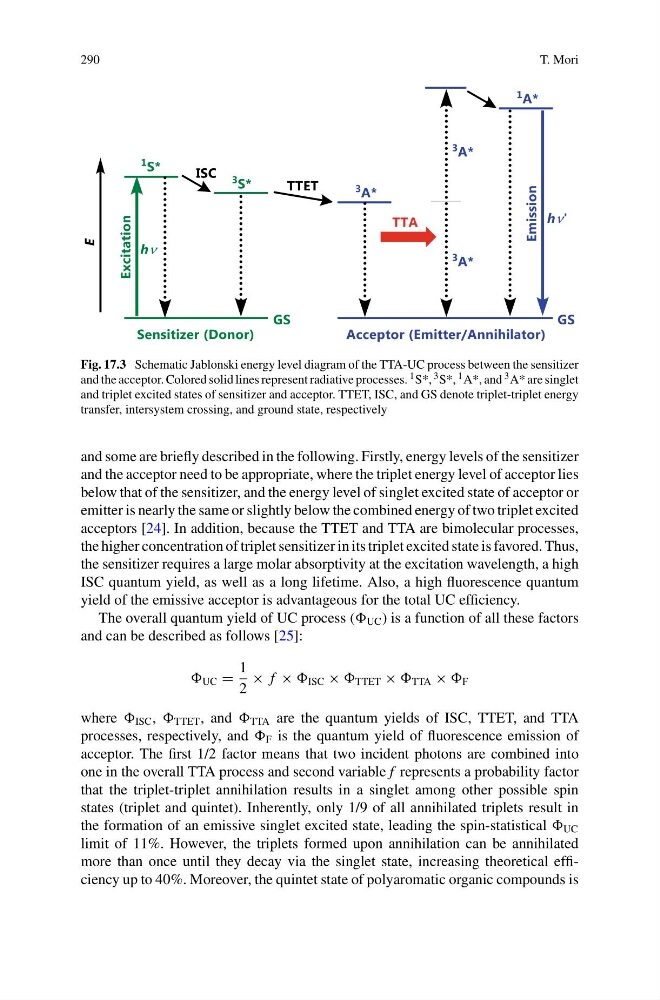
Fig. 17.3 Schematic Jablonski energy level diagram of the TTA-UC process between the sensitizer
and the acceptor. Colored solid lines represent radiative processes. 1 S*, 3 S*, 1 A*, and 3 A* are singlet
and triplet excited states of sensitizer and acceptor. TTET, ISC, and GS denote triplet-triplet energy
transfer, intersystem crossing, and ground state, respectively
and some are briefly described in the following. Firstly, energy levels of the sensitizer
and the acceptor need to be appropriate, where the triplet energy level of acceptor lies
below that of the sensitizer, and the energy level of singlet excited state of acceptor or
emitter is nearly the same or slightly below the combined energy of two triplet excited
acceptors [24]. In addition, because the TTET and TTA are bimolecular processes,
the higher concentration of triplet sensitizer in its triplet excited state is favored. Thus,
the sensitizer requires a large molar absorptivity at the excitation wavelength, a high
ISC quantum yield, as well as a long lifetime. Also, a high fluorescence quantum
yield of the emissive acceptor is advantageous for the total UC efficiency.
The overall quantum yield of UC process ( UC ) is a function of all these factors
and can be described as follows [25]:
UC =
1
2
× f × ISC × TTET × TTA × F
where ISC , TTET , and TTA are the quantum yields of ISC, TTET, and TTA
processes, respectively, and F is the quantum yield of fluorescence emission of
acceptor. The first 1/2 factor means that two incident photons are combined into
one in the overall TTA process and second variable f represents a probability factor
that the triplet-triplet annihilation results in a singlet among other possible spin
states (triplet and quintet). Inherently, only 1/9 of all annihilated triplets result in
the formation of an emissive singlet excited state, leading the spin-statistical UC
limit of 11%. However, the triplets formed upon annihilation can be annihilated
more than once until they decay via the singlet state, increasing theoretical efficiency up to 40%. Moreover, the quintet state of polyaromatic organic compounds is
T. Mori
Fig. 17.3 Schematic Jablonski energy level diagram of the TTA-UC process between the sensitizer
and the acceptor. Colored solid lines represent radiative processes. 1 S*, 3 S*, 1 A*, and 3 A* are singlet
and triplet excited states of sensitizer and acceptor. TTET, ISC, and GS denote triplet-triplet energy
transfer, intersystem crossing, and ground state, respectively
and some are briefly described in the following. Firstly, energy levels of the sensitizer
and the acceptor need to be appropriate, where the triplet energy level of acceptor lies
below that of the sensitizer, and the energy level of singlet excited state of acceptor or
emitter is nearly the same or slightly below the combined energy of two triplet excited
acceptors [24]. In addition, because the TTET and TTA are bimolecular processes,
the higher concentration of triplet sensitizer in its triplet excited state is favored. Thus,
the sensitizer requires a large molar absorptivity at the excitation wavelength, a high
ISC quantum yield, as well as a long lifetime. Also, a high fluorescence quantum
yield of the emissive acceptor is advantageous for the total UC efficiency.
The overall quantum yield of UC process ( UC ) is a function of all these factors
and can be described as follows [25]:
UC =
1
2
× f × ISC × TTET × TTA × F
where ISC , TTET , and TTA are the quantum yields of ISC, TTET, and TTA
processes, respectively, and F is the quantum yield of fluorescence emission of
acceptor. The first 1/2 factor means that two incident photons are combined into
one in the overall TTA process and second variable f represents a probability factor
that the triplet-triplet annihilation results in a singlet among other possible spin
states (triplet and quintet). Inherently, only 1/9 of all annihilated triplets result in
the formation of an emissive singlet excited state, leading the spin-statistical UC
limit of 11%. However, the triplets formed upon annihilation can be annihilated
more than once until they decay via the singlet state, increasing theoretical efficiency up to 40%. Moreover, the quintet state of polyaromatic organic compounds is