

17 Synergetic Photon Upconversion Realized by a Controlled …
289
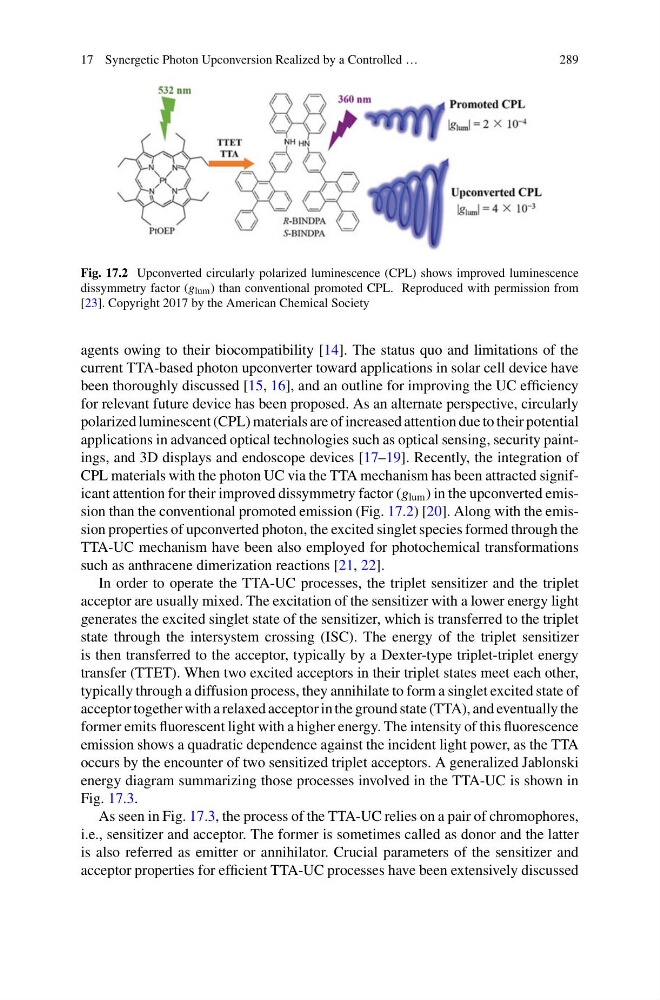
Fig. 17.2 Upconverted circularly polarized luminescence (CPL) shows improved luminescence
dissymmetry factor (g lum ) than conventional promoted CPL. Reproduced with permission from
[23]. Copyright 2017 by the American Chemical Society
agents owing to their biocompatibility [14]. The status quo and limitations of the
current TTA-based photon upconverter toward applications in solar cell device have
been thoroughly discussed [15, 16], and an outline for improving the UC efficiency
for relevant future device has been proposed. As an alternate perspective, circularly
polarized luminescent (CPL) materials are of increased attention due to their potential
applications in advanced optical technologies such as optical sensing, security paintings, and 3D displays and endoscope devices [17–19]. Recently, the integration of
CPL materials with the photon UC via the TTA mechanism has been attracted significant attention for their improved dissymmetry factor (g lum ) in the upconverted emission than the conventional promoted emission (Fig. 17.2) [20]. Along with the emission properties of upconverted photon, the excited singlet species formed through the
TTA-UC mechanism have been also employed for photochemical transformations
such as anthracene dimerization reactions [21, 22].
In order to operate the TTA-UC processes, the triplet sensitizer and the triplet
acceptor are usually mixed. The excitation of the sensitizer with a lower energy light
generates the excited singlet state of the sensitizer, which is transferred to the triplet
state through the intersystem crossing (ISC). The energy of the triplet sensitizer
is then transferred to the acceptor, typically by a Dexter-type triplet-triplet energy
transfer (TTET). When two excited acceptors in their triplet states meet each other,
typically through a diffusion process, they annihilate to form a singlet excited state of
acceptor together with a relaxed acceptor in the ground state (TTA), and eventually the
former emits fluorescent light with a higher energy. The intensity of this fluorescence
emission shows a quadratic dependence against the incident light power, as the TTA
occurs by the encounter of two sensitized triplet acceptors. A generalized Jablonski
energy diagram summarizing those processes involved in the TTA-UC is shown in
Fig. 17.3.
As seen in Fig. 17.3, the process of the TTA-UC relies on a pair of chromophores,
i.e., sensitizer and acceptor. The former is sometimes called as donor and the latter
is also referred as emitter or annihilator. Crucial parameters of the sensitizer and
acceptor properties for efficient TTA-UC processes have been extensively discussed
289
Fig. 17.2 Upconverted circularly polarized luminescence (CPL) shows improved luminescence
dissymmetry factor (g lum ) than conventional promoted CPL. Reproduced with permission from
[23]. Copyright 2017 by the American Chemical Society
agents owing to their biocompatibility [14]. The status quo and limitations of the
current TTA-based photon upconverter toward applications in solar cell device have
been thoroughly discussed [15, 16], and an outline for improving the UC efficiency
for relevant future device has been proposed. As an alternate perspective, circularly
polarized luminescent (CPL) materials are of increased attention due to their potential
applications in advanced optical technologies such as optical sensing, security paintings, and 3D displays and endoscope devices [17–19]. Recently, the integration of
CPL materials with the photon UC via the TTA mechanism has been attracted significant attention for their improved dissymmetry factor (g lum ) in the upconverted emission than the conventional promoted emission (Fig. 17.2) [20]. Along with the emission properties of upconverted photon, the excited singlet species formed through the
TTA-UC mechanism have been also employed for photochemical transformations
such as anthracene dimerization reactions [21, 22].
In order to operate the TTA-UC processes, the triplet sensitizer and the triplet
acceptor are usually mixed. The excitation of the sensitizer with a lower energy light
generates the excited singlet state of the sensitizer, which is transferred to the triplet
state through the intersystem crossing (ISC). The energy of the triplet sensitizer
is then transferred to the acceptor, typically by a Dexter-type triplet-triplet energy
transfer (TTET). When two excited acceptors in their triplet states meet each other,
typically through a diffusion process, they annihilate to form a singlet excited state of
acceptor together with a relaxed acceptor in the ground state (TTA), and eventually the
former emits fluorescent light with a higher energy. The intensity of this fluorescence
emission shows a quadratic dependence against the incident light power, as the TTA
occurs by the encounter of two sensitized triplet acceptors. A generalized Jablonski
energy diagram summarizing those processes involved in the TTA-UC is shown in
Fig. 17.3.
As seen in Fig. 17.3, the process of the TTA-UC relies on a pair of chromophores,
i.e., sensitizer and acceptor. The former is sometimes called as donor and the latter
is also referred as emitter or annihilator. Crucial parameters of the sensitizer and
acceptor properties for efficient TTA-UC processes have been extensively discussed