

288
T. Mori
17.1 Introduction
Triplet-triplet annihilation (TTA) is one of the most promising upconversion (UC)
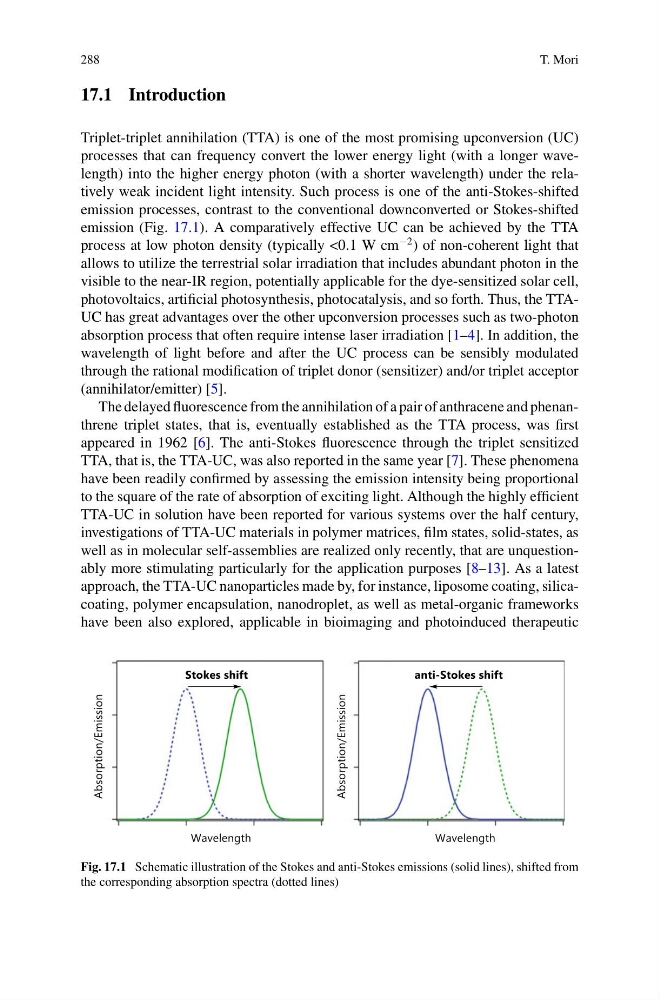
processes that can frequency convert the lower energy light (with a longer wavelength) into the higher energy photon (with a shorter wavelength) under the relatively weak incident light intensity. Such process is one of the anti-Stokes-shifted
emission processes, contrast to the conventional downconverted or Stokes-shifted
emission (Fig. 17.1). A comparatively effective UC can be achieved by the TTA
process at low photon density (typically <0.1 W cm
−2 ) of non-coherent light that
allows to utilize the terrestrial solar irradiation that includes abundant photon in the
visible to the near-IR region, potentially applicable for the dye-sensitized solar cell,
photovoltaics, artificial photosynthesis, photocatalysis, and so forth. Thus, the TTAUC has great advantages over the other upconversion processes such as two-photon
absorption process that often require intense laser irradiation [1–4]. In addition, the
wavelength of light before and after the UC process can be sensibly modulated
through the rational modification of triplet donor (sensitizer) and/or triplet acceptor
(annihilator/emitter) [5].
The delayed fluorescence from the annihilation of a pair of anthracene and phenanthrene triplet states, that is, eventually established as the TTA process, was first
appeared in 1962 [6]. The anti-Stokes fluorescence through the triplet sensitized
TTA, that is, the TTA-UC, was also reported in the same year [7]. These phenomena
have been readily confirmed by assessing the emission intensity being proportional
to the square of the rate of absorption of exciting light. Although the highly efficient
TTA-UC in solution have been reported for various systems over the half century,
investigations of TTA-UC materials in polymer matrices, film states, solid-states, as
well as in molecular self-assemblies are realized only recently, that are unquestionably more stimulating particularly for the application purposes [8–13]. As a latest
approach, the TTA-UC nanoparticles made by, for instance, liposome coating, silicacoating, polymer encapsulation, nanodroplet, as well as metal-organic frameworks
have been also explored, applicable in bioimaging and photoinduced therapeutic
Fig. 17.1 Schematic illustration of the Stokes and anti-Stokes emissions (solid lines), shifted from
the corresponding absorption spectra (dotted lines)
T. Mori
17.1 Introduction
Triplet-triplet annihilation (TTA) is one of the most promising upconversion (UC)
processes that can frequency convert the lower energy light (with a longer wavelength) into the higher energy photon (with a shorter wavelength) under the relatively weak incident light intensity. Such process is one of the anti-Stokes-shifted
emission processes, contrast to the conventional downconverted or Stokes-shifted
emission (Fig. 17.1). A comparatively effective UC can be achieved by the TTA
process at low photon density (typically <0.1 W cm
−2 ) of non-coherent light that
allows to utilize the terrestrial solar irradiation that includes abundant photon in the
visible to the near-IR region, potentially applicable for the dye-sensitized solar cell,
photovoltaics, artificial photosynthesis, photocatalysis, and so forth. Thus, the TTAUC has great advantages over the other upconversion processes such as two-photon
absorption process that often require intense laser irradiation [1–4]. In addition, the
wavelength of light before and after the UC process can be sensibly modulated
through the rational modification of triplet donor (sensitizer) and/or triplet acceptor
(annihilator/emitter) [5].
The delayed fluorescence from the annihilation of a pair of anthracene and phenanthrene triplet states, that is, eventually established as the TTA process, was first
appeared in 1962 [6]. The anti-Stokes fluorescence through the triplet sensitized
TTA, that is, the TTA-UC, was also reported in the same year [7]. These phenomena
have been readily confirmed by assessing the emission intensity being proportional
to the square of the rate of absorption of exciting light. Although the highly efficient
TTA-UC in solution have been reported for various systems over the half century,
investigations of TTA-UC materials in polymer matrices, film states, solid-states, as
well as in molecular self-assemblies are realized only recently, that are unquestionably more stimulating particularly for the application purposes [8–13]. As a latest
approach, the TTA-UC nanoparticles made by, for instance, liposome coating, silicacoating, polymer encapsulation, nanodroplet, as well as metal-organic frameworks
have been also explored, applicable in bioimaging and photoinduced therapeutic
Fig. 17.1 Schematic illustration of the Stokes and anti-Stokes emissions (solid lines), shifted from
the corresponding absorption spectra (dotted lines)