

17 Synergetic Photon Upconversion Realized by a Controlled …
291
often inaccessible. Experimentally, the UC value as high as 20% was achieved [3].
Although some factors such as ISC and F are intrinsic to the chromophore, other
factors ( TTET and TTA ) can be modulated also by external factors such as distance
between the chromophores (concentration of a solution) and mobility (viscosity of
a solution). To improve the former (i.e., maximizing ISC ) by bypassing or minimizing the energy loss through the ISC process, direct singlet-to-triplet absorption
materials, the sensitization from chalcogenide and perovskite nanocrystals, and the
thermally activated delayed fluorescence behavior have been proposed as alternative
triplet sensitization routes [26].
The TTET process between the sensitizer and the acceptor can be treated as a
combination of Förster-type resonant energy transfer and Dexter-type mechanisms.
However, the former contribution is usually very small since the TTET in the TTAUC system usually involves forbidden transitions. The Dexter-type electron transfer
can be described by the active-sphere or Perrin approximation, which is based on the
exponential decay profile of the overlap of the involved orbitals. It has been demonstrated that this assumption is indeed acceptable for dilute solutions of platinum(II)
octaethylporphyrin and 9,10-diphenylanthracene at low temperature [27]. Although
a relatively large Dexter radius of 2.65 nm was found, the shorter distance of around
1 nm is generally required and definitely preferred for more efficient TTET and TTA
processes. Thus, providing translational mobility and/or maximizing the concentrations of the sensitizer and the acceptor, or to make use of (supramolecular) structure
or morphology [28], to the point where the average distance between these species
within the Perrin limit, are effective general strategies for maximizing the efficiency
of the TTET process, despite the possible undesired back electron transfer process.
The triplet pair is also the key functional unit in the TTA-UC. A recent study
demonstrated that the solvent polarity and viscosity play a crucial role in promoting
emission pathways, consequently the efficient UC, over the excimer formation on
the singlet surface which works as energy-loss channels [29].
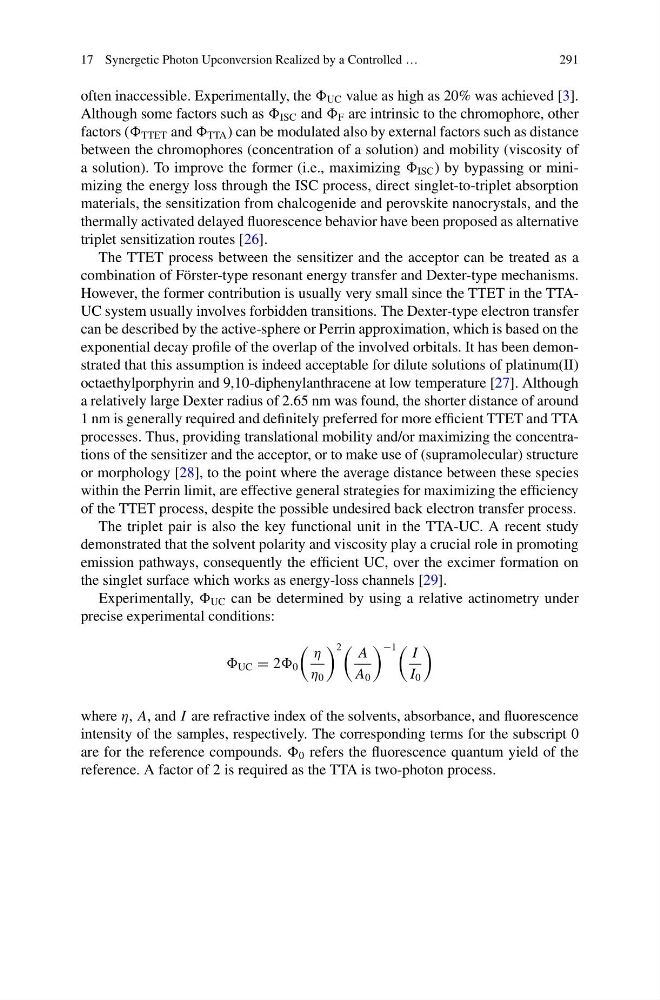
Experimentally, UC can be determined by using a relative actinometry under
precise experimental conditions:
UC = 2 0
η
η 0
2
A
A 0
−1
I
I 0
where η, A, and I are refractive index of the solvents, absorbance, and fluorescence
intensity of the samples, respectively. The corresponding terms for the subscript 0
are for the reference compounds. 0 refers the fluorescence quantum yield of the
reference. A factor of 2 is required as the TTA is two-photon process.
291
often inaccessible. Experimentally, the UC value as high as 20% was achieved [3].
Although some factors such as ISC and F are intrinsic to the chromophore, other
factors ( TTET and TTA ) can be modulated also by external factors such as distance
between the chromophores (concentration of a solution) and mobility (viscosity of
a solution). To improve the former (i.e., maximizing ISC ) by bypassing or minimizing the energy loss through the ISC process, direct singlet-to-triplet absorption
materials, the sensitization from chalcogenide and perovskite nanocrystals, and the
thermally activated delayed fluorescence behavior have been proposed as alternative
triplet sensitization routes [26].
The TTET process between the sensitizer and the acceptor can be treated as a
combination of Förster-type resonant energy transfer and Dexter-type mechanisms.
However, the former contribution is usually very small since the TTET in the TTAUC system usually involves forbidden transitions. The Dexter-type electron transfer
can be described by the active-sphere or Perrin approximation, which is based on the
exponential decay profile of the overlap of the involved orbitals. It has been demonstrated that this assumption is indeed acceptable for dilute solutions of platinum(II)
octaethylporphyrin and 9,10-diphenylanthracene at low temperature [27]. Although
a relatively large Dexter radius of 2.65 nm was found, the shorter distance of around
1 nm is generally required and definitely preferred for more efficient TTET and TTA
processes. Thus, providing translational mobility and/or maximizing the concentrations of the sensitizer and the acceptor, or to make use of (supramolecular) structure
or morphology [28], to the point where the average distance between these species
within the Perrin limit, are effective general strategies for maximizing the efficiency
of the TTET process, despite the possible undesired back electron transfer process.
The triplet pair is also the key functional unit in the TTA-UC. A recent study
demonstrated that the solvent polarity and viscosity play a crucial role in promoting
emission pathways, consequently the efficient UC, over the excimer formation on
the singlet surface which works as energy-loss channels [29].
Experimentally, UC can be determined by using a relative actinometry under
precise experimental conditions:
UC = 2 0
η
η 0
2
A
A 0
−1
I
I 0
where η, A, and I are refractive index of the solvents, absorbance, and fluorescence
intensity of the samples, respectively. The corresponding terms for the subscript 0
are for the reference compounds. 0 refers the fluorescence quantum yield of the
reference. A factor of 2 is required as the TTA is two-photon process.