

16 Efficient Singlet Fission in Acene-Based Molecular Assemblies
279
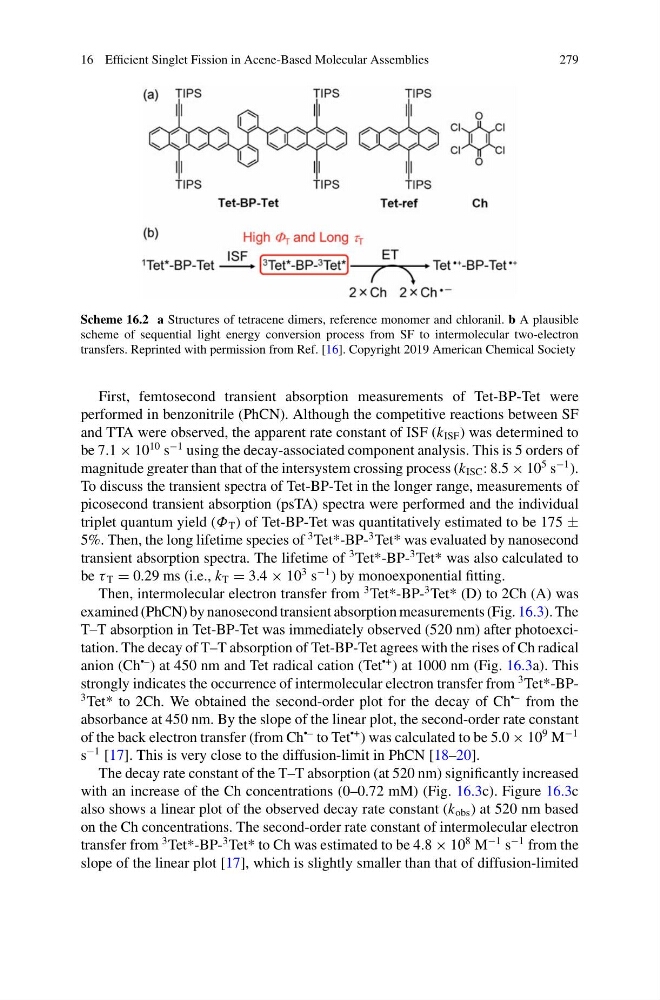
Scheme 16.2 a Structures of tetracene dimers, reference monomer and chloranil. b A plausible
scheme of sequential light energy conversion process from SF to intermolecular two-electron
transfers. Reprinted with permission from Ref. [16]. Copyright 2019 American Chemical Society
First, femtosecond transient absorption measurements of Tet-BP-Tet were
performed in benzonitrile (PhCN). Although the competitive reactions between SF
and TTA were observed, the apparent rate constant of ISF (k ISF ) was determined to
be 7.1 × 10
10 s
−1 using the decay-associated component analysis. This is 5 orders of
magnitude greater than that of the intersystem crossing process (k ISC : 8.5 × 10
5 s
−1 ).
To discuss the transient spectra of Tet-BP-Tet in the longer range, measurements of
picosecond transient absorption (psTA) spectra were performed and the individual
triplet quantum yield (Φ T ) of Tet-BP-Tet was quantitatively estimated to be 175 ±
5%. Then, the long lifetime species of
3 Tet*-BP3 Tet* was evaluated by nanosecond
transient absorption spectra. The lifetime of
3 Tet*-BP3 Tet* was also calculated to
be τ T = 0.29 ms (i.e., k T = 3.4 × 10
3 s
−1 ) by monoexponential fitting.
Then, intermolecular electron transfer from
3 Tet*-BP3 Tet* (D) to 2Ch (A) was
examined (PhCN) by nanosecond transient absorption measurements (Fig. 16.3). The
T–T absorption in Tet-BP-Tet was immediately observed (520 nm) after photoexcitation. The decay of T–T absorption of Tet-BP-Tet agrees with the rises of Ch radical
anion (Ch
•– ) at 450 nm and Tet radical cation (Tet
•+ ) at 1000 nm (Fig. 16.3a). This
strongly indicates the occurrence of intermolecular electron transfer from
3 Tet*-BP3 Tet* to 2Ch. We obtained the second-order plot for the decay of Ch
•– from the
absorbance at 450 nm. By the slope of the linear plot, the second-order rate constant
of the back electron transfer (from Ch
•– to Tet
•+ ) was calculated to be 5.0 × 10
9 M
−1
s
−1 [17]. This is very close to the diffusion-limit in PhCN [18–20].
The decay rate constant of the T–T absorption (at 520 nm) significantly increased
with an increase of the Ch concentrations (0–0.72 mM) (Fig. 16.3c). Figure 16.3c
also shows a linear plot of the observed decay rate constant (k obs ) at 520 nm based
on the Ch concentrations. The second-order rate constant of intermolecular electron
transfer from
3 Tet*-BP3 Tet* to Ch was estimated to be 4.8 × 10
8 M
−1 s
−1 from the
slope of the linear plot [17], which is slightly smaller than that of diffusion-limited
279
Scheme 16.2 a Structures of tetracene dimers, reference monomer and chloranil. b A plausible
scheme of sequential light energy conversion process from SF to intermolecular two-electron
transfers. Reprinted with permission from Ref. [16]. Copyright 2019 American Chemical Society
First, femtosecond transient absorption measurements of Tet-BP-Tet were
performed in benzonitrile (PhCN). Although the competitive reactions between SF
and TTA were observed, the apparent rate constant of ISF (k ISF ) was determined to
be 7.1 × 10
10 s
−1 using the decay-associated component analysis. This is 5 orders of
magnitude greater than that of the intersystem crossing process (k ISC : 8.5 × 10
5 s
−1 ).
To discuss the transient spectra of Tet-BP-Tet in the longer range, measurements of
picosecond transient absorption (psTA) spectra were performed and the individual
triplet quantum yield (Φ T ) of Tet-BP-Tet was quantitatively estimated to be 175 ±
5%. Then, the long lifetime species of
3 Tet*-BP3 Tet* was evaluated by nanosecond
transient absorption spectra. The lifetime of
3 Tet*-BP3 Tet* was also calculated to
be τ T = 0.29 ms (i.e., k T = 3.4 × 10
3 s
−1 ) by monoexponential fitting.
Then, intermolecular electron transfer from
3 Tet*-BP3 Tet* (D) to 2Ch (A) was
examined (PhCN) by nanosecond transient absorption measurements (Fig. 16.3). The
T–T absorption in Tet-BP-Tet was immediately observed (520 nm) after photoexcitation. The decay of T–T absorption of Tet-BP-Tet agrees with the rises of Ch radical
anion (Ch
•– ) at 450 nm and Tet radical cation (Tet
•+ ) at 1000 nm (Fig. 16.3a). This
strongly indicates the occurrence of intermolecular electron transfer from
3 Tet*-BP3 Tet* to 2Ch. We obtained the second-order plot for the decay of Ch
•– from the
absorbance at 450 nm. By the slope of the linear plot, the second-order rate constant
of the back electron transfer (from Ch
•– to Tet
•+ ) was calculated to be 5.0 × 10
9 M
−1
s
−1 [17]. This is very close to the diffusion-limit in PhCN [18–20].
The decay rate constant of the T–T absorption (at 520 nm) significantly increased
with an increase of the Ch concentrations (0–0.72 mM) (Fig. 16.3c). Figure 16.3c
also shows a linear plot of the observed decay rate constant (k obs ) at 520 nm based
on the Ch concentrations. The second-order rate constant of intermolecular electron
transfer from
3 Tet*-BP3 Tet* to Ch was estimated to be 4.8 × 10
8 M
−1 s
−1 from the
slope of the linear plot [17], which is slightly smaller than that of diffusion-limited