

278
T. Hasobe
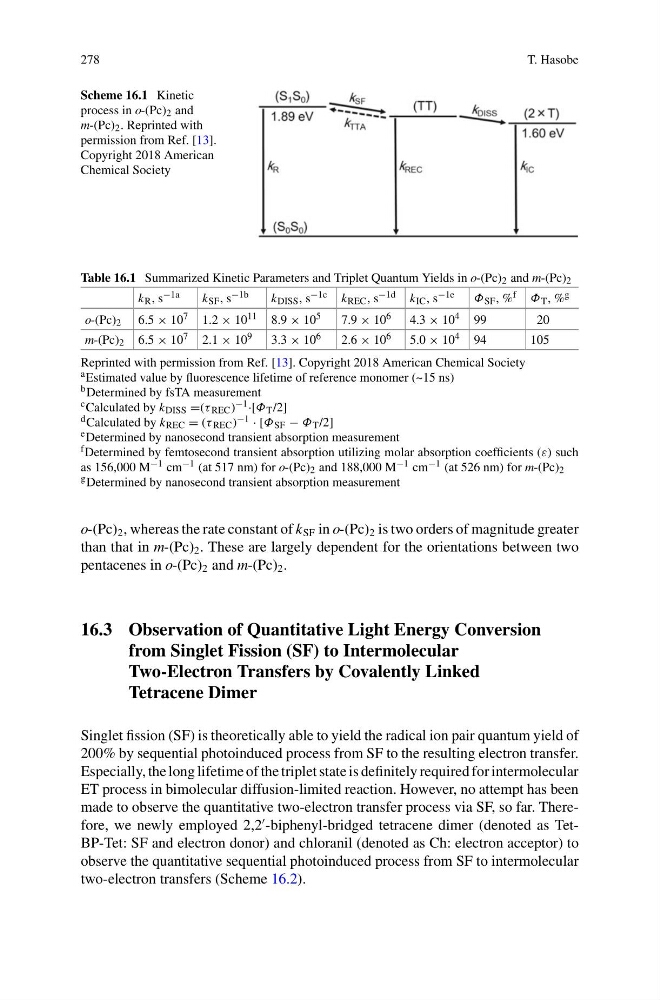
Scheme 16.1 Kinetic
process in o-(Pc) 2 and
m-(Pc) 2 . Reprinted with
permission from Ref. [13].
Copyright 2018 American
Chemical Society
Table 16.1 Summarized Kinetic Parameters and Triplet Quantum Yields in o-(Pc) 2 and m-(Pc) 2
k R , s −1a
k SF , s −1b
k DISS , s −1c k REC , s −1d k IC , s −1e
Φ SF , % f Φ T , % g
o-(Pc) 2 6.5 × 10 7 1.2 × 10 11 8.9 × 10 5
7.9 × 10 6 4.3 × 10 4 99
20
m-(Pc) 2 6.5 × 10 7 2.1 × 10 9
3.3 × 10 6
2.6 × 10 6 5.0 × 10 4 94
105
Reprinted with permission from Ref. [13]. Copyright 2018 American Chemical Society
a Estimated value by fluorescence lifetime of reference monomer (~15 ns)
b Determined by fsTA measurement
c Calculated by k DISS =(τ REC ) −1 ·[Φ T /2]
d Calculated by k REC = (τ REC ) −1 · [Φ SF − Φ T /2]
e Determined by nanosecond transient absorption measurement
f Determined by femtosecond transient absorption utilizing molar absorption coefficients (ε) such
as 156,000 M −1 cm −1 (at 517 nm) for o-(Pc) 2 and 188,000 M −1 cm −1 (at 526 nm) for m-(Pc) 2
g Determined by nanosecond transient absorption measurement
o-(Pc) 2 , whereas the rate constant of k SF in o-(Pc) 2 is two orders of magnitude greater
than that in m-(Pc) 2 . These are largely dependent for the orientations between two
pentacenes in o-(Pc) 2 and m-(Pc) 2 .
16.3 Observation of Quantitative Light Energy Conversion
from Singlet Fission (SF) to Intermolecular
Two-Electron Transfers by Covalently Linked
Tetracene Dimer
Singlet fission (SF) is theoretically able to yield the radical ion pair quantum yield of
200% by sequential photoinduced process from SF to the resulting electron transfer.
Especially, the long lifetime of the triplet state is definitely required for intermolecular
ET process in bimolecular diffusion-limited reaction. However, no attempt has been
made to observe the quantitative two-electron transfer process via SF, so far. Therefore, we newly employed 2,2
-biphenyl-bridged tetracene dimer (denoted as TetBP-Tet: SF and electron donor) and chloranil (denoted as Ch: electron acceptor) to
observe the quantitative sequential photoinduced process from SF to intermolecular
two-electron transfers (Scheme 16.2).
T. Hasobe
Scheme 16.1 Kinetic
process in o-(Pc) 2 and
m-(Pc) 2 . Reprinted with
permission from Ref. [13].
Copyright 2018 American
Chemical Society
Table 16.1 Summarized Kinetic Parameters and Triplet Quantum Yields in o-(Pc) 2 and m-(Pc) 2
k R , s −1a
k SF , s −1b
k DISS , s −1c k REC , s −1d k IC , s −1e
Φ SF , % f Φ T , % g
o-(Pc) 2 6.5 × 10 7 1.2 × 10 11 8.9 × 10 5
7.9 × 10 6 4.3 × 10 4 99
20
m-(Pc) 2 6.5 × 10 7 2.1 × 10 9
3.3 × 10 6
2.6 × 10 6 5.0 × 10 4 94
105
Reprinted with permission from Ref. [13]. Copyright 2018 American Chemical Society
a Estimated value by fluorescence lifetime of reference monomer (~15 ns)
b Determined by fsTA measurement
c Calculated by k DISS =(τ REC ) −1 ·[Φ T /2]
d Calculated by k REC = (τ REC ) −1 · [Φ SF − Φ T /2]
e Determined by nanosecond transient absorption measurement
f Determined by femtosecond transient absorption utilizing molar absorption coefficients (ε) such
as 156,000 M −1 cm −1 (at 517 nm) for o-(Pc) 2 and 188,000 M −1 cm −1 (at 526 nm) for m-(Pc) 2
g Determined by nanosecond transient absorption measurement
o-(Pc) 2 , whereas the rate constant of k SF in o-(Pc) 2 is two orders of magnitude greater
than that in m-(Pc) 2 . These are largely dependent for the orientations between two
pentacenes in o-(Pc) 2 and m-(Pc) 2 .
16.3 Observation of Quantitative Light Energy Conversion
from Singlet Fission (SF) to Intermolecular
Two-Electron Transfers by Covalently Linked
Tetracene Dimer
Singlet fission (SF) is theoretically able to yield the radical ion pair quantum yield of
200% by sequential photoinduced process from SF to the resulting electron transfer.
Especially, the long lifetime of the triplet state is definitely required for intermolecular
ET process in bimolecular diffusion-limited reaction. However, no attempt has been
made to observe the quantitative two-electron transfer process via SF, so far. Therefore, we newly employed 2,2
-biphenyl-bridged tetracene dimer (denoted as TetBP-Tet: SF and electron donor) and chloranil (denoted as Ch: electron acceptor) to
observe the quantitative sequential photoinduced process from SF to intermolecular
two-electron transfers (Scheme 16.2).