

16 Efficient Singlet Fission in Acene-Based Molecular Assemblies
277
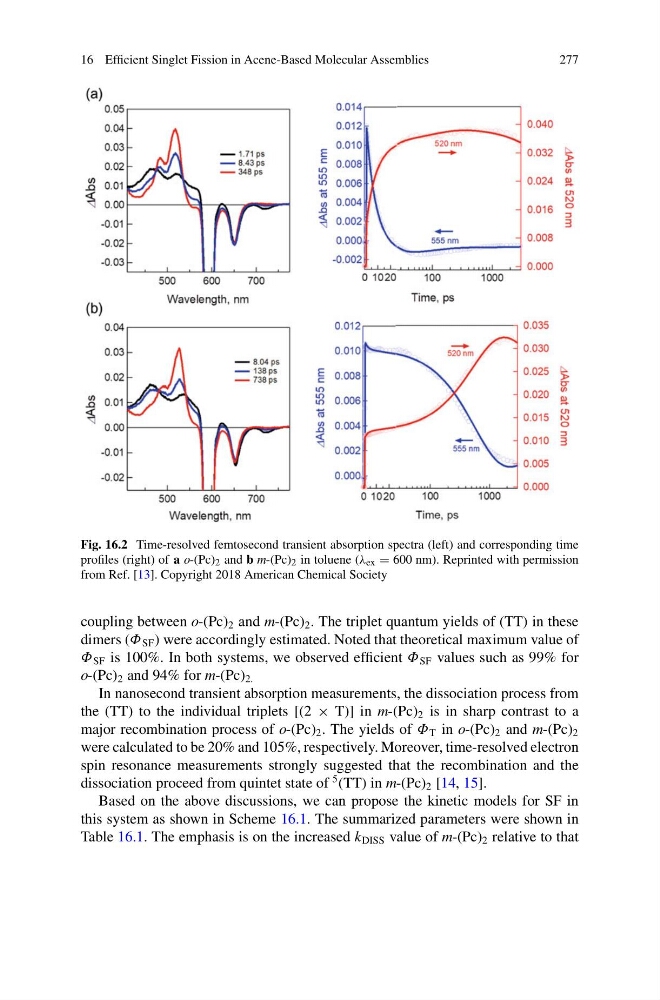
Fig. 16.2 Time-resolved femtosecond transient absorption spectra (left) and corresponding time
profiles (right) of a o-(Pc) 2 and b m-(Pc) 2 in toluene (λ ex = 600 nm). Reprinted with permission
from Ref. [13]. Copyright 2018 American Chemical Society
coupling between o-(Pc) 2 and m-(Pc) 2 . The triplet quantum yields of (TT) in these
dimers (Φ SF ) were accordingly estimated. Noted that theoretical maximum value of
Φ SF is 100%. In both systems, we observed efficient Φ SF values such as 99% for
o-(Pc) 2 and 94% for m-(Pc) 2.
In nanosecond transient absorption measurements, the dissociation process from
the (TT) to the individual triplets [(2 × T)] in m-(Pc) 2 is in sharp contrast to a
major recombination process of o-(Pc) 2 . The yields of Φ T in o-(Pc) 2 and m-(Pc) 2
were calculated to be 20% and 105%, respectively. Moreover, time-resolved electron
spin resonance measurements strongly suggested that the recombination and the
dissociation proceed from quintet state of
5 (TT) in m-(Pc) 2 [14, 15].
Based on the above discussions, we can propose the kinetic models for SF in
this system as shown in Scheme 16.1. The summarized parameters were shown in
Table 16.1. The emphasis is on the increased k DISS value of m-(Pc) 2 relative to that
277
Fig. 16.2 Time-resolved femtosecond transient absorption spectra (left) and corresponding time
profiles (right) of a o-(Pc) 2 and b m-(Pc) 2 in toluene (λ ex = 600 nm). Reprinted with permission
from Ref. [13]. Copyright 2018 American Chemical Society
coupling between o-(Pc) 2 and m-(Pc) 2 . The triplet quantum yields of (TT) in these
dimers (Φ SF ) were accordingly estimated. Noted that theoretical maximum value of
Φ SF is 100%. In both systems, we observed efficient Φ SF values such as 99% for
o-(Pc) 2 and 94% for m-(Pc) 2.
In nanosecond transient absorption measurements, the dissociation process from
the (TT) to the individual triplets [(2 × T)] in m-(Pc) 2 is in sharp contrast to a
major recombination process of o-(Pc) 2 . The yields of Φ T in o-(Pc) 2 and m-(Pc) 2
were calculated to be 20% and 105%, respectively. Moreover, time-resolved electron
spin resonance measurements strongly suggested that the recombination and the
dissociation proceed from quintet state of
5 (TT) in m-(Pc) 2 [14, 15].
Based on the above discussions, we can propose the kinetic models for SF in
this system as shown in Scheme 16.1. The summarized parameters were shown in
Table 16.1. The emphasis is on the increased k DISS value of m-(Pc) 2 relative to that