

276
T. Hasobe
E(S 1 ) = 2.6 eV and E(T 1 ) = 1.3 eV. No attempt has been made to observe the quantitative SF of Tc dimers and molecular assemblies in homogeneous solution because
of the competitive reaction between SF and TTA.
Based on the above points, in this chapter, recent developments of singlet fission
using tetracene and pentacene derivatives are discussed. In addition to the simple
molecular dimers, macroscopic assemblies of pentacene and tetracene using gold
nanoparticles were employed. The detailed structural and photophysical properties
are discussed here.
16.2 Covalently Linked Pentacene Dimers Bridged
by a Phenylene Spacer at Ortho and Meta Positions
First, simple dimeric forms of pentacene derivatives with different orientations are
discussed. We synthesized a series of pentacene dimers linked by a phenylene spacer
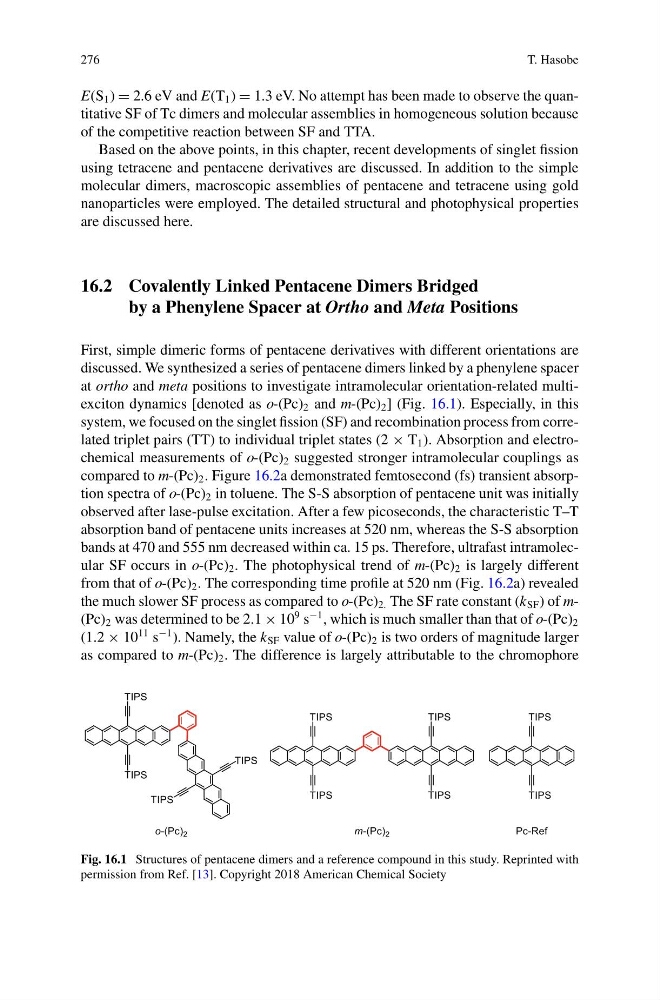
at ortho and meta positions to investigate intramolecular orientation-related multiexciton dynamics [denoted as o-(Pc) 2 and m-(Pc) 2 ] (Fig. 16.1). Especially, in this
system, we focused on the singlet fission (SF) and recombination process from correlated triplet pairs (TT) to individual triplet states (2 × T 1 ). Absorption and electrochemical measurements of o-(Pc) 2 suggested stronger intramolecular couplings as
compared to m-(Pc) 2 . Figure 16.2a demonstrated femtosecond (fs) transient absorption spectra of o-(Pc) 2 in toluene. The S-S absorption of pentacene unit was initially
observed after lase-pulse excitation. After a few picoseconds, the characteristic T–T
absorption band of pentacene units increases at 520 nm, whereas the S-S absorption
bands at 470 and 555 nm decreased within ca. 15 ps. Therefore, ultrafast intramolecular SF occurs in o-(Pc) 2 . The photophysical trend of m-(Pc) 2 is largely different
from that of o-(Pc) 2 . The corresponding time profile at 520 nm (Fig. 16.2a) revealed
the much slower SF process as compared to o-(Pc) 2. The SF rate constant (k SF ) of m(Pc) 2 was determined to be 2.1 × 10
9 s
−1 , which is much smaller than that of o-(Pc) 2
(1.2 × 10
11 s
−1 ). Namely, the k SF value of o-(Pc) 2 is two orders of magnitude larger
as compared to m-(Pc) 2 . The difference is largely attributable to the chromophore
Fig. 16.1 Structures of pentacene dimers and a reference compound in this study. Reprinted with
permission from Ref. [13]. Copyright 2018 American Chemical Society
T. Hasobe
E(S 1 ) = 2.6 eV and E(T 1 ) = 1.3 eV. No attempt has been made to observe the quantitative SF of Tc dimers and molecular assemblies in homogeneous solution because
of the competitive reaction between SF and TTA.
Based on the above points, in this chapter, recent developments of singlet fission
using tetracene and pentacene derivatives are discussed. In addition to the simple
molecular dimers, macroscopic assemblies of pentacene and tetracene using gold
nanoparticles were employed. The detailed structural and photophysical properties
are discussed here.
16.2 Covalently Linked Pentacene Dimers Bridged
by a Phenylene Spacer at Ortho and Meta Positions
First, simple dimeric forms of pentacene derivatives with different orientations are
discussed. We synthesized a series of pentacene dimers linked by a phenylene spacer
at ortho and meta positions to investigate intramolecular orientation-related multiexciton dynamics [denoted as o-(Pc) 2 and m-(Pc) 2 ] (Fig. 16.1). Especially, in this
system, we focused on the singlet fission (SF) and recombination process from correlated triplet pairs (TT) to individual triplet states (2 × T 1 ). Absorption and electrochemical measurements of o-(Pc) 2 suggested stronger intramolecular couplings as
compared to m-(Pc) 2 . Figure 16.2a demonstrated femtosecond (fs) transient absorption spectra of o-(Pc) 2 in toluene. The S-S absorption of pentacene unit was initially
observed after lase-pulse excitation. After a few picoseconds, the characteristic T–T
absorption band of pentacene units increases at 520 nm, whereas the S-S absorption
bands at 470 and 555 nm decreased within ca. 15 ps. Therefore, ultrafast intramolecular SF occurs in o-(Pc) 2 . The photophysical trend of m-(Pc) 2 is largely different
from that of o-(Pc) 2 . The corresponding time profile at 520 nm (Fig. 16.2a) revealed
the much slower SF process as compared to o-(Pc) 2. The SF rate constant (k SF ) of m(Pc) 2 was determined to be 2.1 × 10
9 s
−1 , which is much smaller than that of o-(Pc) 2
(1.2 × 10
11 s
−1 ). Namely, the k SF value of o-(Pc) 2 is two orders of magnitude larger
as compared to m-(Pc) 2 . The difference is largely attributable to the chromophore
Fig. 16.1 Structures of pentacene dimers and a reference compound in this study. Reprinted with
permission from Ref. [13]. Copyright 2018 American Chemical Society