

248
T. Kawai
The author and coworkers have expected marked enhancement of chain propagation
in terarylenes, because of their expanded π-conjugation systems supporting stable
cation radicals. The authors have indeed studied on some terarylene derivatives and
found efficient chain-like isomerization reaction in terthiazole [43]. Their kinetics
were systematically studied with the stopped-flow analysis. The author and coworker
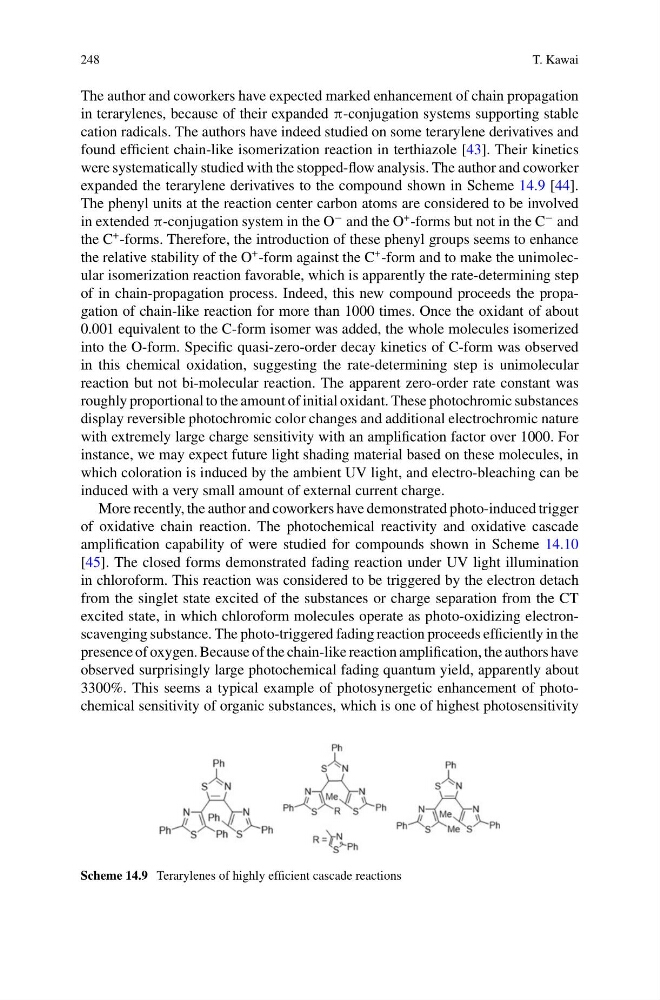
expanded the terarylene derivatives to the compound shown in Scheme 14.9 [44].
The phenyl units at the reaction center carbon atoms are considered to be involved
in extended π-conjugation system in the O
− and the O
+ -forms but not in the C
− and
the C
+ -forms. Therefore, the introduction of these phenyl groups seems to enhance
the relative stability of the O
+ -form against the C
+ -form and to make the unimolecular isomerization reaction favorable, which is apparently the rate-determining step
of in chain-propagation process. Indeed, this new compound proceeds the propagation of chain-like reaction for more than 1000 times. Once the oxidant of about
0.001 equivalent to the C-form isomer was added, the whole molecules isomerized
into the O-form. Specific quasi-zero-order decay kinetics of C-form was observed
in this chemical oxidation, suggesting the rate-determining step is unimolecular
reaction but not bi-molecular reaction. The apparent zero-order rate constant was
roughly proportional to the amount of initial oxidant. These photochromic substances
display reversible photochromic color changes and additional electrochromic nature
with extremely large charge sensitivity with an amplification factor over 1000. For
instance, we may expect future light shading material based on these molecules, in
which coloration is induced by the ambient UV light, and electro-bleaching can be
induced with a very small amount of external current charge.
More recently, the author and coworkers have demonstrated photo-induced trigger
of oxidative chain reaction. The photochemical reactivity and oxidative cascade
amplification capability of were studied for compounds shown in Scheme 14.10
[45]. The closed forms demonstrated fading reaction under UV light illumination
in chloroform. This reaction was considered to be triggered by the electron detach
from the singlet state excited of the substances or charge separation from the CT
excited state, in which chloroform molecules operate as photo-oxidizing electronscavenging substance. The photo-triggered fading reaction proceeds efficiently in the
presence of oxygen. Because of the chain-like reaction amplification, the authors have
observed surprisingly large photochemical fading quantum yield, apparently about
3300%. This seems a typical example of photosynergetic enhancement of photochemical sensitivity of organic substances, which is one of highest photosensitivity
Scheme 14.9 Terarylenes of highly efficient cascade reactions
T. Kawai
The author and coworkers have expected marked enhancement of chain propagation
in terarylenes, because of their expanded π-conjugation systems supporting stable
cation radicals. The authors have indeed studied on some terarylene derivatives and
found efficient chain-like isomerization reaction in terthiazole [43]. Their kinetics
were systematically studied with the stopped-flow analysis. The author and coworker
expanded the terarylene derivatives to the compound shown in Scheme 14.9 [44].
The phenyl units at the reaction center carbon atoms are considered to be involved
in extended π-conjugation system in the O
− and the O
+ -forms but not in the C
− and
the C
+ -forms. Therefore, the introduction of these phenyl groups seems to enhance
the relative stability of the O
+ -form against the C
+ -form and to make the unimolecular isomerization reaction favorable, which is apparently the rate-determining step
of in chain-propagation process. Indeed, this new compound proceeds the propagation of chain-like reaction for more than 1000 times. Once the oxidant of about
0.001 equivalent to the C-form isomer was added, the whole molecules isomerized
into the O-form. Specific quasi-zero-order decay kinetics of C-form was observed
in this chemical oxidation, suggesting the rate-determining step is unimolecular
reaction but not bi-molecular reaction. The apparent zero-order rate constant was
roughly proportional to the amount of initial oxidant. These photochromic substances
display reversible photochromic color changes and additional electrochromic nature
with extremely large charge sensitivity with an amplification factor over 1000. For
instance, we may expect future light shading material based on these molecules, in
which coloration is induced by the ambient UV light, and electro-bleaching can be
induced with a very small amount of external current charge.
More recently, the author and coworkers have demonstrated photo-induced trigger
of oxidative chain reaction. The photochemical reactivity and oxidative cascade
amplification capability of were studied for compounds shown in Scheme 14.10
[45]. The closed forms demonstrated fading reaction under UV light illumination
in chloroform. This reaction was considered to be triggered by the electron detach
from the singlet state excited of the substances or charge separation from the CT
excited state, in which chloroform molecules operate as photo-oxidizing electronscavenging substance. The photo-triggered fading reaction proceeds efficiently in the
presence of oxygen. Because of the chain-like reaction amplification, the authors have
observed surprisingly large photochemical fading quantum yield, apparently about
3300%. This seems a typical example of photosynergetic enhancement of photochemical sensitivity of organic substances, which is one of highest photosensitivity
Scheme 14.9 Terarylenes of highly efficient cascade reactions