

14 Photosynergetic Enhancement of Photosensitivity …
247
14.4 New Domino Reaction for Photosynergetic Approach
The mammalian vision systems are based on ionic transport through the photoswitchable ion-channels at membrane and capable of amplifying light signal over
1:1 ratio between numbers of ions and photons. Artificial systems such as avalanche
photodiode (APD) and Photo-Multiplying Tube (PMT) detectors also have significant amplification nature. Tokumaru et al. and Irie et al. have independently reported
photoisomerization reaction with photochemical quantum yield higher than 100%
[37, 38]. Both systems of these advanced research are based on triplet state energy
transfer between substances. Recently Garcia-Garibay et al. have reported specific
quantum-chain reactions in single crystalline state. They have reported specific
photodecarbonylation reaction of diarylcyclopropenones in the crystalline state with
photochemical quantum yield higher than 300%, which is based on singlet energy
migration [39]. Since all these photo-amplifying systems are based on irreversible
photoreactions and it was still challenging to explore those of reversible photochemical systems. The author has reported a specific chain-like reaction in diarylethene,
where one-electron electrochemical oxidation of C-form resulted in isomerization
of several C-forms to O-forms with chain-like reaction [40]. After Branda et al.
have reported the same phenomenon by means of chemical oxidation, Matsuda
proposed a clear concept of spontaneous isomerization reaction in the oxidized and
even reduced states which are supported with suppressed activation energy between
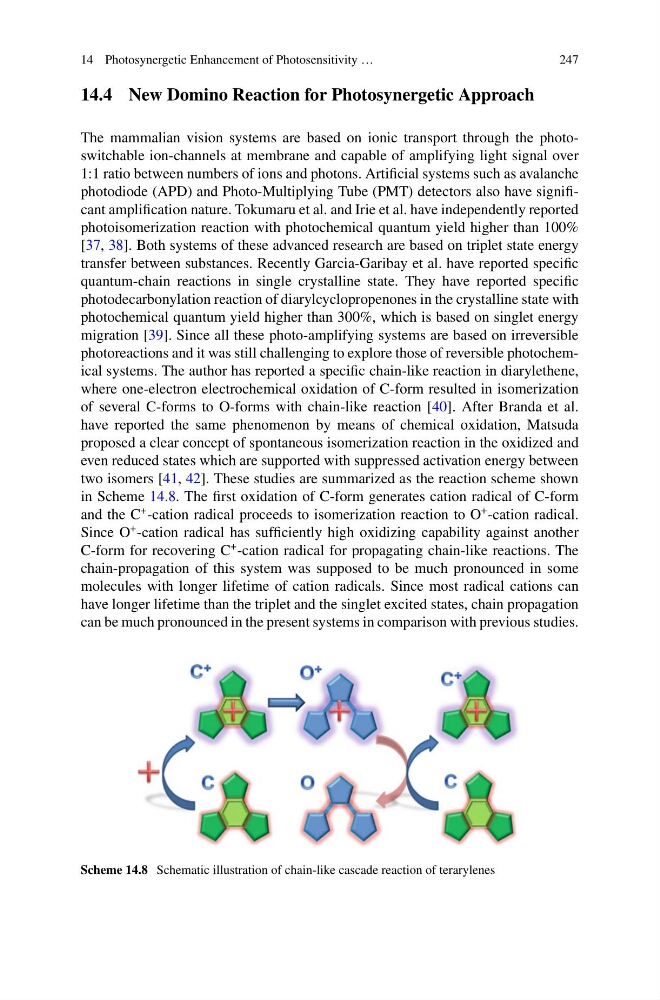
two isomers [41, 42]. These studies are summarized as the reaction scheme shown
in Scheme 14.8. The first oxidation of C-form generates cation radical of C-form
and the C
+ -cation radical proceeds to isomerization reaction to O
+ -cation radical.
Since O
+ -cation radical has sufficiently high oxidizing capability against another
C-form for recovering C
+ -cation radical for propagating chain-like reactions. The
chain-propagation of this system was supposed to be much pronounced in some
molecules with longer lifetime of cation radicals. Since most radical cations can
have longer lifetime than the triplet and the singlet excited states, chain propagation
can be much pronounced in the present systems in comparison with previous studies.
Scheme 14.8 Schematic illustration of chain-like cascade reaction of terarylenes
247
14.4 New Domino Reaction for Photosynergetic Approach
The mammalian vision systems are based on ionic transport through the photoswitchable ion-channels at membrane and capable of amplifying light signal over
1:1 ratio between numbers of ions and photons. Artificial systems such as avalanche
photodiode (APD) and Photo-Multiplying Tube (PMT) detectors also have significant amplification nature. Tokumaru et al. and Irie et al. have independently reported
photoisomerization reaction with photochemical quantum yield higher than 100%
[37, 38]. Both systems of these advanced research are based on triplet state energy
transfer between substances. Recently Garcia-Garibay et al. have reported specific
quantum-chain reactions in single crystalline state. They have reported specific
photodecarbonylation reaction of diarylcyclopropenones in the crystalline state with
photochemical quantum yield higher than 300%, which is based on singlet energy
migration [39]. Since all these photo-amplifying systems are based on irreversible
photoreactions and it was still challenging to explore those of reversible photochemical systems. The author has reported a specific chain-like reaction in diarylethene,
where one-electron electrochemical oxidation of C-form resulted in isomerization
of several C-forms to O-forms with chain-like reaction [40]. After Branda et al.
have reported the same phenomenon by means of chemical oxidation, Matsuda
proposed a clear concept of spontaneous isomerization reaction in the oxidized and
even reduced states which are supported with suppressed activation energy between
two isomers [41, 42]. These studies are summarized as the reaction scheme shown
in Scheme 14.8. The first oxidation of C-form generates cation radical of C-form
and the C
+ -cation radical proceeds to isomerization reaction to O
+ -cation radical.
Since O
+ -cation radical has sufficiently high oxidizing capability against another
C-form for recovering C
+ -cation radical for propagating chain-like reactions. The
chain-propagation of this system was supposed to be much pronounced in some
molecules with longer lifetime of cation radicals. Since most radical cations can
have longer lifetime than the triplet and the singlet excited states, chain propagation
can be much pronounced in the present systems in comparison with previous studies.
Scheme 14.8 Schematic illustration of chain-like cascade reaction of terarylenes