

246
T. Kawai
precious PAGs to form Brφnsted acids. Because of this specific nature, we called this
new PAG as the self-contained PAG, S-PAG. The new S-PAG was indeed capable to
use as the photo-initiator for cationic epoxy polymerization reaction. Various kinds
of Brφnsted acids can be released such as carboxylic acid and sulfonic acid [31,
32]. In the S-PAG for triflic acid which is a typical “super acid”, we stably introduced CF 3 SO3- unit in the open form on a naphthalene unit [33]. The ring-cyclized
form quantitatively releases acid affording the condensed aromatic form. The overall
quantum yield generating the acid is thus determined with the initial photocyclization reaction and can be as high as 71%, which is highest among the neutral PAGs
so far reported. Another advantage of the S-PAG is absence of radical intermediate,
which is commonly involved in the usual PAGs. The extended π-conjugation system
in terarylene seems supportive of the quantitative release of acid via the carbocation
intermediate stabilized over their π-conjugation.
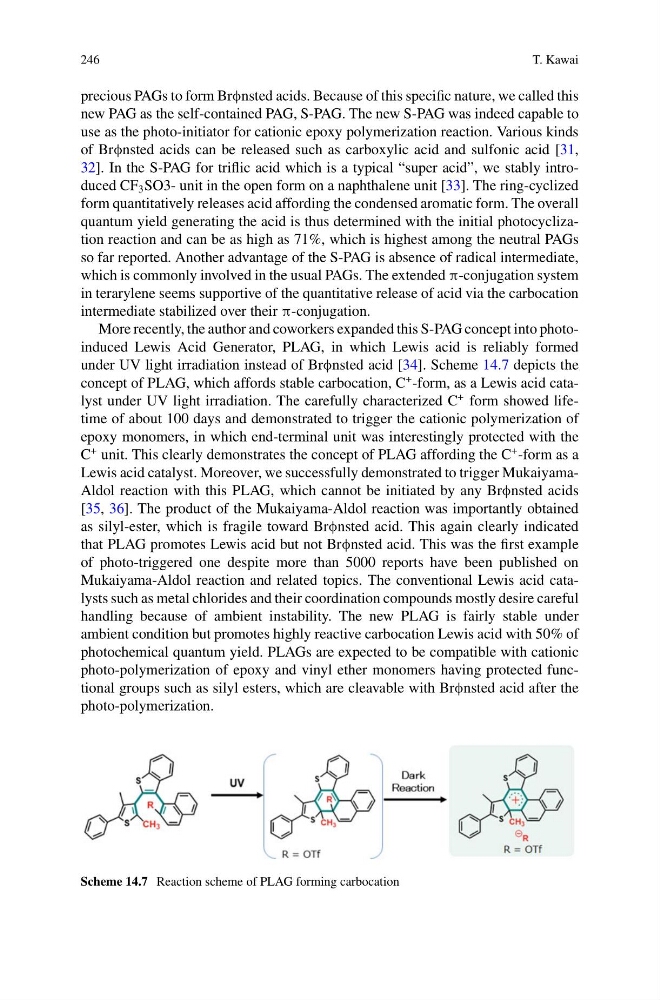
More recently, the author and coworkers expanded this S-PAG concept into photoinduced Lewis Acid Generator, PLAG, in which Lewis acid is reliably formed
under UV light irradiation instead of Brφnsted acid [34]. Scheme 14.7 depicts the
concept of PLAG, which affords stable carbocation, C
+ -form, as a Lewis acid catalyst under UV light irradiation. The carefully characterized C
+ form showed lifetime of about 100 days and demonstrated to trigger the cationic polymerization of
epoxy monomers, in which end-terminal unit was interestingly protected with the
C
+ unit. This clearly demonstrates the concept of PLAG affording the C
+ -form as a
Lewis acid catalyst. Moreover, we successfully demonstrated to trigger MukaiyamaAldol reaction with this PLAG, which cannot be initiated by any Brφnsted acids
[35, 36]. The product of the Mukaiyama-Aldol reaction was importantly obtained
as silyl-ester, which is fragile toward Brφnsted acid. This again clearly indicated
that PLAG promotes Lewis acid but not Brφnsted acid. This was the first example
of photo-triggered one despite more than 5000 reports have been published on
Mukaiyama-Aldol reaction and related topics. The conventional Lewis acid catalysts such as metal chlorides and their coordination compounds mostly desire careful
handling because of ambient instability. The new PLAG is fairly stable under
ambient condition but promotes highly reactive carbocation Lewis acid with 50% of
photochemical quantum yield. PLAGs are expected to be compatible with cationic
photo-polymerization of epoxy and vinyl ether monomers having protected functional groups such as silyl esters, which are cleavable with Brφnsted acid after the
photo-polymerization.
Scheme 14.7 Reaction scheme of PLAG forming carbocation
T. Kawai
precious PAGs to form Brφnsted acids. Because of this specific nature, we called this
new PAG as the self-contained PAG, S-PAG. The new S-PAG was indeed capable to
use as the photo-initiator for cationic epoxy polymerization reaction. Various kinds
of Brφnsted acids can be released such as carboxylic acid and sulfonic acid [31,
32]. In the S-PAG for triflic acid which is a typical “super acid”, we stably introduced CF 3 SO3- unit in the open form on a naphthalene unit [33]. The ring-cyclized
form quantitatively releases acid affording the condensed aromatic form. The overall
quantum yield generating the acid is thus determined with the initial photocyclization reaction and can be as high as 71%, which is highest among the neutral PAGs
so far reported. Another advantage of the S-PAG is absence of radical intermediate,
which is commonly involved in the usual PAGs. The extended π-conjugation system
in terarylene seems supportive of the quantitative release of acid via the carbocation
intermediate stabilized over their π-conjugation.
More recently, the author and coworkers expanded this S-PAG concept into photoinduced Lewis Acid Generator, PLAG, in which Lewis acid is reliably formed
under UV light irradiation instead of Brφnsted acid [34]. Scheme 14.7 depicts the
concept of PLAG, which affords stable carbocation, C
+ -form, as a Lewis acid catalyst under UV light irradiation. The carefully characterized C
+ form showed lifetime of about 100 days and demonstrated to trigger the cationic polymerization of
epoxy monomers, in which end-terminal unit was interestingly protected with the
C
+ unit. This clearly demonstrates the concept of PLAG affording the C
+ -form as a
Lewis acid catalyst. Moreover, we successfully demonstrated to trigger MukaiyamaAldol reaction with this PLAG, which cannot be initiated by any Brφnsted acids
[35, 36]. The product of the Mukaiyama-Aldol reaction was importantly obtained
as silyl-ester, which is fragile toward Brφnsted acid. This again clearly indicated
that PLAG promotes Lewis acid but not Brφnsted acid. This was the first example
of photo-triggered one despite more than 5000 reports have been published on
Mukaiyama-Aldol reaction and related topics. The conventional Lewis acid catalysts such as metal chlorides and their coordination compounds mostly desire careful
handling because of ambient instability. The new PLAG is fairly stable under
ambient condition but promotes highly reactive carbocation Lewis acid with 50% of
photochemical quantum yield. PLAGs are expected to be compatible with cationic
photo-polymerization of epoxy and vinyl ether monomers having protected functional groups such as silyl esters, which are cleavable with Brφnsted acid after the
photo-polymerization.
Scheme 14.7 Reaction scheme of PLAG forming carbocation