

14 Photosynergetic Enhancement of Photosensitivity …
245
was also studied [19]. Both of them displayed specific circularly polarized luminescence in the O-form and its diminish in C-form because of suppressed stereospecific
interaction between two emitting units at both ends of tetra-thiazole. This reversible
photo-switching nature associates with configurational conversion between sp2 and
sp3 at the reaction center carbon atoms.
14.3 Photoacid Generators Based on Terarylenes
Among various studies on photo-switching applications of diarylethenes, some
successful attempts have been reported on photo-reversible modulation of catalytic
activity [20–24]. They may offer remote control of chemical reactions in a limited
space and on-demand reaction triggering at the ambient temperature. The authors
have studied terarylene backbone for new photoacid generator, PAG. PAG is one of
the most frequently used industrial chemicals in photolithography technology and
photocuring processes, which forms Brfnsted acid after photo-decomposition reaction [25, 26]. Especially, non-ionic PAGs are widely used for the industrial process in
VLSI fabrication, in which they are demanded to be compatible with non-ionic polymers and monomers [27]. The non-ionic PAGs are usually composed of sulfonyl ester
and sulfonyl imide, which decompose under UV light irradiation forming sulfonic
acids. In order to trigger polymerization of epoxy monomers, sufficiently strong
acids such as triflic acids and other superacids are also desired. Since most industrial
PAGs have photochemical quantum yield of about 30% or less, it is still worth for
challenging to explore non-ionic PAGs with higher photosensitivity.
The authors have studied a tearylene with H− and CH 3 O− units at the reaction center carbon atoms instead of CH 3 − units, which exhibited photo-induced
release of CH 3 OH affording condensed aromatic substance [28, 29]. This dissociation reaction has been assigned to the E1-like elimination reaction, in which methoxy
anion dissociates from the ring-closed form isomer, and H
+ successively dissociates
from the carbocation intermediate. For developing new efficient PAGs based on
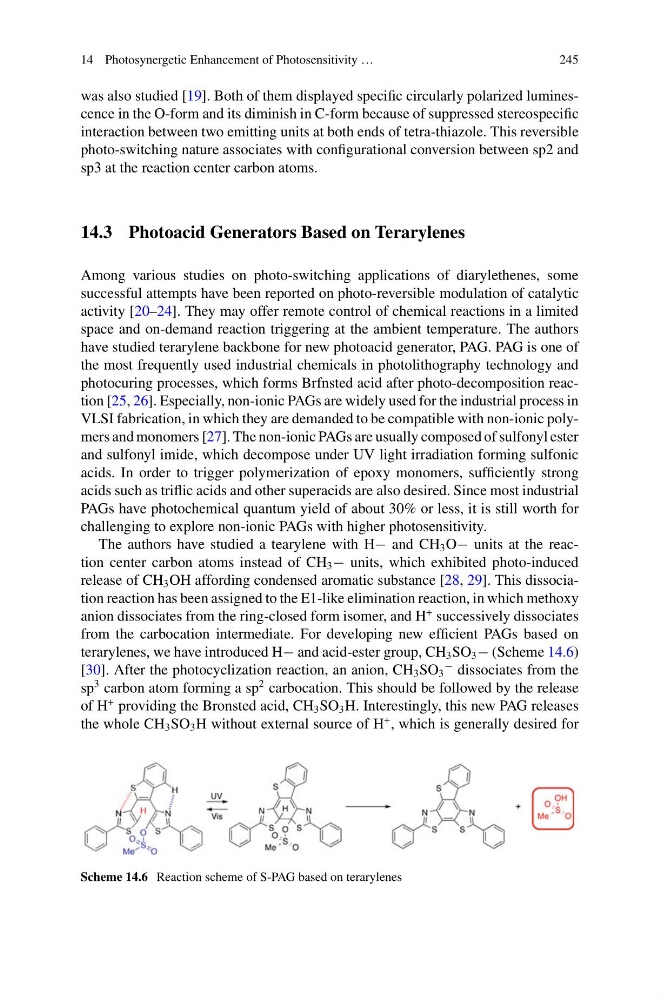
terarylenes, we have introduced H− and acid-ester group, CH 3 SO 3 − (Scheme 14.6)
[30]. After the photocyclization reaction, an anion, CH 3 SO 3
− dissociates from the
sp
3 carbon atom forming a sp
2 carbocation. This should be followed by the release
of H
+ providing the Bronsted acid, CH 3 SO 3 H. Interestingly, this new PAG releases
the whole CH 3 SO 3 H without external source of H
+ , which is generally desired for
Scheme 14.6 Reaction scheme of S-PAG based on terarylenes
245
was also studied [19]. Both of them displayed specific circularly polarized luminescence in the O-form and its diminish in C-form because of suppressed stereospecific
interaction between two emitting units at both ends of tetra-thiazole. This reversible
photo-switching nature associates with configurational conversion between sp2 and
sp3 at the reaction center carbon atoms.
14.3 Photoacid Generators Based on Terarylenes
Among various studies on photo-switching applications of diarylethenes, some
successful attempts have been reported on photo-reversible modulation of catalytic
activity [20–24]. They may offer remote control of chemical reactions in a limited
space and on-demand reaction triggering at the ambient temperature. The authors
have studied terarylene backbone for new photoacid generator, PAG. PAG is one of
the most frequently used industrial chemicals in photolithography technology and
photocuring processes, which forms Brfnsted acid after photo-decomposition reaction [25, 26]. Especially, non-ionic PAGs are widely used for the industrial process in
VLSI fabrication, in which they are demanded to be compatible with non-ionic polymers and monomers [27]. The non-ionic PAGs are usually composed of sulfonyl ester
and sulfonyl imide, which decompose under UV light irradiation forming sulfonic
acids. In order to trigger polymerization of epoxy monomers, sufficiently strong
acids such as triflic acids and other superacids are also desired. Since most industrial
PAGs have photochemical quantum yield of about 30% or less, it is still worth for
challenging to explore non-ionic PAGs with higher photosensitivity.
The authors have studied a tearylene with H− and CH 3 O− units at the reaction center carbon atoms instead of CH 3 − units, which exhibited photo-induced
release of CH 3 OH affording condensed aromatic substance [28, 29]. This dissociation reaction has been assigned to the E1-like elimination reaction, in which methoxy
anion dissociates from the ring-closed form isomer, and H
+ successively dissociates
from the carbocation intermediate. For developing new efficient PAGs based on
terarylenes, we have introduced H− and acid-ester group, CH 3 SO 3 − (Scheme 14.6)
[30]. After the photocyclization reaction, an anion, CH 3 SO 3
− dissociates from the
sp
3 carbon atom forming a sp
2 carbocation. This should be followed by the release
of H
+ providing the Bronsted acid, CH 3 SO 3 H. Interestingly, this new PAG releases
the whole CH 3 SO 3 H without external source of H
+ , which is generally desired for
Scheme 14.6 Reaction scheme of S-PAG based on terarylenes