

244
T. Kawai
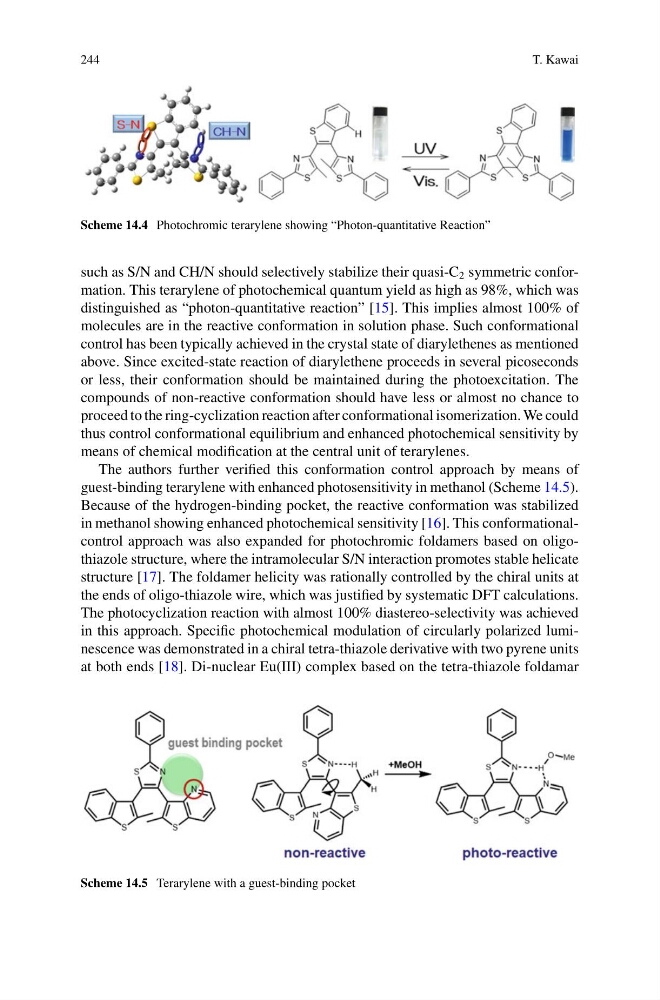
Scheme 14.4 Photochromic terarylene showing “Photon-quantitative Reaction”
such as S/N and CH/N should selectively stabilize their quasi-C 2 symmetric conformation. This terarylene of photochemical quantum yield as high as 98%, which was
distinguished as “photon-quantitative reaction” [15]. This implies almost 100% of
molecules are in the reactive conformation in solution phase. Such conformational
control has been typically achieved in the crystal state of diarylethenes as mentioned
above. Since excited-state reaction of diarylethene proceeds in several picoseconds
or less, their conformation should be maintained during the photoexcitation. The
compounds of non-reactive conformation should have less or almost no chance to
proceed to the ring-cyclization reaction after conformational isomerization. We could
thus control conformational equilibrium and enhanced photochemical sensitivity by
means of chemical modification at the central unit of terarylenes.
The authors further verified this conformation control approach by means of
guest-binding terarylene with enhanced photosensitivity in methanol (Scheme 14.5).
Because of the hydrogen-binding pocket, the reactive conformation was stabilized
in methanol showing enhanced photochemical sensitivity [16]. This conformationalcontrol approach was also expanded for photochromic foldamers based on oligothiazole structure, where the intramolecular S/N interaction promotes stable helicate
structure [17]. The foldamer helicity was rationally controlled by the chiral units at
the ends of oligo-thiazole wire, which was justified by systematic DFT calculations.
The photocyclization reaction with almost 100% diastereo-selectivity was achieved
in this approach. Specific photochemical modulation of circularly polarized luminescence was demonstrated in a chiral tetra-thiazole derivative with two pyrene units
at both ends [18]. Di-nuclear Eu(III) complex based on the tetra-thiazole foldamar
Scheme 14.5 Terarylene with a guest-binding pocket
T. Kawai
Scheme 14.4 Photochromic terarylene showing “Photon-quantitative Reaction”
such as S/N and CH/N should selectively stabilize their quasi-C 2 symmetric conformation. This terarylene of photochemical quantum yield as high as 98%, which was
distinguished as “photon-quantitative reaction” [15]. This implies almost 100% of
molecules are in the reactive conformation in solution phase. Such conformational
control has been typically achieved in the crystal state of diarylethenes as mentioned
above. Since excited-state reaction of diarylethene proceeds in several picoseconds
or less, their conformation should be maintained during the photoexcitation. The
compounds of non-reactive conformation should have less or almost no chance to
proceed to the ring-cyclization reaction after conformational isomerization. We could
thus control conformational equilibrium and enhanced photochemical sensitivity by
means of chemical modification at the central unit of terarylenes.
The authors further verified this conformation control approach by means of
guest-binding terarylene with enhanced photosensitivity in methanol (Scheme 14.5).
Because of the hydrogen-binding pocket, the reactive conformation was stabilized
in methanol showing enhanced photochemical sensitivity [16]. This conformationalcontrol approach was also expanded for photochromic foldamers based on oligothiazole structure, where the intramolecular S/N interaction promotes stable helicate
structure [17]. The foldamer helicity was rationally controlled by the chiral units at
the ends of oligo-thiazole wire, which was justified by systematic DFT calculations.
The photocyclization reaction with almost 100% diastereo-selectivity was achieved
in this approach. Specific photochemical modulation of circularly polarized luminescence was demonstrated in a chiral tetra-thiazole derivative with two pyrene units
at both ends [18]. Di-nuclear Eu(III) complex based on the tetra-thiazole foldamar
Scheme 14.5 Terarylene with a guest-binding pocket