

14 Photosynergetic Enhancement of Photosensitivity …
249
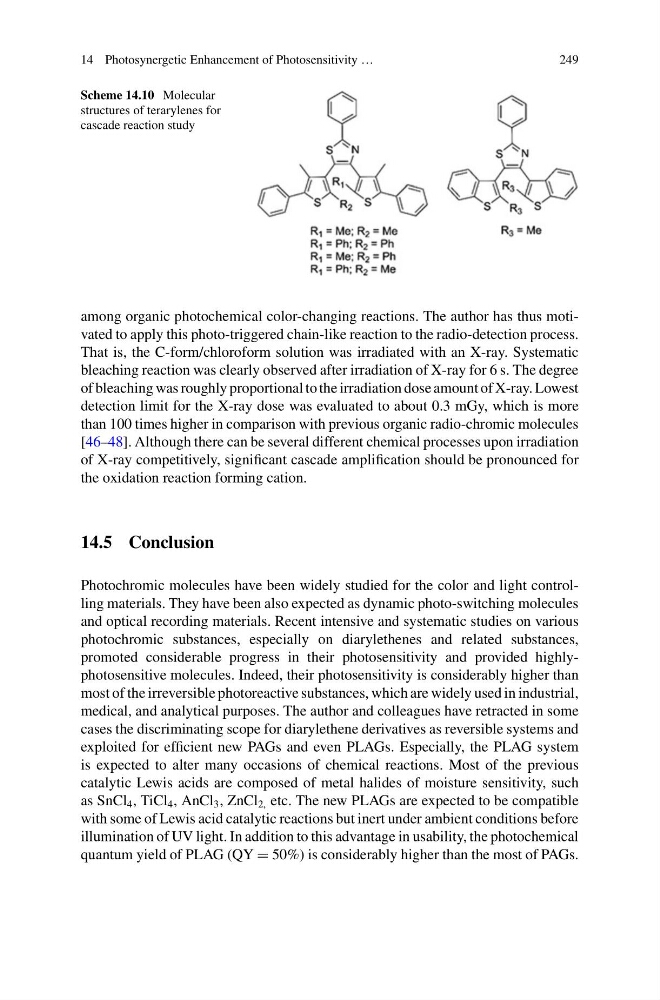
Scheme 14.10 Molecular
structures of terarylenes for
cascade reaction study
among organic photochemical color-changing reactions. The author has thus motivated to apply this photo-triggered chain-like reaction to the radio-detection process.
That is, the C-form/chloroform solution was irradiated with an X-ray. Systematic
bleaching reaction was clearly observed after irradiation of X-ray for 6 s. The degree
of bleaching was roughly proportional to the irradiation dose amount of X-ray. Lowest
detection limit for the X-ray dose was evaluated to about 0.3 mGy, which is more
than 100 times higher in comparison with previous organic radio-chromic molecules
[46–48]. Although there can be several different chemical processes upon irradiation
of X-ray competitively, significant cascade amplification should be pronounced for
the oxidation reaction forming cation.
14.5 Conclusion
Photochromic molecules have been widely studied for the color and light controlling materials. They have been also expected as dynamic photo-switching molecules
and optical recording materials. Recent intensive and systematic studies on various
photochromic substances, especially on diarylethenes and related substances,
promoted considerable progress in their photosensitivity and provided highlyphotosensitive molecules. Indeed, their photosensitivity is considerably higher than
most of the irreversible photoreactive substances, which are widely used in industrial,
medical, and analytical purposes. The author and colleagues have retracted in some
cases the discriminating scope for diarylethene derivatives as reversible systems and
exploited for efficient new PAGs and even PLAGs. Especially, the PLAG system
is expected to alter many occasions of chemical reactions. Most of the previous
catalytic Lewis acids are composed of metal halides of moisture sensitivity, such
as SnCl 4 , TiCl 4 , AnCl 3 , ZnCl 2, etc. The new PLAGs are expected to be compatible
with some of Lewis acid catalytic reactions but inert under ambient conditions before
illumination of UV light. In addition to this advantage in usability, the photochemical
quantum yield of PLAG (QY = 50%) is considerably higher than the most of PAGs.
249
Scheme 14.10 Molecular
structures of terarylenes for
cascade reaction study
among organic photochemical color-changing reactions. The author has thus motivated to apply this photo-triggered chain-like reaction to the radio-detection process.
That is, the C-form/chloroform solution was irradiated with an X-ray. Systematic
bleaching reaction was clearly observed after irradiation of X-ray for 6 s. The degree
of bleaching was roughly proportional to the irradiation dose amount of X-ray. Lowest
detection limit for the X-ray dose was evaluated to about 0.3 mGy, which is more
than 100 times higher in comparison with previous organic radio-chromic molecules
[46–48]. Although there can be several different chemical processes upon irradiation
of X-ray competitively, significant cascade amplification should be pronounced for
the oxidation reaction forming cation.
14.5 Conclusion
Photochromic molecules have been widely studied for the color and light controlling materials. They have been also expected as dynamic photo-switching molecules
and optical recording materials. Recent intensive and systematic studies on various
photochromic substances, especially on diarylethenes and related substances,
promoted considerable progress in their photosensitivity and provided highlyphotosensitive molecules. Indeed, their photosensitivity is considerably higher than
most of the irreversible photoreactive substances, which are widely used in industrial,
medical, and analytical purposes. The author and colleagues have retracted in some
cases the discriminating scope for diarylethene derivatives as reversible systems and
exploited for efficient new PAGs and even PLAGs. Especially, the PLAG system
is expected to alter many occasions of chemical reactions. Most of the previous
catalytic Lewis acids are composed of metal halides of moisture sensitivity, such
as SnCl 4 , TiCl 4 , AnCl 3 , ZnCl 2, etc. The new PLAGs are expected to be compatible
with some of Lewis acid catalytic reactions but inert under ambient conditions before
illumination of UV light. In addition to this advantage in usability, the photochemical
quantum yield of PLAG (QY = 50%) is considerably higher than the most of PAGs.