

13 Controlling Optical Properties of Multinary Quantum Dots …
233
size. Thus, it was clarified that precise control of the chemical composition, particle
size, shape, and heterojunction was necessary to design efficient QD photocatalysts
composed of multinary semiconductors.
13.4 Nonlinear Photoelectrochemical Responses of ZAITe
QD Film Electrodes
As mentioned in the introductory part, semiconductor QDs have been reported to
exhibit higher probabilities to induce nonlinear photoresponses, such as hot carrier
transfer and MEG by the absorption of a high-energy single photon, due to the
increased relaxation times of hot carriers in highly excited states. These can potentially enlarge the efficiencies of light energy conversion systems. Here, we clarified
the nonlinear behavior of photocurrent generation for photoelectrodes composed
of ZAITe QDs, in which hot carriers were generated with visible light irradiation
because of their small E g in the near-IR wavelength region [19].
Rod-shaped ZAITe QDs (Fig. 13.5) were immobilized on ITO substrates by
an alternative layer-by-layer deposition technique using 1,2-ethanedithiol as the
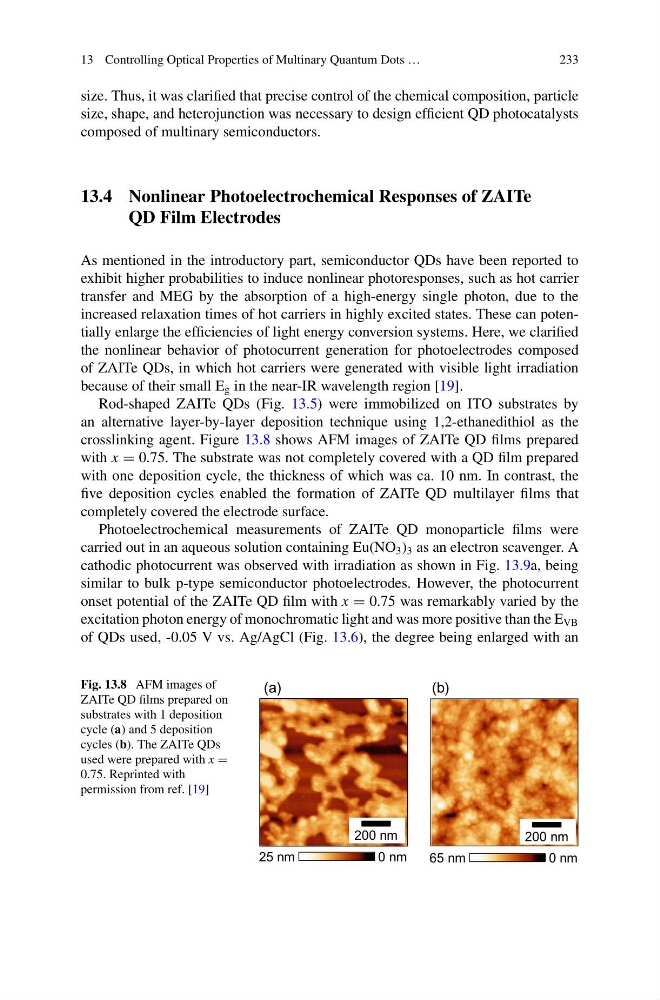
crosslinking agent. Figure 13.8 shows AFM images of ZAITe QD films prepared
with x = 0.75. The substrate was not completely covered with a QD film prepared
with one deposition cycle, the thickness of which was ca. 10 nm. In contrast, the
five deposition cycles enabled the formation of ZAITe QD multilayer films that
completely covered the electrode surface.
Photoelectrochemical measurements of ZAITe QD monoparticle films were
carried out in an aqueous solution containing Eu(NO 3 ) 3 as an electron scavenger. A
cathodic photocurrent was observed with irradiation as shown in Fig. 13.9a, being
similar to bulk p-type semiconductor photoelectrodes. However, the photocurrent
onset potential of the ZAITe QD film with x = 0.75 was remarkably varied by the
excitation photon energy of monochromatic light and was more positive than the E VB
of QDs used, -0.05 V vs. Ag/AgCl (Fig. 13.6), the degree being enlarged with an
Fig. 13.8 AFM images of
ZAITe QD films prepared on
substrates with 1 deposition
cycle (a) and 5 deposition
cycles (b). The ZAITe QDs
used were prepared with x =
0.75. Reprinted with
permission from ref. [19]
25 nm
0 nm
200 nm
65 nm
0 nm
200 nm
(a)
(b)
233
size. Thus, it was clarified that precise control of the chemical composition, particle
size, shape, and heterojunction was necessary to design efficient QD photocatalysts
composed of multinary semiconductors.
13.4 Nonlinear Photoelectrochemical Responses of ZAITe
QD Film Electrodes
As mentioned in the introductory part, semiconductor QDs have been reported to
exhibit higher probabilities to induce nonlinear photoresponses, such as hot carrier
transfer and MEG by the absorption of a high-energy single photon, due to the
increased relaxation times of hot carriers in highly excited states. These can potentially enlarge the efficiencies of light energy conversion systems. Here, we clarified
the nonlinear behavior of photocurrent generation for photoelectrodes composed
of ZAITe QDs, in which hot carriers were generated with visible light irradiation
because of their small E g in the near-IR wavelength region [19].
Rod-shaped ZAITe QDs (Fig. 13.5) were immobilized on ITO substrates by
an alternative layer-by-layer deposition technique using 1,2-ethanedithiol as the
crosslinking agent. Figure 13.8 shows AFM images of ZAITe QD films prepared
with x = 0.75. The substrate was not completely covered with a QD film prepared
with one deposition cycle, the thickness of which was ca. 10 nm. In contrast, the
five deposition cycles enabled the formation of ZAITe QD multilayer films that
completely covered the electrode surface.
Photoelectrochemical measurements of ZAITe QD monoparticle films were
carried out in an aqueous solution containing Eu(NO 3 ) 3 as an electron scavenger. A
cathodic photocurrent was observed with irradiation as shown in Fig. 13.9a, being
similar to bulk p-type semiconductor photoelectrodes. However, the photocurrent
onset potential of the ZAITe QD film with x = 0.75 was remarkably varied by the
excitation photon energy of monochromatic light and was more positive than the E VB
of QDs used, -0.05 V vs. Ag/AgCl (Fig. 13.6), the degree being enlarged with an
Fig. 13.8 AFM images of
ZAITe QD films prepared on
substrates with 1 deposition
cycle (a) and 5 deposition
cycles (b). The ZAITe QDs
used were prepared with x =
0.75. Reprinted with
permission from ref. [19]
25 nm
0 nm
200 nm
65 nm
0 nm
200 nm
(a)
(b)