

232
T. Torimoto and T. Kameyama
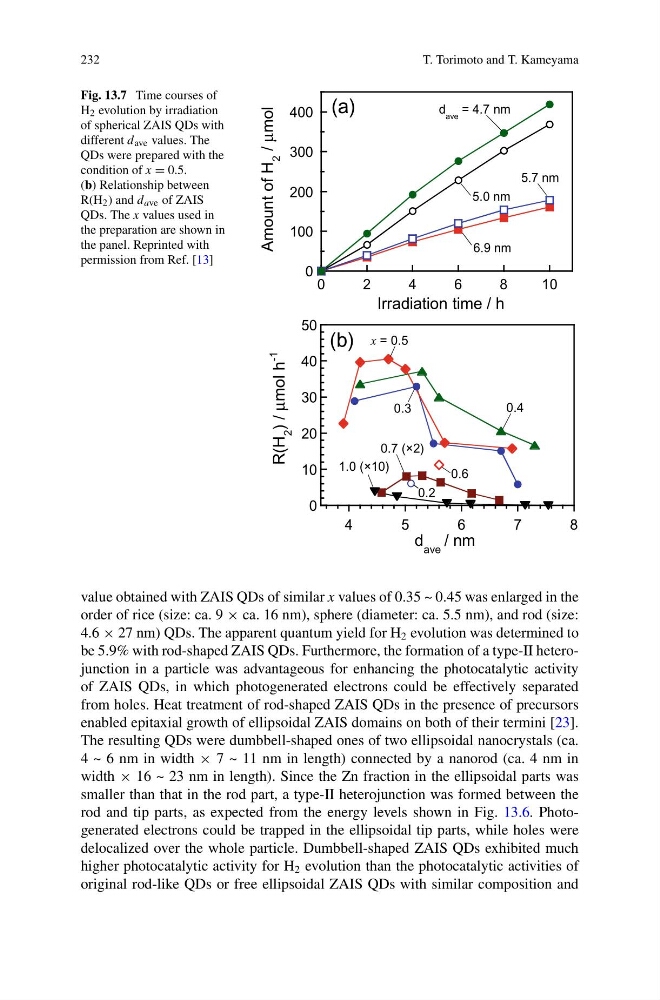
Fig. 13.7 Time courses of
H 2 evolution by irradiation
of spherical ZAIS QDs with
different d ave values. The
QDs were prepared with the
condition of x = 0.5.
(b) Relationship between
R(H 2 ) and d ave of ZAIS
QDs. The x values used in
the preparation are shown in
the panel. Reprinted with
permission from Ref. [13]
(a)
(b)
0
2
4
6
8
10
0
100
200
300
400
Amount of H
2
/ µmol
Irradiation time / h
d ave = 4.7 nm
5.0 nm
6.9 nm
5.7 nm
4
5
6
7
8
0
10
20
30
40
50
R(H
2
) / µmol h
-1
d ave / nm
0.4
0.3
0.7 ( 2)
1.0 ( 10)
0.2
0.6
x = 0.5
value obtained with ZAIS QDs of similar x values of 0.35 ~ 0.45 was enlarged in the
order of rice (size: ca. 9 × ca. 16 nm), sphere (diameter: ca. 5.5 nm), and rod (size:
4.6 × 27 nm) QDs. The apparent quantum yield for H 2 evolution was determined to
be 5.9% with rod-shaped ZAIS QDs. Furthermore, the formation of a type-II heterojunction in a particle was advantageous for enhancing the photocatalytic activity
of ZAIS QDs, in which photogenerated electrons could be effectively separated
from holes. Heat treatment of rod-shaped ZAIS QDs in the presence of precursors
enabled epitaxial growth of ellipsoidal ZAIS domains on both of their termini [23].
The resulting QDs were dumbbell-shaped ones of two ellipsoidal nanocrystals (ca.
4 ~ 6 nm in width × 7 ~ 11 nm in length) connected by a nanorod (ca. 4 nm in
width × 16 ~ 23 nm in length). Since the Zn fraction in the ellipsoidal parts was
smaller than that in the rod part, a type-II heterojunction was formed between the
rod and tip parts, as expected from the energy levels shown in Fig. 13.6. Photogenerated electrons could be trapped in the ellipsoidal tip parts, while holes were
delocalized over the whole particle. Dumbbell-shaped ZAIS QDs exhibited much
higher photocatalytic activity for H 2 evolution than the photocatalytic activities of
original rod-like QDs or free ellipsoidal ZAIS QDs with similar composition and
T. Torimoto and T. Kameyama
Fig. 13.7 Time courses of
H 2 evolution by irradiation
of spherical ZAIS QDs with
different d ave values. The
QDs were prepared with the
condition of x = 0.5.
(b) Relationship between
R(H 2 ) and d ave of ZAIS
QDs. The x values used in
the preparation are shown in
the panel. Reprinted with
permission from Ref. [13]
(a)
(b)
0
2
4
6
8
10
0
100
200
300
400
Amount of H
2
/ µmol
Irradiation time / h
d ave = 4.7 nm
5.0 nm
6.9 nm
5.7 nm
4
5
6
7
8
0
10
20
30
40
50
R(H
2
) / µmol h
-1
d ave / nm
0.4
0.3
0.7 ( 2)
1.0 ( 10)
0.2
0.6
x = 0.5
value obtained with ZAIS QDs of similar x values of 0.35 ~ 0.45 was enlarged in the
order of rice (size: ca. 9 × ca. 16 nm), sphere (diameter: ca. 5.5 nm), and rod (size:
4.6 × 27 nm) QDs. The apparent quantum yield for H 2 evolution was determined to
be 5.9% with rod-shaped ZAIS QDs. Furthermore, the formation of a type-II heterojunction in a particle was advantageous for enhancing the photocatalytic activity
of ZAIS QDs, in which photogenerated electrons could be effectively separated
from holes. Heat treatment of rod-shaped ZAIS QDs in the presence of precursors
enabled epitaxial growth of ellipsoidal ZAIS domains on both of their termini [23].
The resulting QDs were dumbbell-shaped ones of two ellipsoidal nanocrystals (ca.
4 ~ 6 nm in width × 7 ~ 11 nm in length) connected by a nanorod (ca. 4 nm in
width × 16 ~ 23 nm in length). Since the Zn fraction in the ellipsoidal parts was
smaller than that in the rod part, a type-II heterojunction was formed between the
rod and tip parts, as expected from the energy levels shown in Fig. 13.6. Photogenerated electrons could be trapped in the ellipsoidal tip parts, while holes were
delocalized over the whole particle. Dumbbell-shaped ZAIS QDs exhibited much
higher photocatalytic activity for H 2 evolution than the photocatalytic activities of
original rod-like QDs or free ellipsoidal ZAIS QDs with similar composition and