

13 Controlling Optical Properties of Multinary Quantum Dots …
231
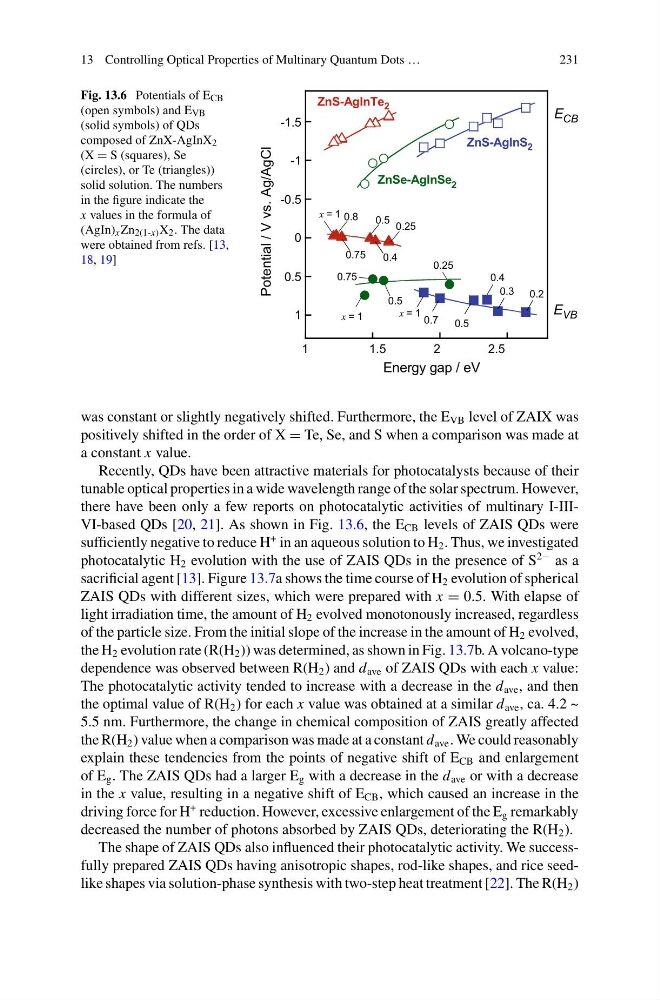
Fig. 13.6 Potentials of E CB
(open symbols) and E VB
(solid symbols) of QDs
composed of ZnX-AgInX 2
(X = S (squares), Se
(circles), or Te (triangles))
solid solution. The numbers
in the figure indicate the
x values in the formula of
(AgIn) x Zn 2(1-x) X 2 . The data
were obtained from refs. [13,
18, 19]
1
1.5
2
2.5
-1.5
-1
-0.5
0
0.5
1
Energy gap / eV
Potential / V vs. Ag/AgCl
E CB
E VB
ZnS-AgInTe 2
ZnSe-AgInSe 2
ZnS-AgInS 2
x = 1
0.5
0.8
0.75
0.5
0.25
x = 1
x = 1 0.7
0.5
0.4
0.3 0.2
0.25
0.4
0.75
was constant or slightly negatively shifted. Furthermore, the E VB level of ZAIX was
positively shifted in the order of X = Te, Se, and S when a comparison was made at
a constant x value.
Recently, QDs have been attractive materials for photocatalysts because of their
tunable optical properties in a wide wavelength range of the solar spectrum. However,
there have been only a few reports on photocatalytic activities of multinary I-IIIVI-based QDs [20, 21]. As shown in Fig. 13.6, the E CB levels of ZAIS QDs were
sufficiently negative to reduce H
+ in an aqueous solution to H 2 . Thus, we investigated
photocatalytic H 2 evolution with the use of ZAIS QDs in the presence of S
2− as a
sacrificial agent [13]. Figure 13.7a shows the time course of H 2 evolution of spherical
ZAIS QDs with different sizes, which were prepared with x = 0.5. With elapse of
light irradiation time, the amount of H 2 evolved monotonously increased, regardless
of the particle size. From the initial slope of the increase in the amount of H 2 evolved,
the H 2 evolution rate (R(H 2 )) was determined, as shown in Fig. 13.7b. A volcano-type
dependence was observed between R(H 2 ) and d ave of ZAIS QDs with each x value:
The photocatalytic activity tended to increase with a decrease in the d ave , and then
the optimal value of R(H 2 ) for each x value was obtained at a similar d ave , ca. 4.2 ~
5.5 nm. Furthermore, the change in chemical composition of ZAIS greatly affected
the R(H 2 ) value when a comparison was made at a constant d ave . We could reasonably
explain these tendencies from the points of negative shift of E CB and enlargement
of E g . The ZAIS QDs had a larger E g with a decrease in the d ave or with a decrease
in the x value, resulting in a negative shift of E CB , which caused an increase in the
driving force for H
+ reduction. However, excessive enlargement of the E g remarkably
decreased the number of photons absorbed by ZAIS QDs, deteriorating the R(H 2 ).
The shape of ZAIS QDs also influenced their photocatalytic activity. We successfully prepared ZAIS QDs having anisotropic shapes, rod-like shapes, and rice seedlike shapes via solution-phase synthesis with two-step heat treatment [22]. The R(H 2 )
231
Fig. 13.6 Potentials of E CB
(open symbols) and E VB
(solid symbols) of QDs
composed of ZnX-AgInX 2
(X = S (squares), Se
(circles), or Te (triangles))
solid solution. The numbers
in the figure indicate the
x values in the formula of
(AgIn) x Zn 2(1-x) X 2 . The data
were obtained from refs. [13,
18, 19]
1
1.5
2
2.5
-1.5
-1
-0.5
0
0.5
1
Energy gap / eV
Potential / V vs. Ag/AgCl
E CB
E VB
ZnS-AgInTe 2
ZnSe-AgInSe 2
ZnS-AgInS 2
x = 1
0.5
0.8
0.75
0.5
0.25
x = 1
x = 1 0.7
0.5
0.4
0.3 0.2
0.25
0.4
0.75
was constant or slightly negatively shifted. Furthermore, the E VB level of ZAIX was
positively shifted in the order of X = Te, Se, and S when a comparison was made at
a constant x value.
Recently, QDs have been attractive materials for photocatalysts because of their
tunable optical properties in a wide wavelength range of the solar spectrum. However,
there have been only a few reports on photocatalytic activities of multinary I-IIIVI-based QDs [20, 21]. As shown in Fig. 13.6, the E CB levels of ZAIS QDs were
sufficiently negative to reduce H
+ in an aqueous solution to H 2 . Thus, we investigated
photocatalytic H 2 evolution with the use of ZAIS QDs in the presence of S
2− as a
sacrificial agent [13]. Figure 13.7a shows the time course of H 2 evolution of spherical
ZAIS QDs with different sizes, which were prepared with x = 0.5. With elapse of
light irradiation time, the amount of H 2 evolved monotonously increased, regardless
of the particle size. From the initial slope of the increase in the amount of H 2 evolved,
the H 2 evolution rate (R(H 2 )) was determined, as shown in Fig. 13.7b. A volcano-type
dependence was observed between R(H 2 ) and d ave of ZAIS QDs with each x value:
The photocatalytic activity tended to increase with a decrease in the d ave , and then
the optimal value of R(H 2 ) for each x value was obtained at a similar d ave , ca. 4.2 ~
5.5 nm. Furthermore, the change in chemical composition of ZAIS greatly affected
the R(H 2 ) value when a comparison was made at a constant d ave . We could reasonably
explain these tendencies from the points of negative shift of E CB and enlargement
of E g . The ZAIS QDs had a larger E g with a decrease in the d ave or with a decrease
in the x value, resulting in a negative shift of E CB , which caused an increase in the
driving force for H
+ reduction. However, excessive enlargement of the E g remarkably
decreased the number of photons absorbed by ZAIS QDs, deteriorating the R(H 2 ).
The shape of ZAIS QDs also influenced their photocatalytic activity. We successfully prepared ZAIS QDs having anisotropic shapes, rod-like shapes, and rice seedlike shapes via solution-phase synthesis with two-step heat treatment [22]. The R(H 2 )