

230
T. Torimoto and T. Kameyama
50 nm
(a)
(b)
5 nm
600 800 1000 1200
0.25
0.50
0.75
x = 1.0
Absorbance / a.u.
Wavelength / nm
PL intensity / a.u.
(c)
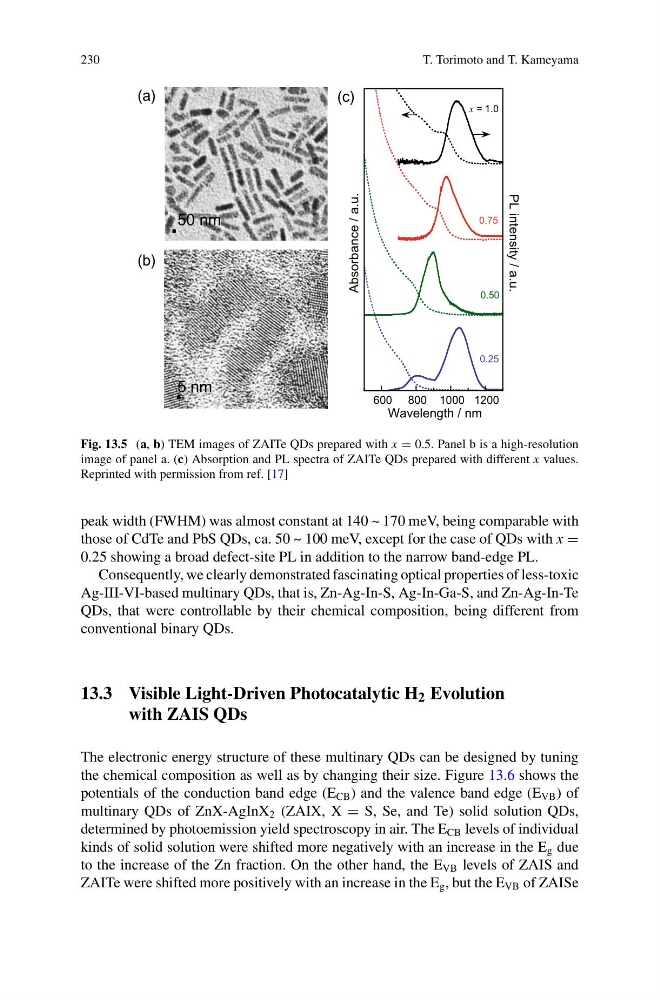
Fig. 13.5 (a, b) TEM images of ZAITe QDs prepared with x = 0.5. Panel b is a high-resolution
image of panel a. (c) Absorption and PL spectra of ZAITe QDs prepared with different x values.
Reprinted with permission from ref. [17]
peak width (FWHM) was almost constant at 140 ~ 170 meV, being comparable with
those of CdTe and PbS QDs, ca. 50 ~ 100 meV, except for the case of QDs with x =
0.25 showing a broad defect-site PL in addition to the narrow band-edge PL.
Consequently, we clearly demonstrated fascinating optical properties of less-toxic
Ag-III-VI-based multinary QDs, that is, Zn-Ag-In-S, Ag-In-Ga-S, and Zn-Ag-In-Te
QDs, that were controllable by their chemical composition, being different from
conventional binary QDs.
13.3 Visible Light-Driven Photocatalytic H 2 Evolution
with ZAIS QDs
The electronic energy structure of these multinary QDs can be designed by tuning
the chemical composition as well as by changing their size. Figure 13.6 shows the
potentials of the conduction band edge (E CB ) and the valence band edge (E VB ) of
multinary QDs of ZnX-AgInX 2 (ZAIX, X = S, Se, and Te) solid solution QDs,
determined by photoemission yield spectroscopy in air. The E CB levels of individual
kinds of solid solution were shifted more negatively with an increase in the E g due
to the increase of the Zn fraction. On the other hand, the E VB levels of ZAIS and
ZAITe were shifted more positively with an increase in the E g , but the E VB of ZAISe
T. Torimoto and T. Kameyama
50 nm
(a)
(b)
5 nm
600 800 1000 1200
0.25
0.50
0.75
x = 1.0
Absorbance / a.u.
Wavelength / nm
PL intensity / a.u.
(c)
Fig. 13.5 (a, b) TEM images of ZAITe QDs prepared with x = 0.5. Panel b is a high-resolution
image of panel a. (c) Absorption and PL spectra of ZAITe QDs prepared with different x values.
Reprinted with permission from ref. [17]
peak width (FWHM) was almost constant at 140 ~ 170 meV, being comparable with
those of CdTe and PbS QDs, ca. 50 ~ 100 meV, except for the case of QDs with x =
0.25 showing a broad defect-site PL in addition to the narrow band-edge PL.
Consequently, we clearly demonstrated fascinating optical properties of less-toxic
Ag-III-VI-based multinary QDs, that is, Zn-Ag-In-S, Ag-In-Ga-S, and Zn-Ag-In-Te
QDs, that were controllable by their chemical composition, being different from
conventional binary QDs.
13.3 Visible Light-Driven Photocatalytic H 2 Evolution
with ZAIS QDs
The electronic energy structure of these multinary QDs can be designed by tuning
the chemical composition as well as by changing their size. Figure 13.6 shows the
potentials of the conduction band edge (E CB ) and the valence band edge (E VB ) of
multinary QDs of ZnX-AgInX 2 (ZAIX, X = S, Se, and Te) solid solution QDs,
determined by photoemission yield spectroscopy in air. The E CB levels of individual
kinds of solid solution were shifted more negatively with an increase in the E g due
to the increase of the Zn fraction. On the other hand, the E VB levels of ZAIS and
ZAITe were shifted more positively with an increase in the E g , but the E VB of ZAISe