

12 Plasmon-Induced Carrier Transfer for Infrared Light Energy …
217
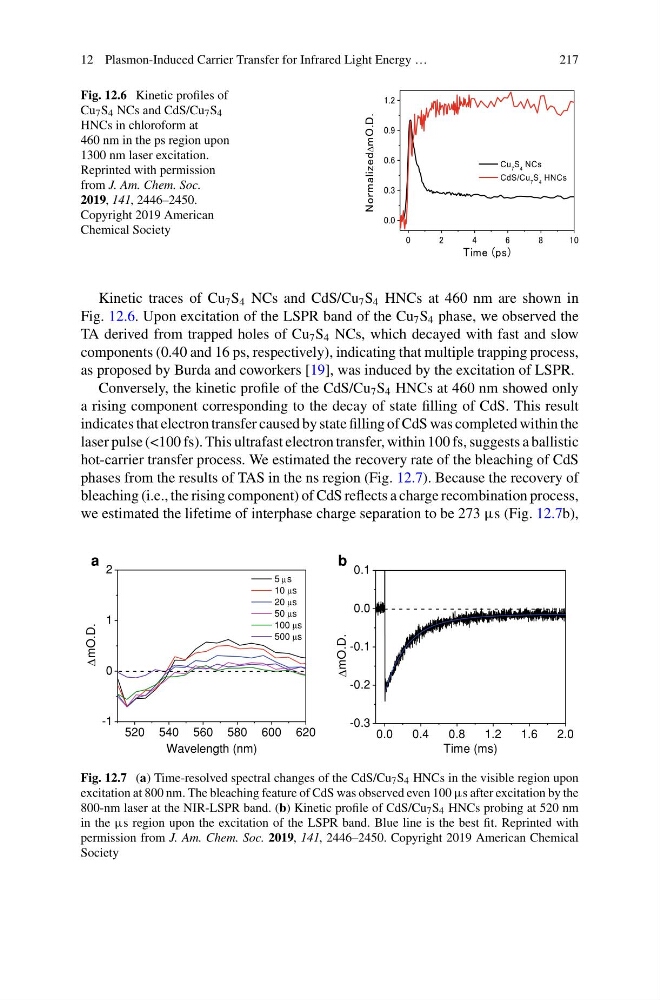
Fig. 12.6 Kinetic profiles of
Cu 7 S 4 NCs and CdS/Cu 7 S 4
HNCs in chloroform at
460 nm in the ps region upon
1300 nm laser excitation.
Reprinted with permission
from J. Am. Chem. Soc.
2019, 141, 2446–2450.
Copyright 2019 American
Chemical Society
Kinetic traces of Cu 7 S 4 NCs and CdS/Cu 7 S 4 HNCs at 460 nm are shown in
Fig. 12.6. Upon excitation of the LSPR band of the Cu 7 S 4 phase, we observed the
TA derived from trapped holes of Cu 7 S 4 NCs, which decayed with fast and slow
components (0.40 and 16 ps, respectively), indicating that multiple trapping process,
as proposed by Burda and coworkers [19], was induced by the excitation of LSPR.
Conversely, the kinetic profile of the CdS/Cu 7 S 4 HNCs at 460 nm showed only
a rising component corresponding to the decay of state filling of CdS. This result
indicates that electron transfer caused by state filling of CdS was completed within the
laser pulse (<100 fs). This ultrafast electron transfer, within 100 fs, suggests a ballistic
hot-carrier transfer process. We estimated the recovery rate of the bleaching of CdS
phases from the results of TAS in the ns region (Fig. 12.7). Because the recovery of
bleaching (i.e., the rising component) of CdS reflects a charge recombination process,
we estimated the lifetime of interphase charge separation to be 273 μs (Fig. 12.7b),
0.0
0.4
0.8
1.2
1.6
2.0
-0.3
-0.2
-0.1
0.0
0.1
∇
mO.D.
Time (ms)
520 540 560 580 600 620
-1
0
1
2
∇
mO.D.
Wavelength (nm)
5 μs
10 μs
20 μs
50 μs
100 μs
500 μs
a
b
Fig. 12.7 (a) Time-resolved spectral changes of the CdS/Cu 7 S 4 HNCs in the visible region upon
excitation at 800 nm. The bleaching feature of CdS was observed even 100 μs after excitation by the
800-nm laser at the NIR-LSPR band. (b) Kinetic profile of CdS/Cu 7 S 4 HNCs probing at 520 nm
in the μs region upon the excitation of the LSPR band. Blue line is the best fit. Reprinted with
permission from J. Am. Chem. Soc. 2019, 141, 2446–2450. Copyright 2019 American Chemical
Society
217
Fig. 12.6 Kinetic profiles of
Cu 7 S 4 NCs and CdS/Cu 7 S 4
HNCs in chloroform at
460 nm in the ps region upon
1300 nm laser excitation.
Reprinted with permission
from J. Am. Chem. Soc.
2019, 141, 2446–2450.
Copyright 2019 American
Chemical Society
Kinetic traces of Cu 7 S 4 NCs and CdS/Cu 7 S 4 HNCs at 460 nm are shown in
Fig. 12.6. Upon excitation of the LSPR band of the Cu 7 S 4 phase, we observed the
TA derived from trapped holes of Cu 7 S 4 NCs, which decayed with fast and slow
components (0.40 and 16 ps, respectively), indicating that multiple trapping process,
as proposed by Burda and coworkers [19], was induced by the excitation of LSPR.
Conversely, the kinetic profile of the CdS/Cu 7 S 4 HNCs at 460 nm showed only
a rising component corresponding to the decay of state filling of CdS. This result
indicates that electron transfer caused by state filling of CdS was completed within the
laser pulse (<100 fs). This ultrafast electron transfer, within 100 fs, suggests a ballistic
hot-carrier transfer process. We estimated the recovery rate of the bleaching of CdS
phases from the results of TAS in the ns region (Fig. 12.7). Because the recovery of
bleaching (i.e., the rising component) of CdS reflects a charge recombination process,
we estimated the lifetime of interphase charge separation to be 273 μs (Fig. 12.7b),
0.0
0.4
0.8
1.2
1.6
2.0
-0.3
-0.2
-0.1
0.0
0.1
∇
mO.D.
Time (ms)
520 540 560 580 600 620
-1
0
1
2
∇
mO.D.
Wavelength (nm)
5 μs
10 μs
20 μs
50 μs
100 μs
500 μs
a
b
Fig. 12.7 (a) Time-resolved spectral changes of the CdS/Cu 7 S 4 HNCs in the visible region upon
excitation at 800 nm. The bleaching feature of CdS was observed even 100 μs after excitation by the
800-nm laser at the NIR-LSPR band. (b) Kinetic profile of CdS/Cu 7 S 4 HNCs probing at 520 nm
in the μs region upon the excitation of the LSPR band. Blue line is the best fit. Reprinted with
permission from J. Am. Chem. Soc. 2019, 141, 2446–2450. Copyright 2019 American Chemical
Society