

218
M. Sakamoto et al.
which is exceptionally long compared with that of typical plasmonic hot-carrier
transfer systems (several tens of ps) [21].
12.4 Photocatalytic H 2 Evolution
The photocatalytic H 2 evolution reaction (HER) activity under IR-light irradiation
(λ > 800 nm, i.e., only exciting the LSPR) of Cu 7 S 4 or CdS/Cu 7 S 4 HNCs was
evaluated in an aqueous solution containing H 2 PtCl 6 as a H 2 evolution cocatalyst
precursor and Na 2 S–Na 2 SO 3 as a hole scavenger.
For photocatalytic H 2 generation measurements, we used a home-made onlineflow sampling system with a quartz reactor connected to a gas chromatograph (GC2004, Shimadzu, with argon as a carrier gas) and a thermal conductivity detector
(TCD). To measure of photocatalytic activity, a 10.0-mg portion of the photocatalyst
was dispersed in 100 mL of an aqueous solution containing 0.25 M Na 2 S and 0.35 M
Na 2 SO 3 as sacrificial reagents, and 27 μL 1 wt% H 2 PtCl 6 aqueous solution was then
added to the solution. Before IR-light irradiation, the system was stirred under an
argon flow to remove oxygen. The reaction temperature was maintained at 20 °C.
A 300-W Xe lamp (Aegle lamp house R300-3 J, Cermax, Excelitas Technology)
equipped with a UV–visible cut-off filter (λ > 800 nm, power density: 50 mW cm
−2 )
was used as the irradiation light source.
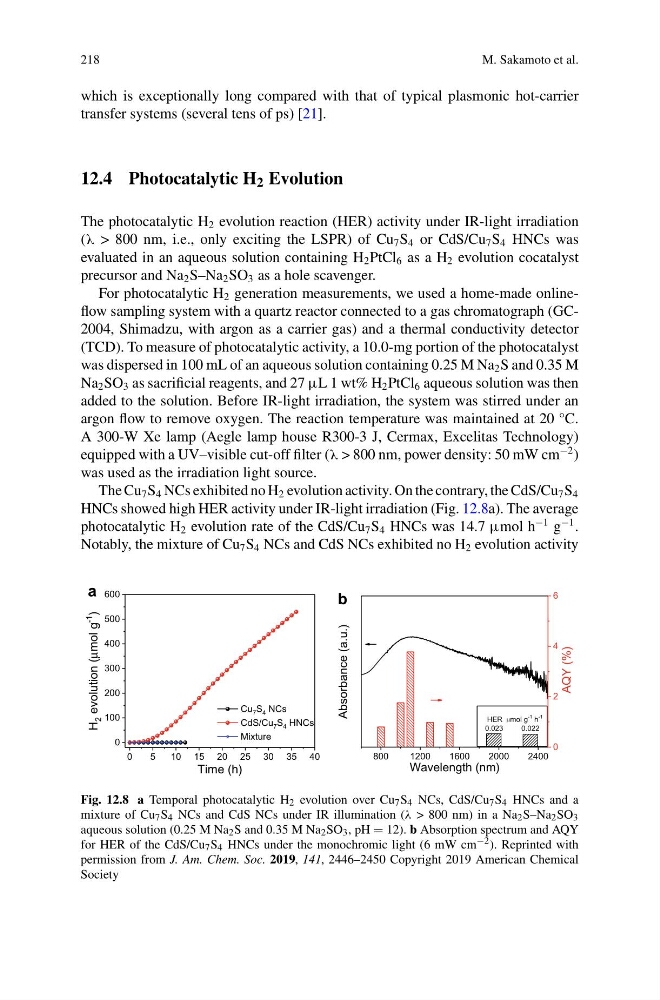
The Cu 7 S 4 NCs exhibited no H 2 evolution activity. On the contrary, the CdS/Cu 7 S 4
HNCs showed high HER activity under IR-light irradiation (Fig. 12.8a). The average
photocatalytic H 2 evolution rate of the CdS/Cu 7 S 4 HNCs was 14.7 μmol h
−1 g
−1 .
Notably, the mixture of Cu 7 S 4 NCs and CdS NCs exhibited no H 2 evolution activity
0
5
10 15 20 25 30 35 40
0
100
200
300
400
500
600
Cu 7 S 4 NCs
CdS/Cu 7 S 4 HNCs
Mixture
H
2 evolution (μmol
g
-1
)
a
Time (h)
800
1200
1600
2000
2400
Wavelength (nm)
Absorbance (a.u.)
b
0
2
4
6
AQY (%)
HER mol g
-1 h
-1
0.023
0.022
Fig. 12.8 a Temporal photocatalytic H 2 evolution over Cu 7 S 4 NCs, CdS/Cu 7 S 4 HNCs and a
mixture of Cu 7 S 4 NCs and CdS NCs under IR illumination (λ > 800 nm) in a Na 2 S–Na 2 SO 3
aqueous solution (0.25 M Na 2 S and 0.35 M Na 2 SO 3 , pH = 12). b Absorption spectrum and AQY
for HER of the CdS/Cu 7 S 4 HNCs under the monochromic light (6 mW cm −2 ). Reprinted with
permission from J. Am. Chem. Soc. 2019, 141, 2446–2450 Copyright 2019 American Chemical
Society
M. Sakamoto et al.
which is exceptionally long compared with that of typical plasmonic hot-carrier
transfer systems (several tens of ps) [21].
12.4 Photocatalytic H 2 Evolution
The photocatalytic H 2 evolution reaction (HER) activity under IR-light irradiation
(λ > 800 nm, i.e., only exciting the LSPR) of Cu 7 S 4 or CdS/Cu 7 S 4 HNCs was
evaluated in an aqueous solution containing H 2 PtCl 6 as a H 2 evolution cocatalyst
precursor and Na 2 S–Na 2 SO 3 as a hole scavenger.
For photocatalytic H 2 generation measurements, we used a home-made onlineflow sampling system with a quartz reactor connected to a gas chromatograph (GC2004, Shimadzu, with argon as a carrier gas) and a thermal conductivity detector
(TCD). To measure of photocatalytic activity, a 10.0-mg portion of the photocatalyst
was dispersed in 100 mL of an aqueous solution containing 0.25 M Na 2 S and 0.35 M
Na 2 SO 3 as sacrificial reagents, and 27 μL 1 wt% H 2 PtCl 6 aqueous solution was then
added to the solution. Before IR-light irradiation, the system was stirred under an
argon flow to remove oxygen. The reaction temperature was maintained at 20 °C.
A 300-W Xe lamp (Aegle lamp house R300-3 J, Cermax, Excelitas Technology)
equipped with a UV–visible cut-off filter (λ > 800 nm, power density: 50 mW cm
−2 )
was used as the irradiation light source.
The Cu 7 S 4 NCs exhibited no H 2 evolution activity. On the contrary, the CdS/Cu 7 S 4
HNCs showed high HER activity under IR-light irradiation (Fig. 12.8a). The average
photocatalytic H 2 evolution rate of the CdS/Cu 7 S 4 HNCs was 14.7 μmol h
−1 g
−1 .
Notably, the mixture of Cu 7 S 4 NCs and CdS NCs exhibited no H 2 evolution activity
0
5
10 15 20 25 30 35 40
0
100
200
300
400
500
600
Cu 7 S 4 NCs
CdS/Cu 7 S 4 HNCs
Mixture
H
2 evolution (μmol
g
-1
)
a
Time (h)
800
1200
1600
2000
2400
Wavelength (nm)
Absorbance (a.u.)
b
0
2
4
6
AQY (%)
HER mol g
-1 h
-1
0.023
0.022
Fig. 12.8 a Temporal photocatalytic H 2 evolution over Cu 7 S 4 NCs, CdS/Cu 7 S 4 HNCs and a
mixture of Cu 7 S 4 NCs and CdS NCs under IR illumination (λ > 800 nm) in a Na 2 S–Na 2 SO 3
aqueous solution (0.25 M Na 2 S and 0.35 M Na 2 SO 3 , pH = 12). b Absorption spectrum and AQY
for HER of the CdS/Cu 7 S 4 HNCs under the monochromic light (6 mW cm −2 ). Reprinted with
permission from J. Am. Chem. Soc. 2019, 141, 2446–2450 Copyright 2019 American Chemical
Society