

216
M. Sakamoto et al.
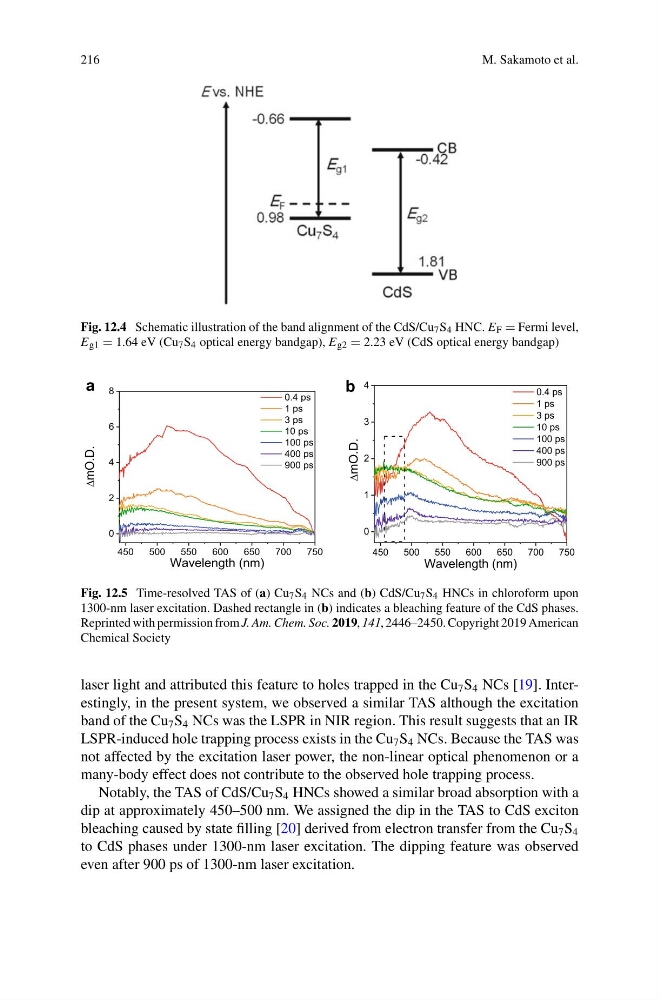
Fig. 12.4 Schematic illustration of the band alignment of the CdS/Cu 7 S 4 HNC. E F = Fermi level,
E g1 = 1.64 eV (Cu 7 S 4 optical energy bandgap), E g2 = 2.23 eV (CdS optical energy bandgap)
Fig. 12.5 Time-resolved TAS of (a) Cu 7 S 4 NCs and (b) CdS/Cu 7 S 4 HNCs in chloroform upon
1300-nm laser excitation. Dashed rectangle in (b) indicates a bleaching feature of the CdS phases.
Reprinted with permission from J. Am. Chem. Soc. 2019, 141, 2446–2450. Copyright 2019 American
Chemical Society
laser light and attributed this feature to holes trapped in the Cu 7 S 4 NCs [19]. Interestingly, in the present system, we observed a similar TAS although the excitation
band of the Cu 7 S 4 NCs was the LSPR in NIR region. This result suggests that an IR
LSPR-induced hole trapping process exists in the Cu 7 S 4 NCs. Because the TAS was
not affected by the excitation laser power, the non-linear optical phenomenon or a
many-body effect does not contribute to the observed hole trapping process.
Notably, the TAS of CdS/Cu 7 S 4 HNCs showed a similar broad absorption with a
dip at approximately 450–500 nm. We assigned the dip in the TAS to CdS exciton
bleaching caused by state filling [20] derived from electron transfer from the Cu 7 S 4
to CdS phases under 1300-nm laser excitation. The dipping feature was observed
even after 900 ps of 1300-nm laser excitation.
M. Sakamoto et al.
Fig. 12.4 Schematic illustration of the band alignment of the CdS/Cu 7 S 4 HNC. E F = Fermi level,
E g1 = 1.64 eV (Cu 7 S 4 optical energy bandgap), E g2 = 2.23 eV (CdS optical energy bandgap)
Fig. 12.5 Time-resolved TAS of (a) Cu 7 S 4 NCs and (b) CdS/Cu 7 S 4 HNCs in chloroform upon
1300-nm laser excitation. Dashed rectangle in (b) indicates a bleaching feature of the CdS phases.
Reprinted with permission from J. Am. Chem. Soc. 2019, 141, 2446–2450. Copyright 2019 American
Chemical Society
laser light and attributed this feature to holes trapped in the Cu 7 S 4 NCs [19]. Interestingly, in the present system, we observed a similar TAS although the excitation
band of the Cu 7 S 4 NCs was the LSPR in NIR region. This result suggests that an IR
LSPR-induced hole trapping process exists in the Cu 7 S 4 NCs. Because the TAS was
not affected by the excitation laser power, the non-linear optical phenomenon or a
many-body effect does not contribute to the observed hole trapping process.
Notably, the TAS of CdS/Cu 7 S 4 HNCs showed a similar broad absorption with a
dip at approximately 450–500 nm. We assigned the dip in the TAS to CdS exciton
bleaching caused by state filling [20] derived from electron transfer from the Cu 7 S 4
to CdS phases under 1300-nm laser excitation. The dipping feature was observed
even after 900 ps of 1300-nm laser excitation.