

12 Plasmon-Induced Carrier Transfer for Infrared Light Energy …
215
Fig. 12.3 Diffuse
reflectance spectra of Cu 7 S 4
NCs and CdS/Cu 7 S 4 HNCs
and AM1.5 solar spectrum.
Reprinted with permission
from J. Am. Chem. Soc.
2019, 141, 2446–2450.
Copyright 2019 American
Chemical Society
400
800
1200
1600
2000
2400
Kubelka-Munk (a.u.)
Wavelength (nm)
Cu 7 S 4 NCs
CdS/Cu 7 S 4 HNCs
1115 nm
1585 nm
0.0
0.4
0.8
1.2
1.6
Spectral irradiance (W m
-2
nm
-1
)
0.21 nm (in Fig. 12.2e), are assigned to r-Cu 7 S 4 (0160) and w-CdS (110), respectively, which agrees with the results of the fast Fourier transform (FFT) patterns
(Fig. 12.2f, g).
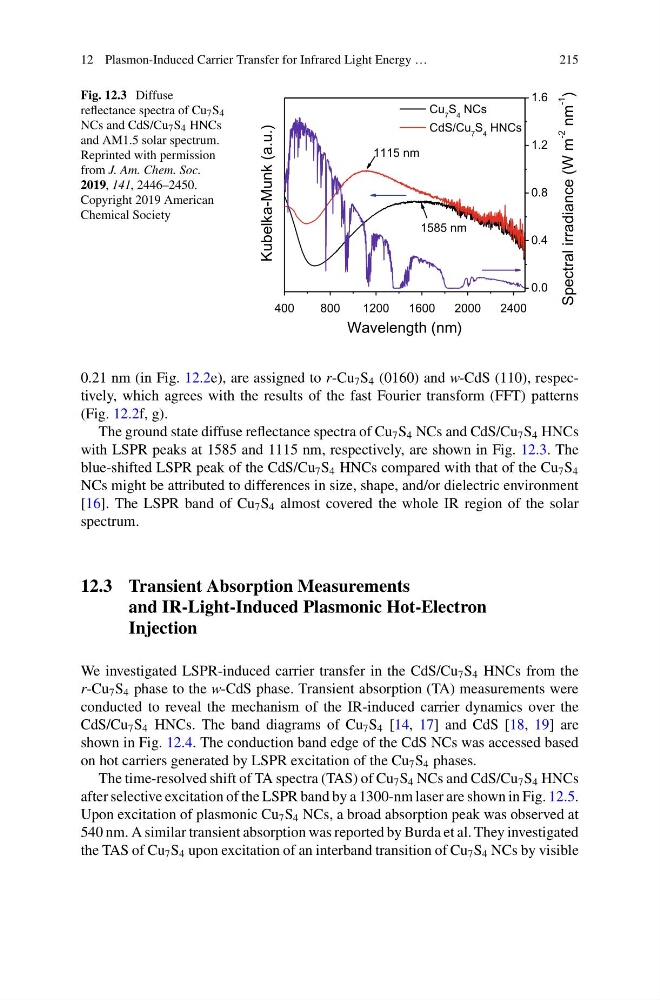
The ground state diffuse reflectance spectra of Cu 7 S 4 NCs and CdS/Cu 7 S 4 HNCs
with LSPR peaks at 1585 and 1115 nm, respectively, are shown in Fig. 12.3. The
blue-shifted LSPR peak of the CdS/Cu 7 S 4 HNCs compared with that of the Cu 7 S 4
NCs might be attributed to differences in size, shape, and/or dielectric environment
[16]. The LSPR band of Cu 7 S 4 almost covered the whole IR region of the solar
spectrum.
12.3 Transient Absorption Measurements
and IR-Light-Induced Plasmonic Hot-Electron
Injection
We investigated LSPR-induced carrier transfer in the CdS/Cu 7 S 4 HNCs from the
r-Cu 7 S 4 phase to the w-CdS phase. Transient absorption (TA) measurements were
conducted to reveal the mechanism of the IR-induced carrier dynamics over the
CdS/Cu 7 S 4 HNCs. The band diagrams of Cu 7 S 4 [14, 17] and CdS [18, 19] are
shown in Fig. 12.4. The conduction band edge of the CdS NCs was accessed based
on hot carriers generated by LSPR excitation of the Cu 7 S 4 phases.
The time-resolved shift of TA spectra (TAS) of Cu 7 S 4 NCs and CdS/Cu 7 S 4 HNCs
after selective excitation of the LSPR band by a 1300-nm laser are shown in Fig. 12.5.
Upon excitation of plasmonic Cu 7 S 4 NCs, a broad absorption peak was observed at
540 nm. A similar transient absorption was reported by Burda et al. They investigated
the TAS of Cu 7 S 4 upon excitation of an interband transition of Cu 7 S 4 NCs by visible
215
Fig. 12.3 Diffuse
reflectance spectra of Cu 7 S 4
NCs and CdS/Cu 7 S 4 HNCs
and AM1.5 solar spectrum.
Reprinted with permission
from J. Am. Chem. Soc.
2019, 141, 2446–2450.
Copyright 2019 American
Chemical Society
400
800
1200
1600
2000
2400
Kubelka-Munk (a.u.)
Wavelength (nm)
Cu 7 S 4 NCs
CdS/Cu 7 S 4 HNCs
1115 nm
1585 nm
0.0
0.4
0.8
1.2
1.6
Spectral irradiance (W m
-2
nm
-1
)
0.21 nm (in Fig. 12.2e), are assigned to r-Cu 7 S 4 (0160) and w-CdS (110), respectively, which agrees with the results of the fast Fourier transform (FFT) patterns
(Fig. 12.2f, g).
The ground state diffuse reflectance spectra of Cu 7 S 4 NCs and CdS/Cu 7 S 4 HNCs
with LSPR peaks at 1585 and 1115 nm, respectively, are shown in Fig. 12.3. The
blue-shifted LSPR peak of the CdS/Cu 7 S 4 HNCs compared with that of the Cu 7 S 4
NCs might be attributed to differences in size, shape, and/or dielectric environment
[16]. The LSPR band of Cu 7 S 4 almost covered the whole IR region of the solar
spectrum.
12.3 Transient Absorption Measurements
and IR-Light-Induced Plasmonic Hot-Electron
Injection
We investigated LSPR-induced carrier transfer in the CdS/Cu 7 S 4 HNCs from the
r-Cu 7 S 4 phase to the w-CdS phase. Transient absorption (TA) measurements were
conducted to reveal the mechanism of the IR-induced carrier dynamics over the
CdS/Cu 7 S 4 HNCs. The band diagrams of Cu 7 S 4 [14, 17] and CdS [18, 19] are
shown in Fig. 12.4. The conduction band edge of the CdS NCs was accessed based
on hot carriers generated by LSPR excitation of the Cu 7 S 4 phases.
The time-resolved shift of TA spectra (TAS) of Cu 7 S 4 NCs and CdS/Cu 7 S 4 HNCs
after selective excitation of the LSPR band by a 1300-nm laser are shown in Fig. 12.5.
Upon excitation of plasmonic Cu 7 S 4 NCs, a broad absorption peak was observed at
540 nm. A similar transient absorption was reported by Burda et al. They investigated
the TAS of Cu 7 S 4 upon excitation of an interband transition of Cu 7 S 4 NCs by visible