

11 The Confinement and Migration of Charge-Carriers in Lead …
205
1
2
3
4
5
10 0
10 -1
10 -2
10 -3
Photocounts
Time (µs)
b
1.0
0.8
0.6
0.4
0.2
0.0
Average PL Lifetime (µs)
Integrated Photocounts ◊ 10 -7
10 -2 10 -1 10 0
10 1
10 2
Power Density (MWcm -2 )
c
8
6
4
2
0
a
Time (µs)
500
550
600
g
1
2
3
4
1
2
3
4
500
550
600
Wavelength (nm)
d
500
550
600
f
1
2
3
4
e
500
550
600
1
2
3
4
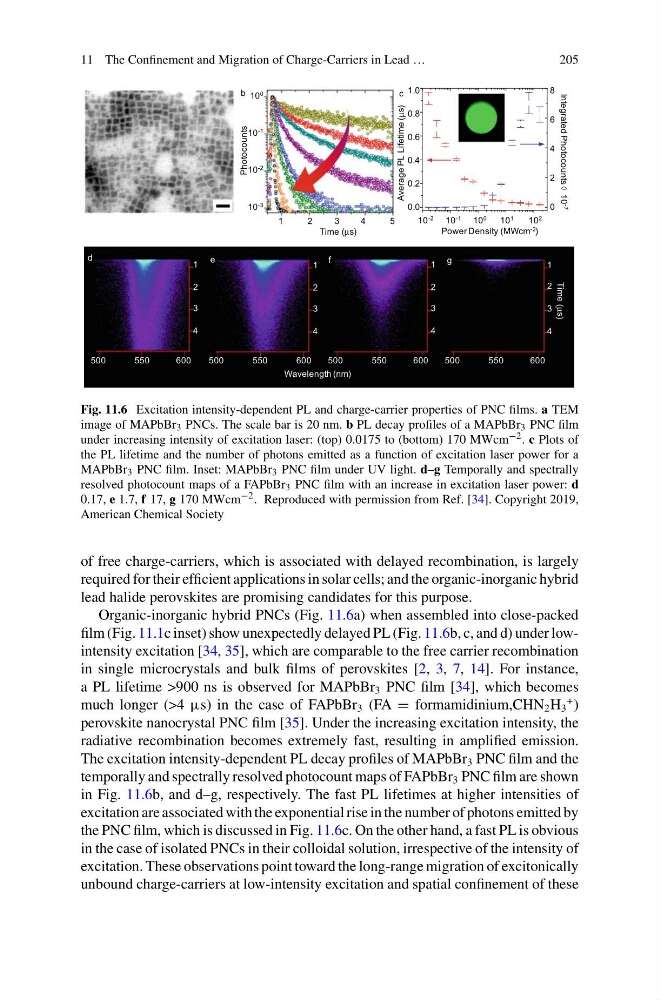
Fig. 11.6 Excitation intensity-dependent PL and charge-carrier properties of PNC films. a TEM
image of MAPbBr 3 PNCs. The scale bar is 20 nm. b PL decay profiles of a MAPbBr 3 PNC film
under increasing intensity of excitation laser: (top) 0.0175 to (bottom) 170 MWcm −2 . c Plots of
the PL lifetime and the number of photons emitted as a function of excitation laser power for a
MAPbBr 3 PNC film. Inset: MAPbBr 3 PNC film under UV light. d–g Temporally and spectrally
resolved photocount maps of a FAPbBr 3 PNC film with an increase in excitation laser power: d
0.17, e 1.7, f 17, g 170 MWcm −2 . Reproduced with permission from Ref. [34]. Copyright 2019,
American Chemical Society
of free charge-carriers, which is associated with delayed recombination, is largely
required for their efficient applications in solar cells; and the organic-inorganic hybrid
lead halide perovskites are promising candidates for this purpose.
Organic-inorganic hybrid PNCs (Fig. 11.6a) when assembled into close-packed
film (Fig. 11.1c inset) show unexpectedly delayed PL (Fig. 11.6b, c, and d) under lowintensity excitation [34, 35], which are comparable to the free carrier recombination
in single microcrystals and bulk films of perovskites [2, 3, 7, 14]. For instance,
a PL lifetime >900 ns is observed for MAPbBr 3 PNC film [34], which becomes
much longer (>4 µs) in the case of FAPbBr 3 (FA = formamidinium,CHN 2 H 3
+ )
perovskite nanocrystal PNC film [35]. Under the increasing excitation intensity, the
radiative recombination becomes extremely fast, resulting in amplified emission.
The excitation intensity-dependent PL decay profiles of MAPbBr 3 PNC film and the
temporally and spectrally resolved photocount maps of FAPbBr 3 PNC film are shown
in Fig. 11.6b, and d–g, respectively. The fast PL lifetimes at higher intensities of
excitation are associated with the exponential rise in the number of photons emitted by
the PNC film, which is discussed in Fig. 11.6c. On the other hand, a fast PL is obvious
in the case of isolated PNCs in their colloidal solution, irrespective of the intensity of
excitation. These observations point toward the long-range migration of excitonically
unbound charge-carriers at low-intensity excitation and spatial confinement of these
205
1
2
3
4
5
10 0
10 -1
10 -2
10 -3
Photocounts
Time (µs)
b
1.0
0.8
0.6
0.4
0.2
0.0
Average PL Lifetime (µs)
Integrated Photocounts ◊ 10 -7
10 -2 10 -1 10 0
10 1
10 2
Power Density (MWcm -2 )
c
8
6
4
2
0
a
Time (µs)
500
550
600
g
1
2
3
4
1
2
3
4
500
550
600
Wavelength (nm)
d
500
550
600
f
1
2
3
4
e
500
550
600
1
2
3
4
Fig. 11.6 Excitation intensity-dependent PL and charge-carrier properties of PNC films. a TEM
image of MAPbBr 3 PNCs. The scale bar is 20 nm. b PL decay profiles of a MAPbBr 3 PNC film
under increasing intensity of excitation laser: (top) 0.0175 to (bottom) 170 MWcm −2 . c Plots of
the PL lifetime and the number of photons emitted as a function of excitation laser power for a
MAPbBr 3 PNC film. Inset: MAPbBr 3 PNC film under UV light. d–g Temporally and spectrally
resolved photocount maps of a FAPbBr 3 PNC film with an increase in excitation laser power: d
0.17, e 1.7, f 17, g 170 MWcm −2 . Reproduced with permission from Ref. [34]. Copyright 2019,
American Chemical Society
of free charge-carriers, which is associated with delayed recombination, is largely
required for their efficient applications in solar cells; and the organic-inorganic hybrid
lead halide perovskites are promising candidates for this purpose.
Organic-inorganic hybrid PNCs (Fig. 11.6a) when assembled into close-packed
film (Fig. 11.1c inset) show unexpectedly delayed PL (Fig. 11.6b, c, and d) under lowintensity excitation [34, 35], which are comparable to the free carrier recombination
in single microcrystals and bulk films of perovskites [2, 3, 7, 14]. For instance,
a PL lifetime >900 ns is observed for MAPbBr 3 PNC film [34], which becomes
much longer (>4 µs) in the case of FAPbBr 3 (FA = formamidinium,CHN 2 H 3
+ )
perovskite nanocrystal PNC film [35]. Under the increasing excitation intensity, the
radiative recombination becomes extremely fast, resulting in amplified emission.
The excitation intensity-dependent PL decay profiles of MAPbBr 3 PNC film and the
temporally and spectrally resolved photocount maps of FAPbBr 3 PNC film are shown
in Fig. 11.6b, and d–g, respectively. The fast PL lifetimes at higher intensities of
excitation are associated with the exponential rise in the number of photons emitted by
the PNC film, which is discussed in Fig. 11.6c. On the other hand, a fast PL is obvious
in the case of isolated PNCs in their colloidal solution, irrespective of the intensity of
excitation. These observations point toward the long-range migration of excitonically
unbound charge-carriers at low-intensity excitation and spatial confinement of these