

206
S. Ghimire et al.
charge-carriers at higher intensities in PNC films. The amplified emission can be
assigned to the radiative recombination of high-density electrons and holes that are
generated and spatially confined among the close-packed PNCs in the film [34, 35].
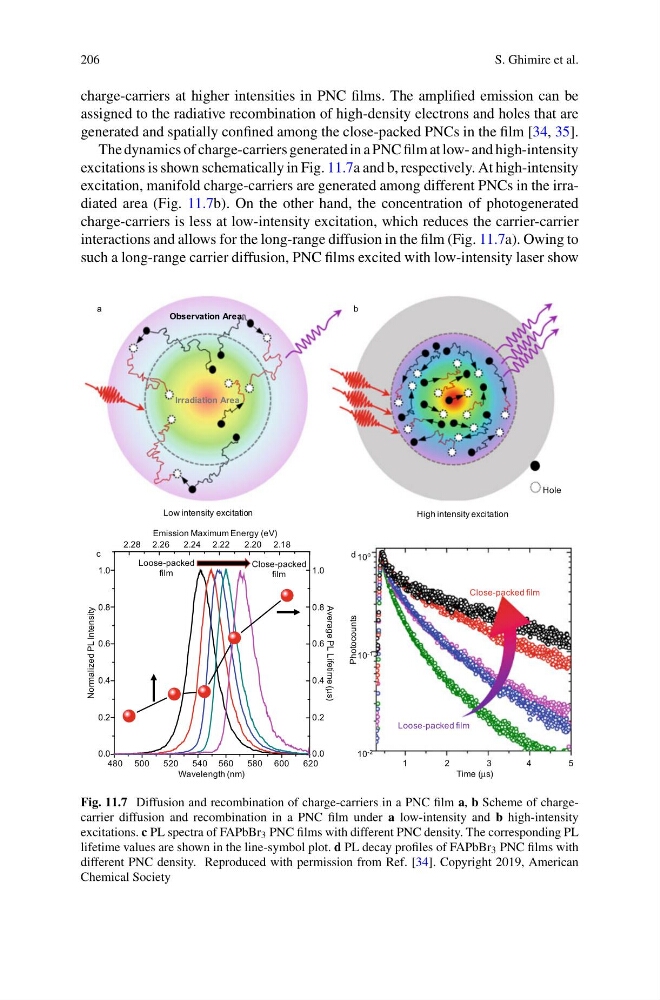
The dynamics of charge-carriers generated in a PNC film at low- and high-intensity
excitations is shown schematically in Fig. 11.7a and b, respectively. At high-intensity
excitation, manifold charge-carriers are generated among different PNCs in the irradiated area (Fig. 11.7b). On the other hand, the concentration of photogenerated
charge-carriers is less at low-intensity excitation, which reduces the carrier-carrier
interactions and allows for the long-range diffusion in the film (Fig. 11.7a). Owing to
such a long-range carrier diffusion, PNC films excited with low-intensity laser show
Low intensity excitation
Irradiation Area
Observation Area
a
b
High intensity excitation
Hole
Average PL Lifetime (µs)
Wavelength (nm)
480 500
520
540 560
580 600
620
2.28 2.26
2.24 2.22
2.20 2.18
Emission Maximum Energy (eV)
Close-packed
film
Normalized PL Intensity
c
1.0
0.8
0.6
0.4
0.2
0.0
Loose-packed
film
1.0
0.8
0.6
0.4
0.2
0.0
10 0
10 -1
10 -2
Photocounts
Time (µs)
1
2
3
4
5
d
Loose-packed film
Close-packed film
Fig. 11.7 Diffusion and recombination of charge-carriers in a PNC film a, b Scheme of chargecarrier diffusion and recombination in a PNC film under a low-intensity and b high-intensity
excitations. c PL spectra of FAPbBr 3 PNC films with different PNC density. The corresponding PL
lifetime values are shown in the line-symbol plot. d PL decay profiles of FAPbBr 3 PNC films with
different PNC density. Reproduced with permission from Ref. [34]. Copyright 2019, American
Chemical Society
S. Ghimire et al.
charge-carriers at higher intensities in PNC films. The amplified emission can be
assigned to the radiative recombination of high-density electrons and holes that are
generated and spatially confined among the close-packed PNCs in the film [34, 35].
The dynamics of charge-carriers generated in a PNC film at low- and high-intensity
excitations is shown schematically in Fig. 11.7a and b, respectively. At high-intensity
excitation, manifold charge-carriers are generated among different PNCs in the irradiated area (Fig. 11.7b). On the other hand, the concentration of photogenerated
charge-carriers is less at low-intensity excitation, which reduces the carrier-carrier
interactions and allows for the long-range diffusion in the film (Fig. 11.7a). Owing to
such a long-range carrier diffusion, PNC films excited with low-intensity laser show
Low intensity excitation
Irradiation Area
Observation Area
a
b
High intensity excitation
Hole
Average PL Lifetime (µs)
Wavelength (nm)
480 500
520
540 560
580 600
620
2.28 2.26
2.24 2.22
2.20 2.18
Emission Maximum Energy (eV)
Close-packed
film
Normalized PL Intensity
c
1.0
0.8
0.6
0.4
0.2
0.0
Loose-packed
film
1.0
0.8
0.6
0.4
0.2
0.0
10 0
10 -1
10 -2
Photocounts
Time (µs)
1
2
3
4
5
d
Loose-packed film
Close-packed film
Fig. 11.7 Diffusion and recombination of charge-carriers in a PNC film a, b Scheme of chargecarrier diffusion and recombination in a PNC film under a low-intensity and b high-intensity
excitations. c PL spectra of FAPbBr 3 PNC films with different PNC density. The corresponding PL
lifetime values are shown in the line-symbol plot. d PL decay profiles of FAPbBr 3 PNC films with
different PNC density. Reproduced with permission from Ref. [34]. Copyright 2019, American
Chemical Society