

204
S. Ghimire et al.
Close-packed Superlattice
VB
CB
Discrete Energy States
Barrier
Weak Electronic Coupling
Strong Electronic Coupling
Narrowed Barrier
Mini-band formation
Decrease in inter-particle distance
Energy
Loose-packed Assembly
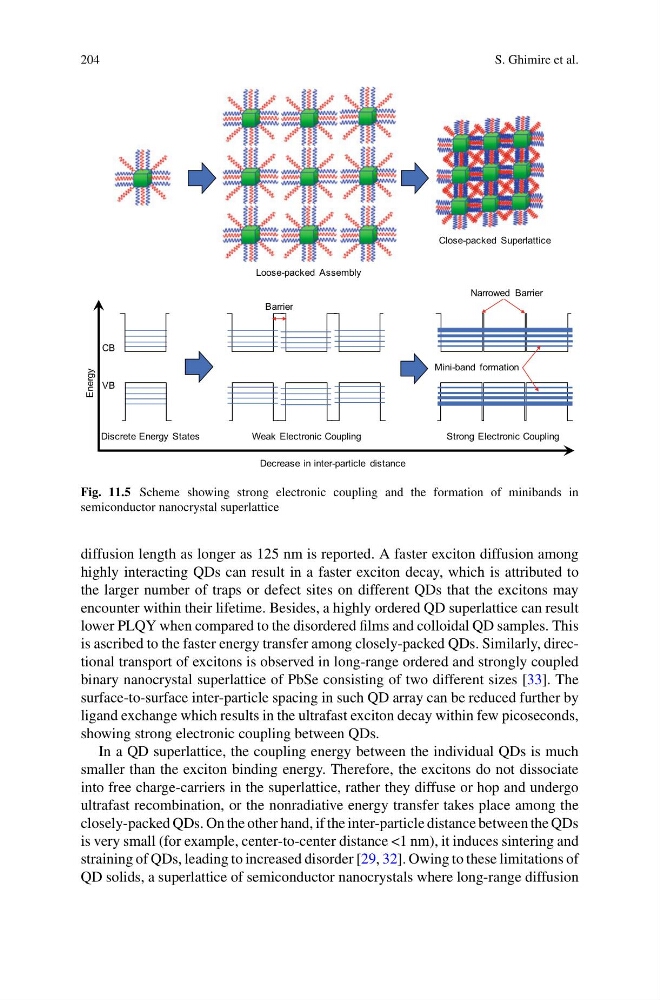
Fig. 11.5 Scheme showing strong electronic coupling and the formation of minibands in
semiconductor nanocrystal superlattice
diffusion length as longer as 125 nm is reported. A faster exciton diffusion among
highly interacting QDs can result in a faster exciton decay, which is attributed to
the larger number of traps or defect sites on different QDs that the excitons may
encounter within their lifetime. Besides, a highly ordered QD superlattice can result
lower PLQY when compared to the disordered films and colloidal QD samples. This
is ascribed to the faster energy transfer among closely-packed QDs. Similarly, directional transport of excitons is observed in long-range ordered and strongly coupled
binary nanocrystal superlattice of PbSe consisting of two different sizes [33]. The
surface-to-surface inter-particle spacing in such QD array can be reduced further by
ligand exchange which results in the ultrafast exciton decay within few picoseconds,
showing strong electronic coupling between QDs.
In a QD superlattice, the coupling energy between the individual QDs is much
smaller than the exciton binding energy. Therefore, the excitons do not dissociate
into free charge-carriers in the superlattice, rather they diffuse or hop and undergo
ultrafast recombination, or the nonradiative energy transfer takes place among the
closely-packed QDs. On the other hand, if the inter-particle distance between the QDs
is very small (for example, center-to-center distance <1 nm), it induces sintering and
straining of QDs, leading to increased disorder [29, 32]. Owing to these limitations of
QD solids, a superlattice of semiconductor nanocrystals where long-range diffusion
S. Ghimire et al.
Close-packed Superlattice
VB
CB
Discrete Energy States
Barrier
Weak Electronic Coupling
Strong Electronic Coupling
Narrowed Barrier
Mini-band formation
Decrease in inter-particle distance
Energy
Loose-packed Assembly
Fig. 11.5 Scheme showing strong electronic coupling and the formation of minibands in
semiconductor nanocrystal superlattice
diffusion length as longer as 125 nm is reported. A faster exciton diffusion among
highly interacting QDs can result in a faster exciton decay, which is attributed to
the larger number of traps or defect sites on different QDs that the excitons may
encounter within their lifetime. Besides, a highly ordered QD superlattice can result
lower PLQY when compared to the disordered films and colloidal QD samples. This
is ascribed to the faster energy transfer among closely-packed QDs. Similarly, directional transport of excitons is observed in long-range ordered and strongly coupled
binary nanocrystal superlattice of PbSe consisting of two different sizes [33]. The
surface-to-surface inter-particle spacing in such QD array can be reduced further by
ligand exchange which results in the ultrafast exciton decay within few picoseconds,
showing strong electronic coupling between QDs.
In a QD superlattice, the coupling energy between the individual QDs is much
smaller than the exciton binding energy. Therefore, the excitons do not dissociate
into free charge-carriers in the superlattice, rather they diffuse or hop and undergo
ultrafast recombination, or the nonradiative energy transfer takes place among the
closely-packed QDs. On the other hand, if the inter-particle distance between the QDs
is very small (for example, center-to-center distance <1 nm), it induces sintering and
straining of QDs, leading to increased disorder [29, 32]. Owing to these limitations of
QD solids, a superlattice of semiconductor nanocrystals where long-range diffusion